Open-Source OMS: Why Open Source Is the Best Foundation for ERP-Driven Order Management
Introduction: The System That Changes Every Month
Every ERP function changes at its own pace. Finance restructures its chart of accounts once a decade. Manufacturing adjusts routings a few times a year. Order management changes something material almost every month.
New marketplaces. New carriers. New delivery promises. New returns policies. New fulfillment nodes. New channel-specific allocation rules.
That change velocity is why Order Management Systems (OMS) are the strongest case for open source anywhere in the enterprise stack. Proprietary OMS platforms price and gate exactly the thing your business needs to do constantly, which turns your channel strategy into a vendor negotiation.
In a Next-Gen ERP architecture, the OMS is not a licensed black box. It is a set of business rules you own, running on a mature commerce data model you did not have to build.
What Is an Open-Source OMS?
An open-source OMS is an order management platform where the source code, data schema, and business logic are licensed openly and deployed under your control.
That means you can:
- Read and modify the order sourcing logic
- Build unlimited channel and carrier integrations
- Query and export order data directly from your own database
- Host anywhere, scale independently of licensing
- Change implementation partners without changing platforms
Simple Definition
An open-source OMS is an order management system built on openly licensed ERP frameworks such as Apache OFBiz or Moqui, where order logic, integrations, and data remain fully owned and modifiable by the business.
What a Real OMS Actually Has to Do
Before the licensing argument, the scope needs to be clear. A system that records orders and passes them to a warehouse is an order entry screen, not an OMS.
Core Functional Surface
- Multi-channel capture across web, mobile, marketplace, POS, EDI, and B2B portals
- Distributed order management with a single available-to-promise view across warehouses, stores, 3PLs, and dropship vendors
- Intelligent sourcing and splitting that weighs cost, distance, node capacity, and promise date
- Backorder and allocation policy governing who gets scarce inventory
- Carrier execution including rate shopping, label generation, and service-level rules
- Returns and reverse logistics from customer initiation through disposition and refund
- Customer communication at every fulfillment milestone
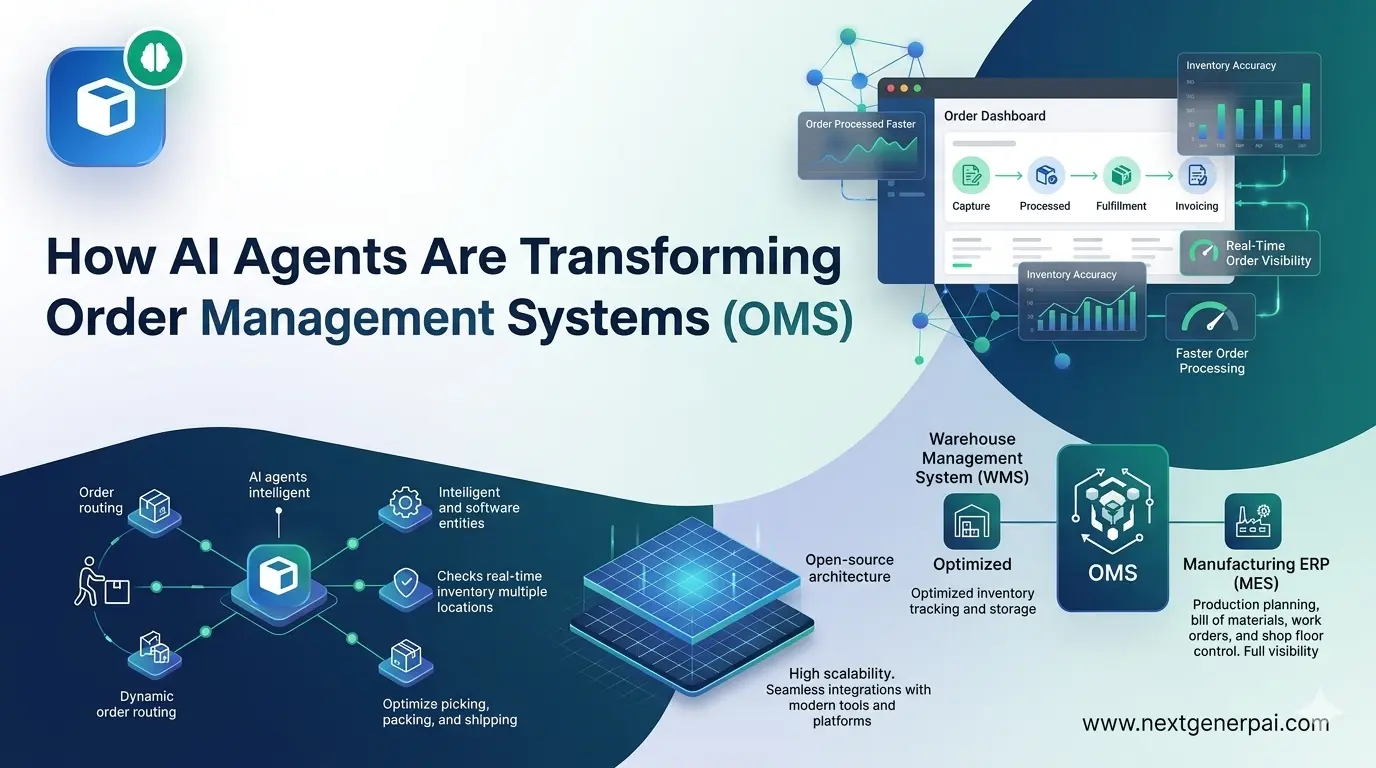
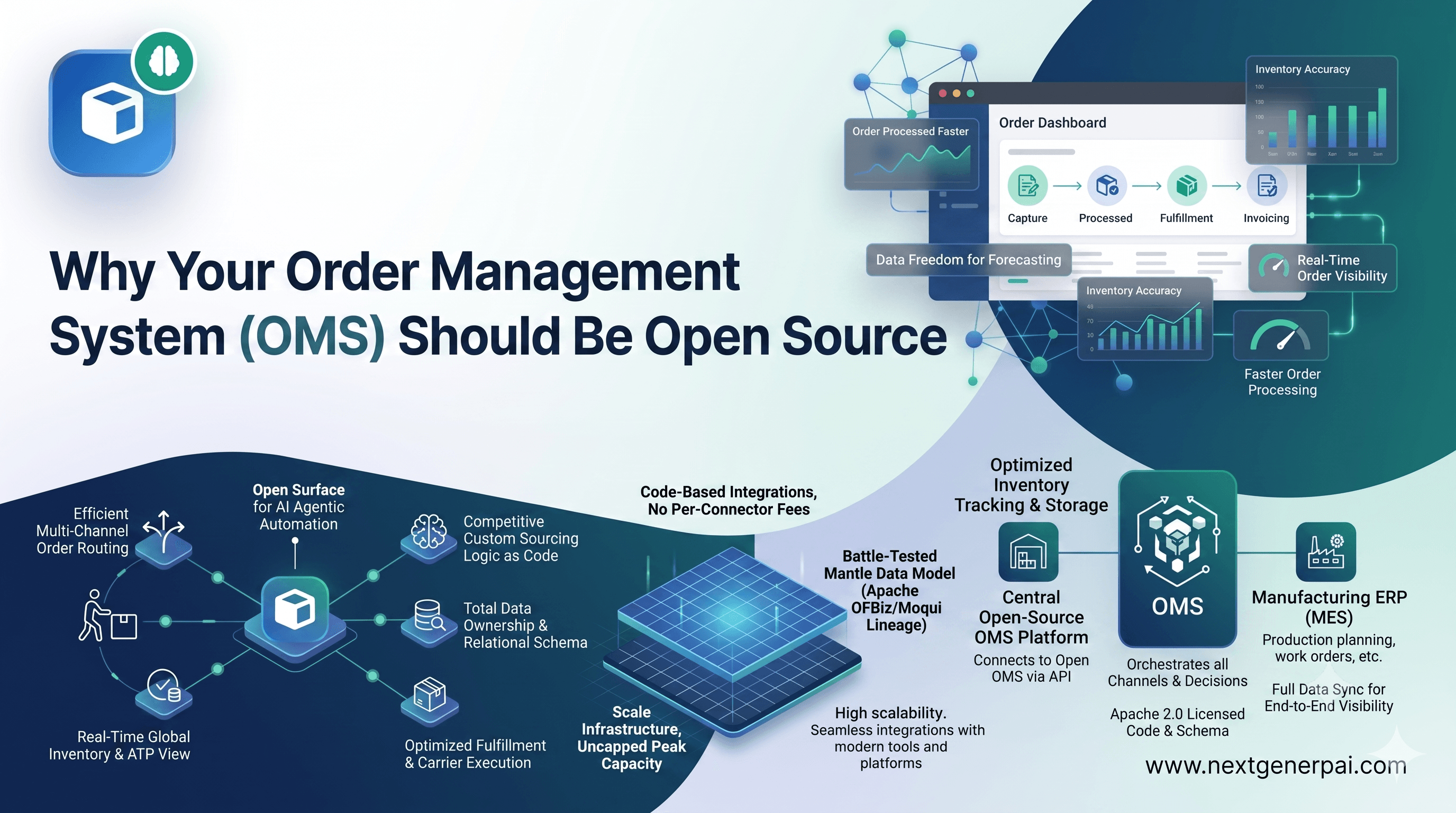
- Operational analytics covering cycle time, perfect order rate, split rate, and node performance Our Order Management System covers this surface on open-source infrastructure and integrates directly with the Warehouse Management System rather than duplicating it.
Now hold that list up against a per-connector licensing model.
Why Open Source Wins Specifically for Order Management
1. Your Sourcing Logic Is a Competitive Asset
Every OMS vendor ships a sourcing engine. It will rank nodes by distance, cost, or priority.
What it will not do is encode the rule that actually differentiates you:
- Splitting fragile SKUs away from a third-party node
- Holding allocation for a subscription cohort
- Regional exceptions your operations lead worked out over three peak seasons In a closed system, each of these becomes a change request and a line item. In an open-source OMS, it becomes a service you author against a documented data model, versioned in your own repository.
Both Apache OFBiz and Moqui Framework exist precisely so business logic is an artifact you write, not a checkbox you hope exists.
2. Integration Cost Is the Real OMS Cost
OMS budgets rarely go to the core. They go to the edges:
- Marketplace connectors
- Carrier APIs
- 3PL and vendor feeds
- Tax engines and payment gateways
- PIM and accounting sync Proprietary vendors know this, which is why connectors are metered separately, tiered, or simply unavailable for the regional marketplace you need. Your channel roadmap ends up shaped by their product roadmap.
With open source, an integration is code against an API. When a business needs Noon, Meesho, or a regional 3PL no global vendor has prioritized, the question is engineering effort rather than vendor willingness.
The practical mechanics are covered in connecting Shopify, Magento, and WooCommerce to an open-source ERP.
3. Order Data Is the Data You Least Want Held Hostage
Order history is your customer relationship, your demand forecast, your returns model, and increasingly your AI training substrate.
Open-source platforms store orders in a documented relational schema in a database you administer. You can query it, replicate it, or migrate it without an export negotiation.
Vendor lock-in in ERP is rarely about license fees. It is about extraction cost, examined in detail in Open-Source ERP Migration in 2026.
4. Peak Scaling Should Not Be a Pricing Event
Order volume is spiky by nature. Festive season, flash sales, marketplace campaigns.
Many commercial OMS platforms price on order or transaction volume, which means your best sales day is also your largest unplanned invoice. Self-hosted open source decouples the two. You scale infrastructure, which is a known and controllable cost.
The five-year picture is broken down in Apache OFBiz implementation cost in 2026.
5. Agentic Automation Needs an Open Surface
Putting AI agents to work on order operations means letting them do real things:
- Investigate a stuck order
- Re-source a line to another node
- Initiate a return
- Escalate a carrier exception That requires authenticated, granular access to order services, plus an audit trail and permission model to keep it safe. Open-source platforms let you expose exactly the services you choose with your own guardrails. Closed platforms expose whatever their API roadmap decided this quarter.
See MCP for ERP: how AI agents securely connect with Moqui, Apache OFBiz, OMS, and WMS and the Agentic ERP Readiness Checklist.
6. The Hardest Part Is Already Solved
Nobody should be modelling an order schema from scratch in 2026.
The genuinely difficult work — order items, ship groups, order adjustments, promise dates, status histories, party roles, allocation plans — has been refined in Apache OFBiz over two decades and carried forward into Moqui's Mantle data model.
Open source here does not mean starting from zero. It means starting from a mature commerce data model under the Apache 2.0 license and adding only what is specific to you. That is why we build on Apache OFBiz development and Moqui ERP development rather than either extreme.
Open-Source OMS vs Proprietary SaaS OMS
| Dimension | Proprietary SaaS OMS | Open-Source OMS |
|---|---|---|
| Licensing model | Per user, order, or transaction | No license fee |
| Peak volume cost | Scales with your revenue | Scales with infrastructure |
| Custom sourcing logic | Configuration limits only | Fully authorable |
| New channel connector | Vendor roadmap or paid add-on | Engineering effort |
| Order data access | Via vendor API and export terms | Direct database access |
| AI agent integration | Whatever the API exposes | Services you choose to expose |
| Exit cost | High, migration-gated | Low, data and code are yours |
| Time to first go-live | Faster for standard flows | Longer, pays back on specifics |
| Requires engineering capacity | Minimal | Yes, in-house or via partner |
Real-World Use Cases
E-commerce: Multi-Marketplace Expansion
A D2C brand adding marketplaces every quarter uses an open-source OMS to:
- Build connectors on its own timeline
- Apply channel-specific allocation and pricing rules
- Prevent overselling across a shared inventory pool
Retail: Omnichannel Orchestration
Store networks use an open-source OMS to enable:
- Buy Online, Pick Up In Store (BOPIS)
- Ship-from-store routing based on live store stock
- Unified returns across online and physical channels
Distribution: Dropship and Vendor Fulfillment
Distributors automate:
- Vendor order transmission and acknowledgement
- Split shipments across warehouse and vendor nodes
- Consolidated tracking back to a single customer order
Manufacturing: Realistic Order Promising
Manufacturers connect OMS to production scheduling to:
- Check real capacity before committing a date
- Avoid over-promising on made-to-order lines
- Sequence orders against material availability These integrations are typically designed through custom ERP development around each organization's actual fulfillment network.
Business Benefits of an Open-Source OMS
1. Integration Economics That Improve With Scale
The tenth connector costs a sprint, not a contract renegotiation.
2. Business Logic That Matches Your Operation
Sourcing, allocation, and exception rules encode how you actually run, not how a vendor assumed you do.
3. Full Ownership of Order Data
Direct query access for analytics, forecasting, and AI, with no export gate.
4. Predictable Cost Under Peak Load
Infrastructure scales; licensing does not follow your revenue curve.
5. Strategic Independence
Code, schema, and deployment are yours. A partner change is not a platform change.
Organizations moving off legacy platforms can unlock these through ERP migration to open source.
Where Open Source Is the Wrong Call
We would rather say this plainly than have you discover it in month four.
- No engineering capacity and no partner. Open source shifts cost from license to capability. Without either, a SaaS OMS is the honest recommendation.
- Three-week timeline with standard requirements. If your order flow is genuinely vanilla, a packaged product wins on time-to-value.
- Compliance regimes requiring a named liable vendor. Answerable with commercially supported open source, but it must be designed for rather than discovered.
- Treating "free" as the business case. It is not. The case is control, integration economics, and data ownership. Underfunded implementations fail regardless of licensing, a pattern documented in why ERP implementations fail.
A Phased Implementation Path
Phase 1: Capture and Visibility
Land every channel's orders in one normalized model with a single inventory view. Do not change fulfillment behaviour yet. Stop the overselling first.
Phase 2: Orchestration
Enable sourcing rules, order splitting, and backorder policy. This is where operational gains appear and where your specific logic starts earning its keep.
Phase 3: Execution
Carrier rate shopping, label automation, WMS integration, and the returns portal.
Phase 4: Intelligence
Exception detection, promise-date modelling, and agent-assisted operations on top of clean, complete order data.
Attempting all four simultaneously is the most common way these programs stall.
The Future of Open-Source Order Management
Emerging Direction
- Agent-assisted exception handling as a standard OMS capability
- Promise dates modelled from live network performance rather than static lead times
- Fulfillment networks that self-balance across nodes
- Order data feeding demand and returns prediction directly Each of these depends on open access to order services and order history. That dependency is why the licensing decision made today constrains the automation available in three years.
Frequently Asked Questions
Is an open-source OMS production-grade at high volume? Yes, given proper architecture. Scaling constraints are the ordinary ones: database tuning, connection pooling, queue design, and horizontal scaling. The implementation limits throughput more often than the platform does.
Do I still need an ERP if I have an OMS? Almost always. They answer different questions. See OMS vs ERP: why modern enterprises need both.
Should I choose OFBiz or Moqui? OFBiz offers more out-of-the-box applications. Moqui offers a leaner modern framework with the same data-model lineage. The right answer depends on how much surrounding ERP you need. Our framework for choosing an open-source ERP walks through it.
What if my implementation partner disappears? The code, schema, and deployment are yours, and any competent Java team can pick them up. With proprietary platforms, a vendor's end-of-life decision becomes your migration deadline.
Can I migrate without stopping operations? Yes, with a phased cutover: run parallel by channel, migrate open orders last, keep a rollback path per phase. The equivalent approach is documented in migrating from SAP Business One.
Conclusion: Own the System That Changes Most
Order management is the fastest-changing function in the enterprise stack and the one most specific to how each business competes. Those two facts point the same direction.
Open source does not make order management free. It makes it yours: the sourcing logic, the integrations, the data, and the automation surface that AI agents will need next.
If your order operations are growing faster than your current system's ability to absorb change, the constraint is architectural rather than effort.
Explore our Order Management System | Talk to our team | More on the Next-Gen ERP blog