OMS vs ERP: Why Modern Enterprises Need Both
Most enterprises hit the same wall at some point in their digital transformation journey. The ERP system that has been running finance, procurement, and core operations for years suddenly cannot keep up with the pace of modern commerce. Orders come in from marketplaces, mobile apps, direct-to-consumer channels, B2B portals, and physical stores, all at once, and the ERP starts to choke under the weight of real-time order processing it was never designed to handle. That is when the conversation around Order Management Systems begins. And almost immediately, leadership asks the same question: if we already have an ERP, why do we need an OMS? Is this not the same thing in different packaging? The short answer is no. The longer and more useful answer is that an OMS and an ERP solve very different problems, sit at different layers of the enterprise architecture, and when designed correctly, work together as a single intelligent backbone for modern commerce operations. This blog breaks down the difference, the overlap, and why forward-looking enterprises are no longer choosing between the two but architecting both into a unified system.
What Is an ERP
An ERP, or Enterprise Resource Planning system, is the system of record for the entire business. It is the central nervous system that holds the truth about your finances, inventory positions, vendor relationships, production schedules, purchase orders, general ledger entries, payroll, and compliance data. Traditional ERP platforms were built decades ago to manage the back office of large enterprises, with a strong emphasis on accounting accuracy, batch processing, and structured workflows. Even modern ERP platforms continue to carry that DNA. They are designed for transactional integrity, regulatory reporting, and cross-functional visibility across departments like finance, HR, manufacturing, and procurement. The ERP is where revenue is recognized, where inventory is valued, and where the books are closed. If you remove the ERP, you remove the financial truth of the organization.
What Is an OMS
An Order Management System sits much closer to the customer. Its job is to manage the entire lifecycle of a customer order across every channel the business sells through. That includes order capture from websites, marketplaces, mobile apps, retail stores, and B2B portals, then orchestration of fulfillment across warehouses, dark stores, drop-ship vendors, and third-party logistics partners. A modern OMS handles real-time inventory availability, sourcing logic, split shipments, partial fulfillment, returns, exchanges, customer notifications, and post-purchase service flows. Where an ERP thinks in terms of monthly cycles and accounting periods, an OMS thinks in seconds and minutes. It is built for high-velocity, customer-facing operations where latency directly affects revenue and customer experience. You can explore how this works in practice on our modern order management systems page.
The Core Difference at a Glance
The simplest way to understand the relationship is to look at what each system optimizes for. An ERP optimizes for accuracy, control, and financial truth. An OMS optimizes for speed, customer experience, and omnichannel orchestration. The table below maps the key distinctions side by side.
| Dimension | ERP | OMS |
|---|---|---|
| Primary role | System of record for the entire business | System of orchestration for customer orders |
| Core users | Finance, procurement, operations, HR | Commerce, customer service, fulfillment teams |
| Time horizon | Daily, weekly, monthly, quarterly cycles | Real-time and near real-time |
| Data focus | Financial truth, inventory valuation, compliance | Order state, fulfillment logic, customer promises |
| Processing style | Transactional, batch-oriented, structured | Event-driven, real-time, orchestration-heavy |
| Channels handled | Limited or single-channel | Native multi-channel and omnichannel |
| Inventory view | Accounting view of stock | Available-to-promise view of stock |
| Returns and exchanges | Recorded for accounting | Orchestrated as a customer experience |
| Customer interaction | Indirect through finance and operations | Direct through fulfillment and service |
Both systems touch orders. Both touch inventory. But they look at the same data through completely different lenses, which is exactly why one cannot replace the other.
Why the Confusion Exists
The confusion between OMS and ERP is not accidental. Legacy ERP vendors have long marketed order management modules as part of their core suite, and for businesses with low order volumes and a single sales channel, those modules were good enough. The problem starts when the business scales. The moment a company adds a second sales channel, a marketplace integration, a buy-online-pickup-in-store flow, a vendor drop-ship arrangement, or a returns experience that needs to feel seamless to the customer, the ERP order module begins to crack. It was never designed for the orchestration complexity of modern commerce. It was designed to record what happened, not to decide what should happen next in real time. This is where many enterprises start looking at standalone OMS platforms, and where the architecture conversation gets interesting.
The Architecture Question: Bolt-On OMS or ERP-Native OMS
There are two common ways enterprises bring OMS capabilities into their landscape, and the choice has long-term consequences. The first approach is the bolt-on OMS, where a standalone OMS platform is integrated with the existing ERP through APIs and middleware. This works, but it creates two systems of truth, two inventory views, and two places where business logic lives. Reconciliation becomes a daily exercise. The second approach is what we call an ERP-native OMS architecture, where the OMS is built on the same open-source foundation as the ERP, sharing the same data model, the same entity definitions, and the same business rules engine. There is no synchronization lag because there is nothing to synchronize. Inventory, customers, orders, and financial events all live in one coherent model, with the OMS layer optimized for real-time orchestration and the ERP layer optimized for record-keeping. This is the model we build on at Next-Gen ERP, and it is the reason platforms like Moqui and Apache OFBiz have become foundational for enterprises that want both speed and integrity in one stack.
How an ERP-Native OMS Actually Works
In an ERP-native OMS, an order placed on a website does not travel through a middleware tunnel to reach the ERP. It is captured directly into a shared data model where the OMS engine immediately runs sourcing logic, checks available-to-promise inventory across all fulfillment nodes, applies business rules for splits or holds, and pushes fulfillment instructions to the relevant warehouse or vendor. At the same time, the ERP layer sees the same order, recognizes the financial commitment, updates the customer ledger, and prepares the invoice flow. Returns flow back through the same shared model, automatically triggering reverse logistics in the OMS layer and credit notes in the ERP layer. There is no data drift, no reconciliation queue, and no integration debt. For deeper insight into how AI agents are reshaping this layer, our analysis on AI agents in ERP walks through real orchestration patterns.
Where the Warehouse Fits
OMS and ERP are not the only systems in the picture. The Warehouse Management System sits between them, handling the physical execution of fulfillment. The OMS decides where an order should be fulfilled from. The WMS executes the picking, packing, and shipping inside that warehouse. The ERP records the inventory movement and updates the financial books. When all three are designed on a shared foundation, the result is a continuous loop of decision, execution, and record-keeping with no broken handoffs. This is why our approach to AI-powered warehouse management systems is built into the same architectural layer as our OMS and ERP modules. The three are not stitched together. They are grown together.
Real-World Scenarios Where Both Are Needed
Consider a mid-sized retailer running fifty stores, a direct-to-consumer website, and three marketplace channels. Without an OMS, every channel ends up with its own inventory view, leading to overselling, cancellations, and customer complaints. The ERP records the damage but cannot prevent it. With an ERP-native OMS, the same retailer sees a single global inventory pool, intelligent sourcing across stores and warehouses, and a finance team that closes the books on time because the data is already consistent. Consider a manufacturer running both B2B and D2C operations. The ERP handles bill of materials, production planning, and vendor payments. The OMS handles dealer orders, distributor allocations, consumer orders, and after-sales service requests. Trying to run both flows through the ERP alone forces compromises in customer experience. Trying to run both through a standalone OMS forces compromises in financial control. Running both on a unified open-source foundation eliminates the trade-off entirely. Our work on custom ERP development solutions often starts exactly at this architectural decision point.
Business Benefits of Running Both as One System
The benefits of an ERP-native OMS approach show up across operations, finance, and customer experience. Order accuracy improves because inventory is always consistent. Fulfillment speed improves because sourcing decisions happen in real time. Reconciliation effort drops because there is one source of truth. Total cost of ownership falls because there are fewer integration points, fewer middleware licenses, and fewer reconciliation teams. Customer experience improves because returns, exchanges, and order status updates flow through a single coherent system. Most importantly, the business gains the ability to launch new channels, geographies, and fulfillment models without rebuilding the backend every time. For enterprises planning a move away from rigid legacy stacks, our Moqui ERP development and consultancy practice focuses on exactly this kind of unified architecture.
The Comparison That Matters: When You Need What
| Business Scenario | ERP Alone | OMS Alone | ERP + OMS Together |
|---|---|---|---|
| Single channel, low order volume | Sufficient | Overkill | Optional |
| Multi-channel commerce | Insufficient | Partial fit | Recommended |
| Omnichannel retail with BOPIS, ship-from-store | Insufficient | Partial fit | Essential |
| Manufacturing with B2B and D2C flows | Insufficient | Partial fit | Essential |
| High-volume marketplace operations | Insufficient | Strong fit | Essential |
| Strict financial compliance and reporting | Strong fit | Insufficient | Essential |
| Global operations with multi-warehouse sourcing | Insufficient | Partial fit | Essential |
The pattern is clear. Once a business crosses a basic threshold of channel complexity or geographic spread, the question is no longer ERP or OMS. It becomes how to design both into a single coherent architecture without paying the integration tax.
The Future Outlook
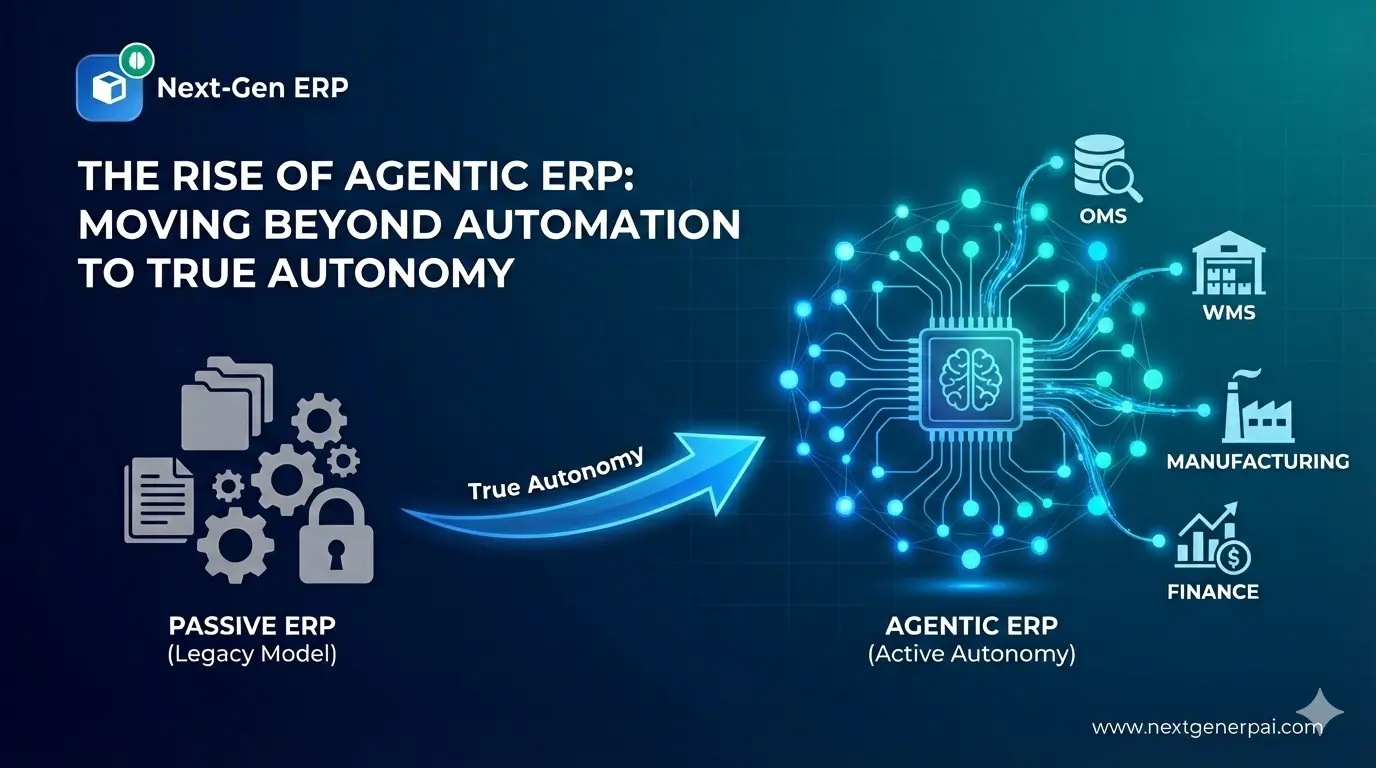
The next evolution of this conversation is already underway. AI agents are starting to operate across the OMS and ERP layers as a single intelligent fabric, making sourcing decisions, predicting demand, flagging anomalies in financial flows, and orchestrating exceptions without human intervention. Enterprises that have a unified data model across OMS, WMS, and ERP will be able to deploy these agents quickly because the data is already coherent. Enterprises stuck with bolt-on architectures will spend the next decade trying to clean up integration debt before they can even start. The winning architecture is one where the OMS, WMS, and ERP are not three products glued together but three views of the same business reality, each optimized for its own purpose and each contributing to a shared intelligence layer. That is the architecture modern enterprises should be building toward, and it is the foundation we help our clients design from day one.