Open-Source ERP Migration in 2026: How to Escape Vendor Lock-in Without Disrupting Operations
ERP vendor lock-in rarely feels urgent until the business needs to change. A new warehouse has to go live, a manufacturing workflow needs automation, a finance report takes too long, or a simple integration request turns into a long and expensive dependency on the existing ERP vendor. For many growing companies in India and global markets, this is exactly why open-source ERP migration is becoming a board-level discussion in 2026.
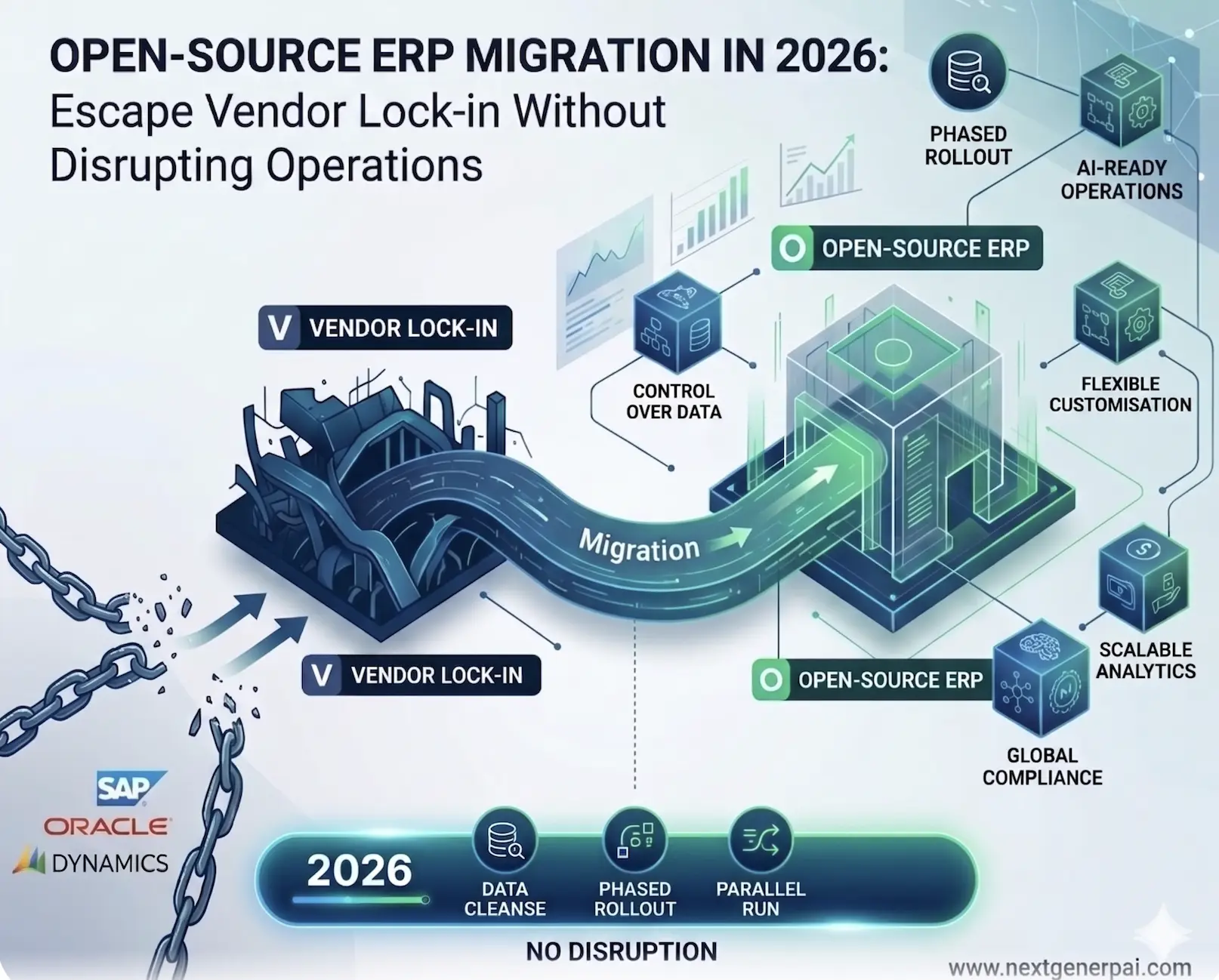
Open-source ERP migration means moving from a proprietary or legacy ERP such as SAP, Oracle, Microsoft Dynamics, Tally, or an in-house system to an open-source ERP foundation such as Moqui or Apache OFBiz. The goal is not just to replace software. The goal is to regain control over data, workflows, integrations, customization, deployment, and long-term ERP modernization.
A well-planned migration does not have to disrupt operations. With the right architecture, data migration controls, phased rollout, parallel run, and post-go-live support, businesses can move away from vendor lock-in while keeping order processing, inventory, warehouse operations, production, finance, and reporting stable.
Next-Gen ERP approaches ERP migration as a business transformation program, not a risky technical cutover. The focus is simple: move from rigid ERP systems to open-source platforms with data accuracy, operational continuity, cost control, and future-ready automation.
What Is ERP Vendor Lock-in?
ERP vendor lock-in happens when a business becomes dependent on a specific ERP vendor for licensing, customization, upgrades, integrations, reporting, hosting, support, and data access. The system may still work, but the organization loses flexibility because every meaningful change depends on the vendor’s pricing, roadmap, technical limitations, or partner ecosystem.
Vendor lock-in usually shows up in practical ways: high recurring license costs, expensive change requests, restricted access to source code, limited integration options, slow upgrades, dependency on niche consultants, and difficulty extracting clean historical data. For Indian businesses managing GST, e-invoicing, multi-location inventory, manufacturing compliance, customer data, and audit requirements, these limitations can directly affect growth and governance.
The real cost of ERP vendor lock-in is not only the invoice. It is the lost speed of decision-making, delayed process improvements, and inability to build AI-ready operations around your own data.
What Is Open-Source ERP Migration?
Open-source ERP migration is the structured movement of business processes, data, configurations, integrations, and users from a proprietary or legacy ERP to an open-source ERP platform. In a 2026 ERP modernization program, this usually includes master data cleansing, transaction migration, process redesign, integration rebuilding, user role mapping, reporting modernization, security controls, and phased go-live planning.
A strong open-source ERP migration strategy does not copy every old process into a new platform. It identifies what should be retained, redesigned, automated, integrated, or retired. This is especially important when moving from large proprietary systems where years of customization may have created hidden complexity.
For companies evaluating an open-source ERP migration strategy, the key question is not “Can we replace SAP or Oracle?” The better question is “Which processes should become simpler, more transparent, and easier to control after migration?”
Why Businesses Are Moving Away From Proprietary ERP in 2026
ERP modernization in 2026 is being shaped by four strong business pressures: cost control, data sovereignty, AI-readiness, and operational flexibility. Proprietary ERP systems often provide strong enterprise capabilities, but many companies are now questioning whether their ERP architecture gives them enough control for the next decade.
| Business pressure | What companies are experiencing | Why open-source ERP helps |
|---|---|---|
| Rising ERP costs | License renewals, user-based pricing, module fees, support costs, and expensive customizations | Open-source platforms reduce license dependency and shift investment toward implementation, support, and innovation |
| Data governance | Businesses need better control over customer, financial, operational, and compliance data | Open architecture improves visibility into data models, access controls, audit trails, and hosting choices |
| AI automation | ERP data is often trapped in rigid workflows or difficult-to-access databases | Open-source ERP makes it easier to build AI agents, workflow automation, analytics, and decision-support layers |
| Integration complexity | OMS, WMS, MES, e-commerce, logistics, payments, and finance tools need real-time connectivity | API-first and modular ERP architecture simplifies integration across business systems |
| Vendor dependency | Customization and upgrades depend heavily on vendor timelines and partner availability | Open-source ERP gives businesses more control over customization, roadmap, and technical ownership |
This is why businesses are not only looking for a SAP alternative or Oracle alternative. They are looking for an ERP foundation that gives them control without forcing them to compromise operational stability.
Moqui and OFBiz as Open-Source ERP Migration Targets
Moqui and Apache OFBiz are two strong open-source ERP foundations for businesses that want flexibility, source-level control, and scalable enterprise architecture.
Moqui Framework is often a good fit when the business needs a modern, flexible, service-oriented ERP foundation with custom workflows, complex integrations, and fast process adaptability. It works well for companies that want to build ERP around unique operations instead of forcing operations into a rigid software template. Next-Gen ERP supports this through Moqui ERP development and consultancy and related knowledge on the Moqui ERP foundation.
Apache OFBiz is a mature open-source business application suite with ERP, CRM, order management, inventory, warehousing, accounting, manufacturing, and e-commerce capabilities. It can be a strong fit for companies that want a broad ERP base with configurable modules and deep extensibility. Next-Gen ERP supports this through Apache OFBiz ERP development services and practical OFBiz implementation planning.
SAP Alternative, Oracle Alternative, or Legacy ERP Replacement: How to Choose the Right Migration Path
A good ERP migration decision starts with business fit. SAP and Oracle migrations are usually more complex because they often involve deep finance, procurement, production, supply chain, and reporting dependencies. Tally and legacy ERP migrations may look smaller, but they often contain data quality issues, manual workarounds, and undocumented business logic.
| Current ERP environment | Common lock-in pain | Migration priority | Best-fit open-source direction |
|---|---|---|---|
| SAP ECC or SAP Business One | High customization cost, complex upgrades, expensive partner dependency | Preserve core process controls while simplifying workflows and reports | OFBiz for broad enterprise modules, Moqui for custom process-heavy operations |
| Oracle EBS or Oracle-based ERP | License dependency, complex integrations, finance-heavy workflows | Rebuild finance, order, procurement, and supply chain flows with clean data governance | OFBiz for structured ERP suite needs, Moqui for flexible workflow modernization |
| Microsoft Dynamics | Upgrade pressure, customization limitations, integration complexity | Create API-first workflows and reduce dependency on closed customization layers | Moqui for agile architecture, OFBiz where standard ERP modules are required |
| Tally | Branch-wise silos, manual consolidation, limited operational depth | Centralize inventory, order, finance, reporting, and approvals | Moqui or OFBiz depending on process complexity |
| In-house legacy ERP | Old technology, weak documentation, fragile databases, limited reporting | Rebuild essential workflows, migrate clean data, retire obsolete logic | Moqui for modern custom ERP, OFBiz for reusable ERP module foundation |
| Spreadsheet-driven operations | Manual errors, no real-time visibility, weak audit control | Establish master data, workflows, roles, and integrated reporting | Moqui for custom workflows, OFBiz for standard ERP capabilities |
The right migration path is rarely a one-size-fits-all decision. Companies should use an open-source ERP evaluation framework that compares process fit, data complexity, integration needs, customization depth, compliance requirements, user adoption, and long-term support.
How to Escape Vendor Lock-in Without Operational Disruption
A stable ERP migration is not a “big bang” replacement. It is a controlled transition where business continuity is designed into every phase. The safest approach is to move in layers: data, integrations, workflows, users, reporting, and finally cutover.
| Migration phase | What happens | How disruption is reduced |
|---|---|---|
| Lock-in diagnostic | Identify license dependencies, customization bottlenecks, data ownership issues, and vendor-controlled processes | Creates a clear business case and avoids migrating unnecessary complexity |
| Process mapping | Map current workflows across orders, inventory, warehouse, manufacturing, procurement, finance, and reporting | Ensures the new ERP supports real operations, not assumptions |
| Data discovery | Profile master data, transaction history, open balances, inventory lots, customer records, supplier records, and audit trails | Prevents dirty data from damaging the new ERP |
| Target architecture design | Define Moqui or OFBiz modules, integrations, APIs, roles, reports, and deployment model | Reduces rework and keeps modernization aligned with business goals |
| Migration factory | Build repeatable extraction, transformation, validation, and loading routines | Improves data accuracy and makes test migrations measurable |
| Parallel run | Run old and new systems together for selected workflows, branches, or business units | Allows reconciliation before full go-live |
| Controlled cutover | Move users, transactions, and integrations in a planned sequence | Reduces downtime and provides rollback options |
| Hypercare | Monitor users, reports, data quality, and operational exceptions after go-live | Stabilizes adoption and protects business continuity |
This is the foundation of ERP migration to open-source platforms: minimize disruption by reducing uncertainty before the cutover.
Data Accuracy Is the Heart of ERP Migration
Most ERP migrations fail because of poor data discipline, not because of software. If customer masters, item masters, BOMs, ledgers, tax codes, inventory balances, warehouse locations, supplier records, and open transactions are not cleaned and reconciled, the new ERP will simply inherit old problems.
Data accuracy should be treated as a formal workstream with business ownership. IT teams can extract and transform data, but finance, operations, warehouse, manufacturing, and sales teams must validate whether the migrated data reflects business reality.
| Data area | Migration risk | Control method |
|---|---|---|
| Customer and supplier master | Duplicate records, missing GST or tax details, inactive accounts | Deduplication, validation rules, ownership mapping |
| Item master | Wrong units of measure, duplicate SKUs, missing categories | SKU normalization, UOM conversion, category mapping |
| Inventory | Incorrect stock, lot, serial, bin, or warehouse balances | Physical reconciliation, snapshot controls, variance reporting |
| Finance | Opening balances, ledger mapping, tax configuration errors | Trial balance reconciliation, account mapping, finance sign-off |
| Orders and invoices | Open order mismatch, invoice status errors, fulfillment gaps | Open document migration, order lifecycle checks |
| Manufacturing data | BOM errors, routing gaps, work order inconsistencies | BOM validation, production test runs, quality checks |
| Historical records | Incomplete audit trails or reporting gaps | Archive strategy, read-only legacy access, reporting warehouse |
A practical rule: do not migrate everything blindly. Migrate what the business needs for live operations, compliance, customer service, reporting, and auditability. Archive the rest in a controlled, searchable format.
Where OMS, WMS, Inventory, MES, and AI Fit Into ERP Modernization
Open-source ERP migration is not only a back-office finance project. For most businesses, the operational value comes from modernizing the systems that run daily work.
A modern order management system gives teams better visibility from order capture to fulfillment, invoicing, returns, and customer communication. This is critical when migrating from systems where order data is scattered across ERP screens, spreadsheets, e-commerce tools, and email approvals.
AI-powered warehouse management systems help businesses improve receiving, putaway, picking, packing, dispatch, and stock accuracy. During migration, WMS design should be aligned with item masters, warehouse hierarchy, bin structures, batch tracking, barcode flows, and dispatch processes.
Inventory management solutions are especially important for manufacturers, distributors, retailers, and e-commerce companies. Inventory is where ERP migration mistakes become visible immediately. That is why stock reconciliation, location mapping, lot tracking, reorder logic, and cycle-counting processes must be tested before go-live.
Manufacturing ERP and MES workflows need extra care because production planning, BOMs, work orders, shop floor activity, quality checks, and material consumption directly affect delivery commitments and cost accuracy. Migration teams should test real production scenarios, not only sample data.
The Role of AI in Open-Source ERP Migration
AI-driven ERP automation means using artificial intelligence to reduce manual work, improve decision-making, and automate repetitive business workflows. In migration projects, AI can support data profiling, anomaly detection, document processing, field mapping, duplicate identification, reconciliation alerts, and post-go-live exception monitoring.
The bigger opportunity comes after migration. Once the business moves to a more open ERP architecture, it becomes easier to build AI agents for order follow-ups, inventory alerts, procurement suggestions, production bottleneck detection, invoice validation, demand planning, and management reporting. That is why many companies connect open-source ERP modernization with AI ERP solutions.
A proprietary ERP can also use AI, but open-source ERP gives the business more freedom to decide where AI runs, which data it uses, how workflows are triggered, and how automation is governed.
Cost Considerations: License Savings Are Only One Part of the Business Case
Open-source ERP migration can reduce long-term licensing dependency, but the strongest business case is broader than license savings. Companies should evaluate total cost of ownership across software, hosting, implementation, integrations, support, customization, reporting, upgrades, and internal productivity.
| Cost category | Proprietary ERP pattern | Open-source ERP migration pattern |
|---|---|---|
| Licensing | Recurring user, module, or enterprise license cost | No traditional license dependency for the open-source core |
| Customization | Vendor or certified partner dependency | Greater flexibility through source-level customization |
| Integration | Often constrained by vendor tools, middleware, or paid connectors | API-first and custom integration options |
| Hosting | Vendor cloud or managed environment dependency | More choice across cloud, private cloud, hybrid, or on-premise models |
| Reporting | Paid reporting layers or complex extraction | More direct control over data models and analytics pipelines |
| Upgrades | Upgrade projects may break customizations | Roadmap can be managed around business needs |
| Support | Vendor-defined support tiers | Flexible support through open-source specialists and internal teams |
The right question is not “Is open-source ERP free?” It is “Can we redirect ERP spending from recurring dependency to business capability?”
Migration Risk Checklist for Business Leaders
Before starting a Moqui migration, OFBiz migration, or broader ERP modernization program, leadership should review the risk areas that most often affect business continuity.
| Risk area | What to ask before migration |
|---|---|
| Process ownership | Do we have business owners for sales, warehouse, manufacturing, finance, procurement, and reporting? |
| Data quality | Do we know which master data and transaction data is clean enough to migrate? |
| Integration dependency | Which systems must remain connected during and after migration? |
| Reporting continuity | Which daily, weekly, monthly, audit, GST, finance, and management reports are business-critical? |
| User adoption | Which teams need training, role changes, and guided go-live support? |
| Downtime tolerance | Which processes cannot stop, even during cutover? |
| Rollback planning | What happens if a data load, integration, or workflow fails during go-live? |
| Governance | Who approves data, configuration, access rights, and process changes? |
A migration project should not begin with coding. It should begin with business clarity.
When Should You Migrate From SAP, Oracle, Tally, Dynamics, or Legacy ERP?
A migration becomes urgent when the current ERP starts slowing growth, limiting data access, or increasing operational risk. Companies should strongly consider open-source ERP migration when one or more of the following conditions are present:
- License renewal or support costs are increasing without matching business value.
- Customization requests are too slow or too expensive.
- The ERP cannot support new branches, warehouses, manufacturing units, or digital channels.
- Data is difficult to extract, reconcile, or govern.
- The system is blocking AI automation, analytics, or real-time reporting.
- Critical knowledge is locked with a small vendor team or legacy developer.
- Users rely heavily on spreadsheets outside the ERP.
- Integrations with e-commerce, logistics, banking, CRM, WMS, MES, or marketplaces are fragile.
- The business wants stronger control over data residency, access, hosting, and security.
A phased migration is usually better than waiting for the current system to become a crisis.
A Practical Open-Source ERP Migration Roadmap
A realistic migration roadmap should be built around operational risk, not software enthusiasm. The safest sequence depends on the business, but this structure works well for many growing companies.
| Stage | Business outcome | Key deliverables |
|---|---|---|
| 1. Assessment | Understand lock-in, cost, process, and data risks | ERP audit, data audit, integration map, business case |
| 2. Blueprint | Define the target operating model | Process maps, Moqui or OFBiz architecture, module scope, migration plan |
| 3. Data preparation | Improve migration accuracy | Cleansed master data, mapping rules, validation scripts, reconciliation reports |
| 4. Build and configure | Prepare the open-source ERP environment | Workflows, roles, reports, integrations, custom modules |
| 5. Test migrations | Prove the migration before go-live | Trial loads, user testing, finance reconciliation, inventory checks |
| 6. Parallel operations | Reduce cutover risk | Parallel run, exception tracking, performance checks |
| 7. Go-live | Move operations with controlled disruption | Cutover plan, support desk, rollback plan, business sign-off |
| 8. Optimization | Turn migration into modernization | Automation, dashboards, AI agents, workflow improvements |
This roadmap keeps the project focused on measurable business outcomes rather than a vague system replacement.
How Next-Gen ERP Supports Open-Source ERP Migration
Next-Gen ERP helps businesses move from proprietary or legacy ERP systems to modern open-source ERP foundations with a strong focus on continuity, data accuracy, and long-term modernization. The work includes ERP assessment, migration planning, data cleansing, Moqui or OFBiz architecture, workflow redesign, integration rebuilding, custom module development, reporting, user training, go-live, and post-go-live support.
For companies moving from SAP, Oracle, Tally, Dynamics, or legacy ERP, Next-Gen ERP can design a migration path around actual business priorities: order flow, inventory accuracy, warehouse operations, manufacturing control, finance reconciliation, reporting continuity, and AI automation readiness.
This is where custom ERP development solutions become important. A good open-source migration should not force the business into a generic template. It should preserve what works, remove what slows the business down, and build the new ERP around the way the company actually operates.
Frequently Asked Questions
What is open-source ERP migration?
Open-source ERP migration is the process of moving data, workflows, integrations, configurations, reports, and users from a proprietary or legacy ERP system to an open-source ERP platform such as Moqui or Apache OFBiz. It helps businesses reduce vendor lock-in, improve customization control, and modernize ERP architecture.
Is Moqui a SAP alternative?
Moqui can be a SAP alternative for businesses that need flexible workflows, custom ERP development, service-oriented architecture, and open-source control. It is especially useful when the company wants to redesign processes instead of copying rigid legacy workflows.
Is Apache OFBiz an Oracle alternative?
Apache OFBiz can be an Oracle alternative for companies that need a broad open-source ERP foundation with modules for accounting, order management, inventory, warehousing, manufacturing, and e-commerce. The fit depends on process complexity, reporting needs, data model requirements, and implementation planning.
Can ERP migration be done without downtime?
ERP migration can be done with minimal or near-zero downtime when the project uses phased rollout, test migrations, incremental data sync, parallel run, reconciliation controls, integration bridges, rollback planning, and focused hypercare. Downtime risk increases when migration is treated as a one-time technical switch.
What data should be migrated first?
Master data should usually come first because it supports every transaction. This includes customers, suppliers, items, warehouses, chart of accounts, tax settings, BOMs, users, roles, and pricing rules. After that, businesses can migrate open transactions, balances, inventory, active orders, and selected historical records.
How does open-source ERP improve data governance?
Open-source ERP improves data governance by giving the business more control over data models, access permissions, hosting choices, audit trails, integration logic, reporting structures, and security policies. This is especially valuable for companies that need stronger control over operational, customer, financial, and compliance data.
Why is ERP vendor lock-in risky?
ERP vendor lock-in is risky because it limits the company’s ability to change workflows, control costs, access data, integrate systems, adopt AI, and modernize operations at its own pace. The ERP may keep running, but the business becomes slower and more dependent over time.
What is Next-Gen ERP?
Next-Gen ERP is a modern, intelligent, and flexible ERP approach that combines core business systems such as order management, warehouse management, manufacturing, finance, inventory, and AI-powered automation with open-source architecture and scalable integrations.
Future Outlook: ERP Modernization Is Becoming a Control Strategy
In 2026, ERP modernization is no longer only about replacing old screens with new screens. It is about business control. Companies want control over costs, data, workflows, integrations, automation, cloud choices, compliance, and future innovation.
Open-source ERP migration gives businesses a practical path out of vendor lock-in without forcing them to disrupt operations. With Moqui, OFBiz, strong data governance, AI-ready architecture, and careful migration planning, companies can move from ERP dependency to ERP ownership.
For business leaders, the decision is not whether legacy ERP will eventually need modernization. The decision is whether to modernize before the current ERP becomes a growth bottleneck.
To plan a controlled migration from SAP, Oracle, Tally, Dynamics, or legacy ERP, explore Next-Gen ERP’s ERP migration to open-source platforms.