Migrating from SAP Business One to Open-Source ERP: Data, Timeline, and Real Cost
Most SAP Business One customers who start looking at alternatives are not unhappy with the software. They are unhappy with the shape of the commitment: per-user licensing that scales with headcount rather than value, an annual maintenance line that never goes down, an add-on stack from three different partners that all need to be revalidated at every upgrade, and a customization ceiling they keep hitting. The question they actually want answered is not whether open-source ERP is cheaper in theory. It is what the migration costs, how long it takes, what happens to twelve years of transactional history, and whether the numbers work for a business their size.
This guide answers those four questions directly. It includes a table-level data mapping from the SAP Business One schema to the open-source target, a phased timeline with realistic durations, cost ranges by deployment size, and a break-even analysis that will tell some readers not to migrate. That last part matters. If you are running 15 users on a clean SAP Business One installation with no add-on sprawl and no customization backlog, migration is very unlikely to pay for itself, and any consultancy that tells you otherwise is selling rather than advising.
The 2026 Context: Why This Question Is Being Asked Now
Three things changed the calculus for SAP Business One customers, and all three are worth understanding before you build a business case.
The release family cycle is forcing a decision. SAP's published policy for Business One is a minimum of five years of mainstream maintenance per release family, measured from the general availability date of the major release. Version 10.0 reached general availability in 2020, its commonly cited mainstream maintenance end date is 31 December 2026, and partners have been guiding customers toward an expected version 11 in 2027. Whatever the final dates turn out to be, and you should verify them against the SAP Product Availability Matrix for your own contract, the practical effect is the same: a large part of the install base is being asked to fund a platform upgrade, revalidate every add-on against the new release, and re-test every integration. That is the moment when a migration business case becomes legitimate, because you are comparing the cost of moving against the cost of a project you are being asked to do anyway rather than against zero.
The commercial exit is no longer a one-way door. In July 2026 the European Commission accepted binding commitments from SAP that resolve an antitrust investigation into its on-premise maintenance and support practices. SAP has agreed to waive reinstatement fees entirely, materially reduce back-maintenance charges for customers who return after a gap, stop systematically extending initial licence terms when new licences are purchased, and allow customers to source maintenance for different parts of their SAP estate from different providers rather than being required to take uniform support across everything. The commitments apply globally to all current and future on-premise customers, run for ten years, and are monitored by an independent trustee. SAP's own summary of these adaptations is published on its on-premise maintenance and support page.
The migration relevance is direct. The historical argument against a phased exit from SAP was that stepping away from maintenance was financially irreversible, which pushed organisations into all-or-nothing decisions. That penalty structure is now substantially dismantled, which makes a staged migration, running SAP Business One and an open-source platform side by side for a period, a commercially defensible option rather than a trap.
Open-source ERP has matured past the framework stage. Apache OFBiz and Moqui both ship a complete, production-grade data model for parties, products, inventory, orders, invoicing, and general ledger accounting. The work in a migration today is data, process, and integration work, not building an ERP from primitives. That shifts the risk profile of the project considerably compared to the same conversation five years ago.
Decision First: Should You Migrate at All?
Before any timeline or cost discussion, run the assessment below. This is the framework we use in ERP migration to open-source platforms engagements, and it is deliberately structured so that a low score produces a clear recommendation to stay put and optimise instead.
| Dimension | Weight | Score 1 | Score 3 | Score 5 |
|---|---|---|---|---|
| Licence cost pressure | 20% | Under 20 users, cost is not a board topic | 30 to 75 users, licence line is noticed at budget time | 100+ users, or licence growth is blocking hiring and channel expansion |
| Customization backlog | 20% | Standard processes, no unmet requirements | A handful of workarounds documented in spreadsheets | Core differentiating processes cannot be built inside the platform |
| Add-on dependency | 15% | No third-party add-ons | Two or three add-ons, each with its own maintenance line | Five or more add-ons, upgrade coordination is a project in itself |
| Upgrade or re-implementation due | 15% | Recently upgraded, stable for years | Upgrade due in the next 18 months | Upgrade or re-implementation already scoped and budgeted |
| Integration and data ambitions | 15% | Reporting needs are met by standard output | Growing demand for real-time data across channels | AI automation, agentic workflows, or deep channel integration are on the roadmap |
| Internal technical capability | 15% | No developers, no appetite to acquire any | One technical resource, willing to build partner-led capability | In-house engineering team already maintains other business systems |
Weighted score interpretation:
| Score | Recommendation |
|---|---|
| Below 2.0 | Do not migrate. Optimise your SAP Business One licence mix, renegotiate using the new commitments as leverage, and revisit in two years |
| 2.0 to 3.0 | Do not migrate the whole estate. Consider selectively moving a bounded domain such as order management or warehouse operations while finance stays on Business One |
| 3.0 to 4.0 | A full migration is defensible. Build a detailed business case and run a proof of concept on your hardest process before committing |
| Above 4.0 | Migration is likely the lower-risk option, because the cost and constraint trajectory of staying is worse than the one-time cost of moving |
The honest read on this framework is that most SAP Business One customers under 30 users score below 3.0, and most above 75 users with an add-on stack score above 3.5. If you are still choosing between platforms rather than assessing whether to move, our open-source ERP evaluation framework covers the platform selection question separately, and the open-source ERP versus proprietary ERP analysis covers the structural lock-in argument.
What You Are Actually Giving Up
Any migration guide that only lists benefits is marketing. SAP Business One has real strengths that an open-source target does not inherit for free, and every one of these becomes a line item in your migration budget.
| SAP Business One capability | What it costs you to replace | Mitigation |
|---|---|---|
| 40+ certified country localizations covering statutory formats and tax rules | Localization becomes your responsibility, per country | Scope precisely which jurisdictions you actually operate in, and budget compliance work as a named deliverable |
| Certified e-invoicing and statutory reporting for regulated markets | Build or integrate a compliance service per jurisdiction | Use a specialist e-invoicing provider through an integration rather than building formats in the ERP |
| Large VAR and add-on ecosystem with packaged micro-vertical solutions | Vertical functionality is configured or built rather than bought | Assess whether the vertical add-on encodes genuine differentiation or just fills a gap you could configure |
| Crystal Reports authoring familiar to your finance team | Report authoring moves to a different tool and skill set | Plan report migration explicitly, and expect to consolidate rather than recreate one for one |
| Vendor-provided support with defined SLAs | Support comes from a partner or in-house team | Contract a managed support arrangement before go-live, not after |
| Predictable upgrade path delivered by the vendor | You own the upgrade cadence for the framework and your extensions | Adopt an upgrade-safe customization model from day one, which is non-negotiable regardless |
The pattern here is that migration converts vendor-managed obligations into obligations you own. That is precisely the trade that makes sense at scale and does not make sense below it. Note also that the compliance and localization item is where migrations most often overrun, so if you operate in a jurisdiction with mandatory real-time invoice clearance, treat that as the critical path rather than a late-phase detail.
The Data Migration: A Table-Level Mapping
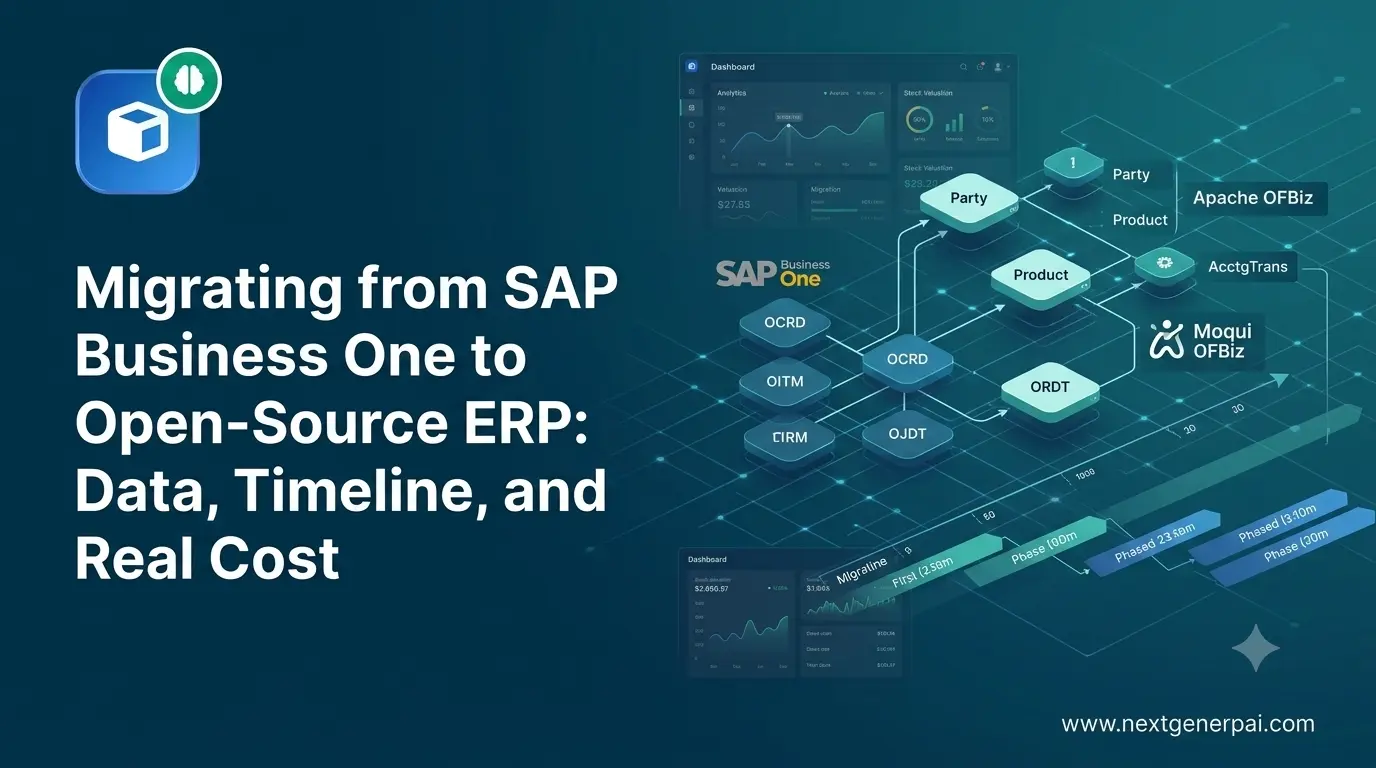
This is the part of the project that gets underestimated, and it is the part where a mapping document earns its cost ten times over. SAP Business One stores each company in its own database on Microsoft SQL Server or SAP HANA, with a shared SBO-Common database for cross-company configuration. Its schema is stable, well documented, and mercifully consistent: master data tables are prefixed with O, line item tables carry a numeric suffix, user-defined fields appear as U_-prefixed columns, and user-defined tables carry an @ prefix.
The target data model in Apache OFBiz and Moqui is normalised differently. Business partners, employees, and your own organisation all resolve to the same Party abstraction with roles applied on top. Documents are not separate tables per type but statused entities with roles and adjustments. Understanding this reshaping is the whole job, because a field-to-field mapping without a model-to-model mapping produces a system that technically holds your data and cannot transact against it.
Master data
| SAP Business One | Contents | Open-source target entities | Migration notes |
|---|---|---|---|
OCRD, CRD1, OCPR | Business partners, addresses, contact persons | Party, PartyGroup, Person, PartyRole, PartyContactMech, ContactMech, PostalAddress, TelecomNumber | Customers and suppliers become one Party with CUSTOMER and SUPPLIER roles. A BP that is both stops being two records |
OCRG, OCRY, OCST | BP groups, countries, states | PartyClassificationGroup, Geo | Geo data is seeded in the target, so map to existing IDs rather than importing |
OITM, OITB | Item master, item groups | Product, ProductCategory, ProductCategoryMember, GoodIdentification | Barcodes, manufacturer part numbers, and supplier codes all move to GoodIdentification with distinct type IDs |
OPLN, ITM1, OSPP | Price lists, item prices, special prices | ProductPrice, ProductPriceRule, ProductStore price configuration | Volume and customer-specific pricing usually needs rules rather than rows. This is a design decision, not a data conversion |
OWHS | Warehouses | Facility, FacilityLocation | Bin locations map to FacilityLocation. If you use bins in Business One, model them before loading inventory |
OACT | Chart of accounts | GlAccount, GlAccountOrganization, GlAccountTypeDefault | The account hierarchy and the type defaults that drive automatic posting must both be mapped. Getting the defaults wrong produces silently incorrect postings |
OUSR, OHEM, OSLP | Users, employees, sales employees | UserLogin, Party with EMPLOYEE role, SalesRepresentative role | Do not migrate credentials. Create accounts and force enrolment |
CUFD, @-prefixed tables | User-defined fields and tables | Extended entities in your own plugin component | Inventory these early. UDFs are where undocumented business logic hides |
Inventory and transactional history
| SAP Business One | Contents | Open-source target entities | Migration notes |
|---|---|---|---|
OITW, OINM | Item warehouse stock, inventory transaction journal | InventoryItem, InventoryItemDetail | Migrate balances as an opening adjustment, not by replaying the journal. Replaying years of movements is the single most common cause of a failed data migration |
OSRN, OIBT, OBTN, OITL | Serial numbers, batches, item transaction log | InventoryItem with lotId, Lot | If you are regulated and need full genealogy, this is a scope item with real cost. Decide whether history stays in an archive or moves |
ORDR, RDR1 | Sales orders and lines | OrderHeader, OrderItem, OrderAdjustment, OrderRole, OrderItemShipGroup, OrderStatus | Migrate open orders only. Discounts and freight become OrderAdjustment rows, not line fields |
ODLN, DLN1, OIGE, OIGN, OWTR | Deliveries, goods issues and receipts, transfers | Shipment, ShipmentItem, ItemIssuance, InventoryTransfer | Only in-flight documents need to move |
OINV, INV1, ORIN | AR invoices, credit memos | Invoice, InvoiceItem, InvoiceStatus, InvoiceRole | Migrate open receivables at full detail. Settled invoices belong in an archive |
OPOR, POR1, OPDN, OPCH | Purchase orders, goods receipts, AP invoices | OrderHeader with PURCHASE_ORDER type, Shipment, Invoice with purchase type | The same entities serve both directions, differentiated by type and role |
ORCT, OVPM | Incoming and outgoing payments | Payment, PaymentApplication, PaymentMethod | Partial applications and on-account payments need careful reconciliation after load |
OJDT, JDT1 | Journal entries and lines | AcctgTrans, AcctgTransEntry | Migrate opening trial balance per account, plus the current fiscal year if your auditors require comparatives in-system |
OITT, ITT1 | Bills of material | ProductAssoc with manufacturing type, ProductAssocAttr | Multi-level BOMs need validation after load, since a broken parent reference is not always obvious |
OWOR, WOR1 | Production orders | WorkEffort, WorkEffortGoodStandard, WorkEffortInventoryAssign | Open production orders only, and expect to rebuild routing detail rather than convert it |
The history decision, and why it dominates the timeline
The most consequential decision in the entire project is how much transactional history moves into the new system. Teams default to "all of it" and then discover that migrating six years of settled invoices, closed orders, and posted journals costs more than every other data activity combined while delivering almost no operational value.
| Strategy | What moves | Typical cost impact | When it is right |
|---|---|---|---|
| Open items only | Master data, stock balances, open orders, open AR and AP, opening trial balance | Baseline | The default. Correct for the large majority of migrations |
| Open items plus current year | The above plus the current fiscal year's transactions | 25% to 40% more data migration effort | Where auditors or regulators require in-system comparatives |
| Full history | Everything | 2x to 4x data migration effort, and it distorts the whole timeline | Rarely justified. Almost always better served by a read-only archive |
| Open items plus archive | Open items into the ERP, full history into a reporting database or data warehouse | 10% to 20% above baseline | The pragmatic answer. Preserves query access without contaminating the new ledger |
Keep the retired SAP Business One database available read-only for the statutory retention period, and expose it through your reporting layer. This satisfies auditors, satisfies the finance team's instinct to look things up, and keeps your new general ledger clean.
Extraction and load architecture
Three architectural rules make the difference between a migration that converges and one that does not. Extraction is read-only and never writes to Business One, both because direct database writes are unsupported by SAP and because you want the source system unchanged until cutover. Every transformation rule lives in version control as code or configuration, never in a spreadsheet or a one-off script, because you will run the full pipeline at least four times. And reconciliation is a first-class deliverable with its own reports: record counts per entity, trial balance comparison to the cent, stock valuation comparison per warehouse, and open AR and AP ageing comparison. If those four reconciliations do not tie, you are not ready to cut over, regardless of what the project plan says.
The Timeline: What a Realistic Phased Migration Looks Like
The figures below reflect a mid-market migration: 40 to 80 users, one or two legal entities, three to six integrations, moderate customization. Small single-entity migrations compress to roughly 60% of this. Multi-country manufacturing migrations extend to 18 months or more.
| Phase | Duration | Primary output | Where projects fail |
|---|---|---|---|
| Discovery and fit-gap | 4 to 6 weeks | Documented current-state processes, gap register, UDF and add-on inventory | Skipping the UDF inventory. Undocumented logic in user-defined fields surfaces during UAT and forces rework |
| Design | 4 to 6 weeks | Target data model, chart of accounts design, integration specifications, mapping document | Designing the chart of accounts by copying the old one instead of fixing what was wrong with it |
| Build | 10 to 14 weeks | Configured platform, extensions in a separate component, working integrations | Customizing the framework core instead of a plugin component, which makes every future upgrade a merge project |
| Migration rehearsals | 6 to 10 weeks, overlapping build | Repeatable pipeline, reconciliation reports that tie | Running one rehearsal. Three is the practical minimum, and each one should be faster than the last |
| UAT and parallel run | 6 to 10 weeks | Signed-off process scripts, one full finance close run in both systems | Testing screens rather than end-to-end processes. Nobody discovers a broken three-way match by clicking around |
| Cutover | 1 week, usually a long weekend | Live system with tied opening balances | No documented rollback decision point. You need a defined time at which you stop and revert |
| Hypercare | 8 weeks | Stabilised operations, transferred knowledge | Releasing the delivery team at go-live. Weeks two through five generate the most defects |
Two scheduling constraints are worth planning around from the start. Cut over at a period boundary, ideally the start of a fiscal year and never during a quarter-end or a peak trading season. And run at least one full month-end close in parallel across both systems before go-live, because the close is where data quality problems become visible and it is far cheaper to find them while Business One is still authoritative.
The coexistence option
Full replacement is not the only path, and for scores in the 2.0 to 3.0 band it is usually the wrong one. A bounded migration moves one domain to open source while SAP Business One remains the system of record for finance. The most common pattern is to move fulfilment operations first, because that is where per-user licensing hurts most and where the operational gain is fastest. In that model, a modern order management system and AI-powered warehouse management run on the open-source platform, with a bidirectional interface posting summarised financial results back into Business One. It reduces project risk substantially, delivers value in three to four months rather than a year, and leaves a full replacement as an option rather than a commitment. The cost is a real integration you have to own for as long as the coexistence lasts, so it should be scoped as a durable interface, not a temporary bridge.
The Real Cost
Cost ranges in ERP content are usually either absent or fantasy. The figures below are the ranges we see in the market for professional delivery, expressed in USD, excluding your internal team's time. Regional rates vary substantially and offshore or hybrid delivery models sit at the lower end of each band.
Migration project cost
| Deployment profile | Users | Integrations | Migration project cost | Duration |
|---|---|---|---|---|
| Small, single entity, light customization | 10 to 25 | 1 to 3 | $60,000 to $150,000 | 4 to 6 months |
| Mid-market, single or dual entity | 25 to 75 | 3 to 6 | $150,000 to $400,000 | 7 to 11 months |
| Complex, multi-entity or manufacturing | 75 to 250 | 6 to 12 | $400,000 to $900,000 | 12 to 18 months |
| Multi-country with statutory localization | 100+ | 10+ | $900,000 and above | 18 months and above |
Where that money goes
| Cost component | Share of project | Notes |
|---|---|---|
| Discovery, design, and project management | 15% to 20% | Compressing this is the most expensive saving available |
| Configuration and extension development | 25% to 35% | Driven by your gap register, not by the platform |
| Data migration | 15% to 25% | Driven almost entirely by the history decision and data quality |
| Integration | 15% to 20% | Each interface is a small project with its own testing burden |
| Testing and UAT support | 10% to 15% | Underfunded in most plans |
| Training and change management | 5% to 10% | Underfunded in almost all plans |
| Software licences | 0% | This is the structural difference |
Annual run cost after migration
| Item | Small | Mid-market | Complex |
|---|---|---|---|
| Platform licences | $0 | $0 | $0 |
| Hosting and infrastructure | $4,000 to $12,000 | $12,000 to $30,000 | $30,000 to $90,000 |
| Managed support and maintenance | $15,000 to $40,000 | $40,000 to $110,000 | $110,000 to $250,000 |
| Enhancement capacity | $10,000 to $30,000 | $30,000 to $90,000 | $90,000 to $250,000 |
| Total annual run cost | $29,000 to $82,000 | $82,000 to $230,000 | $230,000 to $590,000 |
Note the honest shape of that table. Open source removes the licence line and replaces part of it with support and enhancement capacity that you now buy deliberately rather than receive bundled. The saving is real but it is not the whole licence value, and anyone presenting it as such is misleading you. What you also buy is the ability to direct that spend at your own priorities instead of a vendor roadmap. Our Apache OFBiz implementation cost analysis breaks the run cost side down in more detail.
Break-even against staying on SAP Business One
To model this you need your avoided cost, which is your annual SAP Business One spend plus the cost of the platform upgrade you are otherwise committing to. SAP's published 2026 list pricing for Business One is roughly €2,700 per perpetual Professional user and €1,400 per Limited user, with cloud subscriptions around €91 and €47 per user per month respectively, and annual maintenance on perpetual licences running at 18% to 22% of original licence value indefinitely. Partner-quoted cloud pricing typically sits above list because it bundles hosting and support, with professional-user quotes commonly spanning $95 to $250 per user per month. Add-on licences and maintenance sit on top of all of that.
The table below models a typical mix of 70% Professional and 30% Limited users on partner-quoted cloud pricing, plus a conservative add-on and support allowance.
| Users | Estimated annual SAP Business One cost | Migration investment | Simple payback | Five-year net position |
|---|---|---|---|---|
| 15 | $28,000 | $110,000 | Beyond 5 years | Negative. Do not migrate on cost grounds |
| 30 | $56,000 | $175,000 | Approximately 4.5 years | Roughly break-even |
| 60 | $112,000 | $290,000 | Approximately 3.4 years | Positive, moderately |
| 120 | $224,000 | $480,000 | Approximately 2.7 years | Clearly positive |
| 250 | $465,000 | $780,000 | Approximately 2.1 years | Strongly positive |
Three adjustments materially improve every row. A platform upgrade or re-implementation you are already committed to should be subtracted from the migration cost, because you are paying it either way, and that alone can move a marginal case. Retiring add-on licences and their maintenance lines adds directly to avoided cost. And per-user licensing means the SAP side of the comparison grows with headcount while the open-source side grows with complexity, so the gap widens over time for any business that is hiring.
The conclusion is uncomfortable for a firm that sells migrations, and it is the correct one: below roughly 30 users, migrate only for capability reasons, never for licence savings. The capability reasons are legitimate and often decisive, but they should be argued on their own terms.
Choosing the Target Platform
Both viable open-source targets are mature, and the choice depends on what you are actually replacing.
| Consideration | Apache OFBiz | Moqui |
|---|---|---|
| What you get | A full ERP application suite including accounting, order management, inventory, manufacturing, and e-commerce | A lean application framework plus a compatible business data model, with applications assembled on top |
| Best fit | You want to adopt substantial standard ERP functionality and configure around it | You are building differentiated processes and want less standard functionality in the way |
| Data model heritage | The original Open For Business universal data model | A modernised evolution of the same modelling tradition |
| Learning curve | Steeper, larger codebase, more conventions to absorb | Lighter, more modern tooling, smaller surface area |
| Community and ecosystem | Larger, Apache Software Foundation governance, longer track record | Smaller and more specialised, with a tightly maintained core |
| Typical migration fit from Business One | Distribution, wholesale, multi-warehouse retail, standard manufacturing | Operations with unusual process requirements or a strong internal engineering culture |
For most SAP Business One migrations, where the point is to replace a broadly standard ERP footprint, Apache OFBiz gives you more out of the box and less to build. Where the migration is really an opportunity to rebuild differentiating operations properly, Moqui tends to get there faster with less friction. We deliver both, through Apache OFBiz ERP development services and Moqui ERP development and consultancy, and the honest answer in a first conversation is usually that the decision should follow the fit-gap analysis rather than precede it.
Whichever you choose, the customization discipline is identical and non-negotiable. Your extensions live in a separate versioned component that layers on top of the upstream release. Teams that edit the core lose the ability to take security patches within two years and end up in a worse lock-in position than the one they migrated to escape. This is the central discipline behind sustainable custom ERP development solutions, and it is the difference between owning your platform and merely hosting it.
What Migration Makes Possible That Business One Does Not
The licence saving is the reason finance approves a migration. It is rarely the reason the migration was proposed. In practice the driver is that the organisation has hit a capability ceiling, and the value shows up in three places.
Process fidelity. Open-source platforms let you model the process you actually run rather than the closest available approximation. Every workaround currently living in a spreadsheet, a manual reconciliation, or a user-defined field with undocumented rules attached is a candidate for elimination. Quantify these during discovery, because collectively they are often worth more than the licence line.
Real integration rather than data exchange. With direct access to the service layer and the data model, integration stops being scheduled file transfers and becomes real-time. That matters most where order promising, inventory availability, and fulfilment meet, which is exactly where growing businesses feel the constraint first. The same access supports inventory management solutions that reflect actual multi-location availability rather than an overnight snapshot.
Automation with the data model open underneath it. This is the part that changes fastest. When every business operation is an addressable service and every transaction is fully modelled with an audit trail, automation becomes a design activity rather than a screen-scraping exercise. The practical starting points are document-heavy processes and exception queues: AI-powered document processing for supplier invoices and inbound orders, then exception handling in procurement and order management. Beyond that, AI ERP solutions and an agentic ERP architecture treat the ERP service layer as a toolset that autonomous agents can call under policy, with the entity model providing the audit trail that makes such automation defensible to an auditor. Attempting the same thing across a closed platform's API surface is possible and considerably more constrained.
The sequencing point matters more than the technology. Automate after the migration has stabilised, not during it. Intelligent automation layered onto an unstable data migration amplifies the instability rather than compensating for it.
Migration Risks and How They Actually Get Managed
| Risk | Likelihood | Mitigation that works |
|---|---|---|
| Data quality worse than assumed | High | Profile the source data in week one, not month four. Duplicate business partners and orphaned items are near-universal |
| Undocumented logic in user-defined fields and add-ons | High | Inventory every UDF and add-on during discovery, and treat each as a requirement to be re-elicited rather than converted |
| Scope creep during build | High | Freeze the gap register at design sign-off, and route new requirements to a phase two backlog with an explicit budget |
| Localization and statutory compliance gaps | Medium | Identify mandatory jurisdictional requirements in discovery and make them critical path, not late-phase |
| Key-person dependency on the partner | Medium | Contract knowledge transfer as a deliverable with named outputs, not a goodwill activity |
| User resistance to an unfamiliar interface | Medium | Involve operational users in UAT design, and train on their real processes with their real data |
| Cutover overrun | Medium | Three rehearsals minimum, a documented rollback decision point, and a period-boundary cutover date |
| Losing security patch currency post-migration | Medium | Separate component customization plus a standing monthly patch window with staging validation |
The two risks that most often prove fatal are the first and third. Data quality is discoverable in the first two weeks for a modest cost, and every week you delay discovering it multiplies the rework. Scope creep is a governance failure rather than a technical one, and the only reliable defence is a named person empowered to say that a good idea belongs in phase two.
Frequently Asked Questions
Can you migrate from SAP Business One to open-source ERP without losing transactional history?
Yes, but you should not move all of it into the new ERP. The recommended pattern is to migrate master data, stock balances, open orders, open receivables and payables, and an opening trial balance into the new system, while retaining the SAP Business One database read-only and exposing full history through your reporting layer. This satisfies audit and lookup requirements at a fraction of the cost, and it keeps the new general ledger clean.
How long does a migration from SAP Business One take?
A small single-entity migration with light customization typically runs 4 to 6 months. A mid-market migration with 40 to 80 users and several integrations runs 7 to 11 months. Multi-entity or multi-country migrations with statutory localization requirements run 12 to 18 months or longer. The largest single variable is not user count but the volume of history you insist on migrating and the number of integrations in scope.
What does it cost to migrate from SAP Business One to open-source ERP?
Professional delivery ranges from roughly $60,000 to $150,000 for a small single-entity migration, $150,000 to $400,000 for a mid-market migration, and $400,000 to $900,000 for complex multi-entity or manufacturing deployments. Ongoing annual run cost, covering hosting, support, and enhancement capacity but no licence fees, typically runs $29,000 to $82,000 for small deployments and $82,000 to $230,000 for mid-market ones.
Is open-source ERP actually cheaper than SAP Business One?
It depends almost entirely on user count. Below roughly 30 users, migration rarely pays back within five years on licence savings alone, and should only be pursued for capability reasons. Above roughly 100 users, payback is commonly under three years and improves further as headcount grows, because per-user licensing scales with people while open-source cost scales with complexity. The licence line goes to zero, but part of that saving is replaced by support and enhancement spend you now buy explicitly.
Which open-source ERP is the best replacement for SAP Business One?
Apache OFBiz is usually the better fit when you want to replace a broadly standard ERP footprint, because it ships complete accounting, order management, inventory, and manufacturing applications. Moqui is often the better fit when the migration is an opportunity to rebuild differentiated processes and you have or intend to build internal engineering capability. Both share a common data modelling heritage, and the decision should follow a fit-gap analysis rather than precede it.
Do we have to migrate everything at once?
No, and for many organisations a bounded migration is the lower-risk path. Moving order management and warehouse operations to open source while SAP Business One remains the finance system of record delivers value in three to four months and leaves full replacement as a later option. The trade-off is a bidirectional financial interface that you own for the duration of the coexistence, which should be designed as a durable component rather than a temporary bridge.
Does leaving SAP support lock us out of returning?
Far less than it used to. Following binding commitments accepted by the European Commission in July 2026, SAP has waived reinstatement fees entirely, reduced back-maintenance charges for customers returning after a gap, and agreed to allow maintenance for different parts of an SAP estate to be sourced from different providers. The commitments apply globally for ten years and are monitored by an independent trustee. Confirm the specific terms that apply to your contract, but the historical penalty structure that made a staged exit financially irreversible has been substantially dismantled.
What is the most common cause of a failed SAP Business One migration?
Two causes dominate. The first is deciding to migrate full transactional history, which inflates the data workstream to the point that it consumes the schedule and the contingency. The second is failing to inventory user-defined fields and add-ons during discovery, because that is where years of undocumented business logic accumulates, and it surfaces during user acceptance testing when there is no budget left to address it.
Final Thoughts
A migration from SAP Business One to open-source ERP is a data and process project wearing a technology costume. The platform choice matters less than four decisions: how much history you move, whether your customizations live outside the upstream core, whether you cut over at a period boundary after a genuine parallel close, and whether you have honestly assessed that your organisation is large enough and constrained enough for the move to pay. Get those right and you end up with a platform whose cost scales with your complexity rather than your headcount, and whose data model is fully open to the automation work that comes next. Get them wrong and you will have spent a year and a substantial budget to acquire a different set of constraints.
The 2026 timing is unusually favourable for organisations that were already going to face a platform upgrade, and the commercial penalties for a staged exit are lower than they have been in years. That does not make migration right for everyone, and the scoring framework above will tell some readers plainly that it is not right for them.
If you are building a business case, we run structured migration assessments that produce a data mapping document, a phased plan, and a costed comparison against staying put, across manufacturing, retail, healthcare, e-commerce, and distribution. The assessment is worth doing even when the answer is to stay, because a documented answer is more valuable than an assumption in either direction.