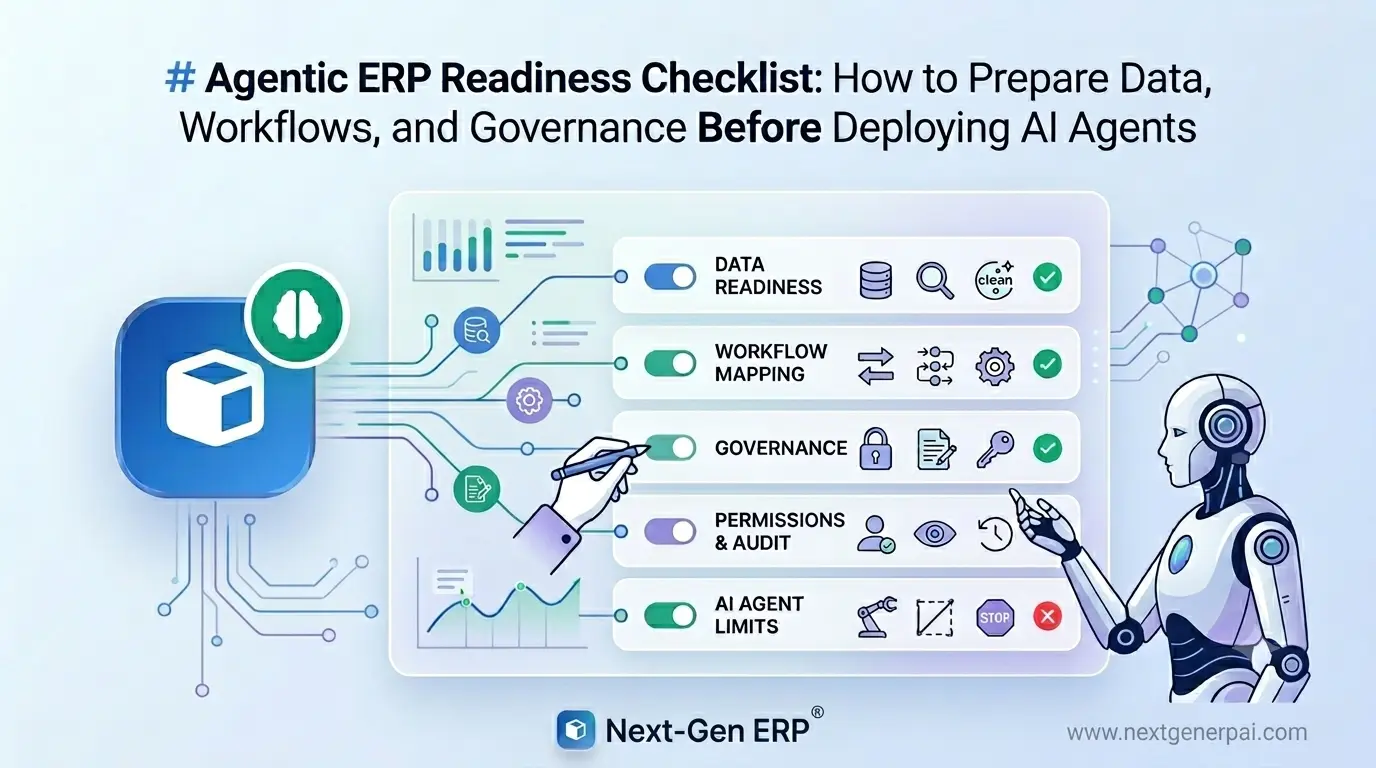
Agentic ERP Readiness Checklist: How to Prepare Data, Workflows, and Governance Before Deploying AI Agents
Quick Answer
Agentic ERP readiness means preparing your enterprise data, workflows, permissions, integrations, and governance rules before allowing AI agents to make or execute business decisions inside ERP systems. A company is ready for Agentic ERP when its data is clean enough to trust, its workflows are clearly mapped, its business rules are documented, its approval limits are defined, and its ERP architecture can safely support autonomous actions across OMS, WMS, inventory, finance, procurement, and manufacturing.
Why Agentic ERP Readiness Matters
AI agents are changing how ERP systems work. Traditional ERP records transactions, AI ERP recommends actions, but Agentic ERP can take action. That action may be creating a purchase order, adjusting inventory, routing an order, rescheduling production, flagging a financial exception, or notifying a manager before a delay turns into a customer complaint.
That sounds powerful, but it also raises an important question: is your ERP environment ready for AI agents to act inside it?
Many businesses want autonomous ERP workflows, but they still operate with inconsistent item masters, manual approvals, disconnected spreadsheets, unclear ownership, and legacy integrations that break whenever processes change. Deploying AI agents on top of that kind of foundation does not create intelligence. It only automates confusion faster.
This is why readiness comes before deployment. At Next-Gen ERP, we look at Agentic ERP as a practical business transformation, not a technology experiment. The goal is not to replace human judgment. The goal is to let AI agents handle repetitive, high-volume, rule-based, and exception-driven work while business leaders stay in control of policies, limits, and outcomes.
What Is Agentic ERP?
Agentic ERP is an enterprise resource planning approach where AI agents can understand business goals, analyze ERP data, make decisions within approved limits, and execute workflows across business systems. Unlike standard automation, which follows fixed rules, Agentic ERP uses context-aware agents that can reason through multi-step tasks and adapt when conditions change.
For example, a traditional ERP system may alert a buyer when stock falls below the reorder point. An AI ERP system may recommend how much stock to buy based on demand trends. An Agentic ERP system can go further by checking supplier lead times, reviewing open purchase orders, validating budget limits, creating a draft purchase order, and sending it for approval or auto-submitting it if the value is within policy.
This is why businesses exploring agentic ERP architecture need to prepare their data, workflows, and governance before deployment. AI agents work best when they operate inside a clean, modular, permission-aware ERP architecture.
Agentic ERP vs Traditional ERP Automation
| Area | Traditional ERP Automation | AI ERP | Agentic ERP |
|---|---|---|---|
| Decision style | Rule-based | Recommendation-based | Action-oriented and goal-driven |
| Human role | Performs most actions | Reviews AI suggestions | Sets goals, limits, and exceptions |
| Workflow behavior | Fixed steps | Predictive insights | Adaptive multi-step execution |
| Best use case | Alerts, approvals, scheduled reports | Forecasting, anomaly detection, recommendations | Procurement, inventory, finance, order routing, manufacturing execution |
| Risk level | Low to medium | Medium | Higher if governance is weak |
| Readiness requirement | Process documentation | Data quality and model readiness | Data, workflow, integration, permissions, audit, and governance readiness |
The Practical Agentic ERP Readiness Checklist
1. Start With Data Readiness
AI agents depend on data the same way your operations team depends on facts. If item codes are duplicated, inventory balances are unreliable, supplier records are outdated, or customer master data is inconsistent, an AI agent will struggle to make safe decisions.
Before deploying AI agents, review the quality of data across core ERP areas such as products, customers, suppliers, inventory, pricing, orders, invoices, production schedules, and financial records. The objective is not perfection on day one. The objective is to identify which data can be trusted, which data needs cleansing, and which data should not be used for autonomous execution yet.
| Data Area | Readiness Question | Why It Matters for AI Agents |
|---|---|---|
| Item master | Are SKUs, units of measure, categories, and alternates consistent? | Agents need accurate product context for procurement, inventory, and fulfillment decisions. |
| Inventory | Are stock levels, reserved quantities, and warehouse locations reliable? | Poor inventory data can lead to wrong replenishment, overselling, or production delays. |
| Supplier data | Are lead times, pricing, contracts, and performance records updated? | Procurement agents need supplier confidence before creating purchase actions. |
| Customer and order data | Are customer priorities, order history, and service rules available? | OMS agents need context for routing, allocation, and exception handling. |
| Finance data | Are invoices, payments, tax rules, and approval limits clean? | Finance agents need accuracy before matching invoices or flagging exceptions. |
| Production data | Are BOMs, routings, work centers, and capacity records maintained? | Manufacturing agents need reliable data to reschedule work orders or plan materials. |
Businesses using inventory management solutions should start by validating inventory accuracy because stock decisions are often among the first areas selected for AI-driven ERP automation.
2. Map Workflows Before Automating Them
One of the biggest mistakes companies make is asking AI agents to automate workflows that no one has clearly documented. If a process lives only in the mind of one experienced employee, it is not ready for autonomous execution.
Start with the workflows where delays, manual effort, and repeated exceptions are easiest to see. Good candidates include purchase requisition approval, invoice matching, order routing, replenishment, production scheduling, returns management, stock transfers, and warehouse task prioritization.
A strong workflow map should show the trigger, decision points, required data, approval rules, system actions, exception paths, and final outcome. For example, in order management, the workflow should explain what happens when an order arrives, how inventory is allocated, how warehouse selection is decided, when split shipment is allowed, and when a human must intervene.
Companies modernizing their order lifecycle can connect this readiness exercise with modern order management systems and the broader role of AI agents in ERP.
Workflow Readiness Framework
| Readiness Level | Workflow Condition | AI Agent Suitability |
|---|---|---|
| Level 1 | Process is undocumented and dependent on individuals | Not ready |
| Level 2 | Process is documented but exceptions are unclear | Ready for observation only |
| Level 3 | Process has clear rules, data inputs, and approval steps | Ready for assisted automation |
| Level 4 | Process has defined exception handling and audit trails | Ready for supervised AI agents |
| Level 5 | Process has measurable outcomes, limits, and governance | Ready for controlled autonomous execution |
3. Define Human-in-the-Loop Boundaries
Agentic ERP does not mean removing people from the business. It means assigning people to the right decisions. A warehouse manager should not approve every small replenishment if the rules are clear, but they should approve unusual stock transfers, high-value purchases, risky substitutions, or customer-impacting exceptions.
Human-in-the-loop design defines when an AI agent can act independently, when it must ask for approval, and when it must escalate immediately. This is especially important in procurement, finance, healthcare, manufacturing quality, regulated industries, and high-value customer orders.
| Decision Type | Example | Recommended Control |
|---|---|---|
| Low-risk repetitive action | Send reorder alert, update task priority, prepare draft document | Allow agent to execute or draft automatically |
| Medium-risk operational action | Create stock transfer, recommend supplier, reroute order | Require supervisor approval or rule-based threshold |
| High-risk financial action | Approve invoice payment, change credit limit, submit purchase order above limit | Require human approval |
| Compliance-sensitive action | Change batch status, release regulated shipment, modify audit record | Escalate to authorized user only |
| Strategic decision | Change sourcing policy, alter production priority for key customer | Human decision with AI recommendation |
This boundary-setting is central to AI agent development services, where agents are designed around business authority, not just technical capability.
4. Prepare Governance Before Giving Agents Execution Power
Governance is the difference between useful autonomy and uncontrolled automation. AI agents should never have unrestricted access to ERP systems. Each agent needs a defined role, permission scope, decision limit, audit trail, and escalation path.
For example, a procurement agent may be allowed to monitor inventory, compare suppliers, and create draft purchase orders. It may also auto-submit purchase orders below a set value for approved suppliers. But it should not onboard new suppliers, change payment terms, or approve high-value purchases without human review.
Strong governance should answer five questions: who owns the agent, what data can it access, what actions can it perform, what limits apply, and how will every decision be audited?
Agent Governance Checklist
| Governance Area | What to Define |
|---|---|
| Agent ownership | Business owner, technical owner, and escalation contact |
| Access control | Data, modules, services, and APIs the agent can use |
| Action permissions | Read-only, draft-only, approval-required, or auto-execute |
| Financial limits | Maximum transaction value, approval threshold, and budget rules |
| Exception rules | When the agent must stop, ask, or escalate |
| Audit trail | Logs of data used, decision made, action taken, and user notified |
| Monitoring | Performance reviews, error tracking, and outcome measurement |
| Change control | Process for updating prompts, rules, models, and integrations |
5. Check ERP Architecture Readiness
Agentic ERP works best on modular, service-driven, API-first architecture. AI agents should not depend on screen scraping, direct database edits, or fragile workarounds. They need clean service contracts, secure integrations, and controlled execution layers.
Open-source ERP platforms such as Moqui and Apache OFBiz are strong foundations because they support flexible business logic, extensibility, and service-oriented ERP development. Businesses that want deeper customization can explore Moqui ERP development and consultancy, Apache OFBiz ERP development services, or custom ERP development solutions.
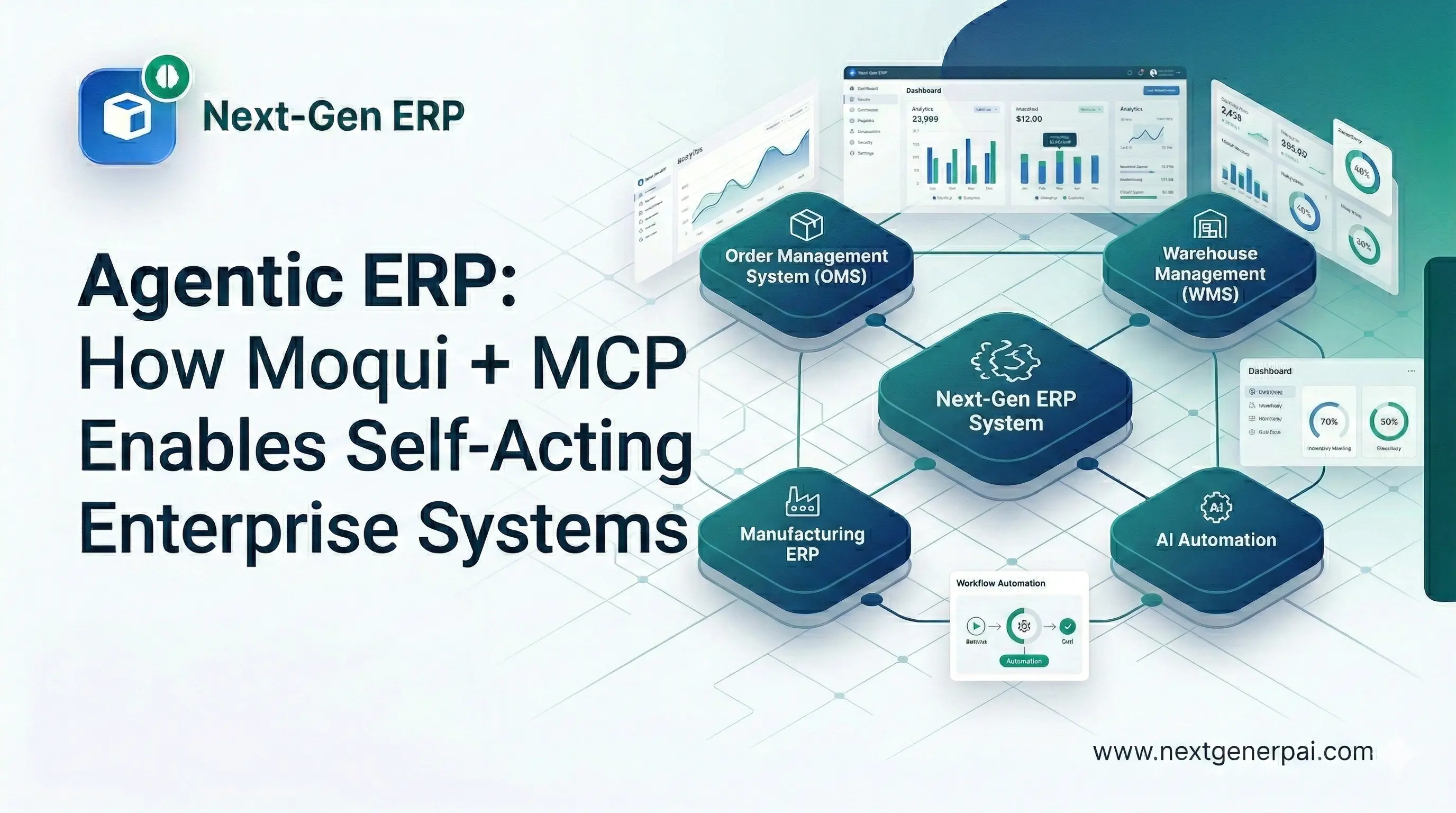
A modern Agentic ERP architecture usually connects five layers: ERP data, business services, integration APIs, AI agent orchestration, and governance controls. When these layers are designed properly, AI agents can execute business workflows safely instead of bypassing the ERP system.
For a deeper architectural view, read how ERP architecture with AI agents connects modular ERP components with intelligent automation.
6. Select the Right First Use Case
Your first Agentic ERP use case should be valuable, measurable, and controlled. Avoid starting with the most complex or riskiest workflow. The best first use cases usually have frequent volume, clear rules, visible business impact, and manageable risk.
Good starting points include inventory replenishment recommendations, invoice matching support, order routing assistance, warehouse task prioritization, purchase order drafting, demand forecast alerts, and production delay detection. These use cases help teams build trust before moving toward deeper autonomous execution.
| Use Case | Business Value | Risk Level | Good First Project? |
|---|---|---|---|
| Inventory replenishment recommendations | High | Medium | Yes |
| Draft purchase order creation | High | Medium | Yes |
| Invoice matching and exception flagging | High | Medium | Yes |
| Autonomous payment approval | High | High | Not first |
| Dynamic order routing | High | Medium | Yes |
| Production rescheduling | High | Medium to high | Start supervised |
| Supplier contract negotiation | Medium | High | Not first |
| Warehouse task prioritization | Medium | Low | Yes |
Companies focused on warehouse execution can connect this with AI-powered warehouse management systems and learn from the shift toward autonomous warehouse management.
7. Build an Exception Handling Model
AI agents will not face perfect conditions every day. Suppliers may delay shipments, inventory may not match physical stock, orders may fail validation, invoices may have missing tax details, and production machines may go down unexpectedly. Readiness means preparing the agent for exceptions before go-live.
Every autonomous workflow should define what the agent should do when confidence is low, data is missing, rules conflict, an action exceeds approval limits, or a business outcome may affect customers. In some cases, the agent should retry. In others, it should create a task, send an alert, or escalate to a manager.
A simple rule works well: AI agents can handle routine variation, but humans should handle ambiguity, policy conflict, and high-impact exceptions.
8. Prepare Documents and Unstructured Data
Many ERP decisions depend on unstructured information such as supplier quotes, invoices, bills of lading, purchase agreements, emails, quality certificates, and delivery notes. If these documents remain outside the ERP system, AI agents will have incomplete context.
This is where AI-powered document processing becomes important. OCR and intelligent document extraction help convert unstructured documents into usable ERP data. For example, invoice fields can be extracted, matched against purchase orders, checked against goods receipts, and routed for approval if exceptions are found.
Document readiness is especially important before deploying finance agents, procurement agents, compliance agents, and supply chain agents.
9. Align Agentic ERP With OMS, WMS, MES, and Inventory
Agentic ERP becomes most valuable when agents can work across business functions instead of sitting inside one isolated module. An order fulfillment agent may need OMS data, WMS inventory, shipping rules, customer priority, and manufacturing capacity. A production planning agent may need sales orders, BOMs, inventory, supplier lead times, and machine availability.
This is why readiness should be cross-functional. OMS, WMS, MES, inventory, procurement, and finance teams should agree on shared data definitions, event triggers, approval boundaries, and exception ownership.
A practical example is order promising. If inventory is available, the agent can allocate stock. If inventory is short, it can check incoming purchase orders. If supply is delayed, it can check production options. If production capacity is constrained, it can recommend a revised promise date. That is not simple automation. That is coordinated ERP intelligence.
To understand this model further, explore autonomous ERP workflows and how AI agents connect real-time data with ERP execution.
10. Decide Whether to Modernize Before Deploying AI Agents
Some ERP environments are ready for AI agents with limited preparation. Others need architecture cleanup, migration, or process redesign first. If your business relies heavily on spreadsheets, manual approvals, disconnected systems, or proprietary ERP limitations, you may need modernization before autonomous execution.
This does not always mean replacing everything at once. A phased approach can work well. You can start by integrating core data, exposing selected workflows through APIs, cleaning high-value master data, and deploying supervised agents in one function before expanding.
Businesses dealing with legacy ERP constraints should review their ERP migration to open-source platforms and compare options through an open-source ERP migration strategy.
Agentic ERP Readiness Scorecard
| Readiness Area | Score 1: Weak | Score 3: Developing | Score 5: Ready |
|---|---|---|---|
| Data quality | Duplicate, incomplete, unreliable records | Key data is usable but needs cleansing | Clean, governed, and trusted master data |
| Workflow clarity | Processes are informal | Processes are documented but exceptions vary | Workflows, decisions, and exceptions are clearly mapped |
| System architecture | Legacy, rigid, hard to integrate | Some APIs and modular systems exist | API-first, service-driven, and scalable |
| Governance | No clear AI policy | Some access controls and approvals defined | Role-based permissions, audit trails, and decision limits |
| Human oversight | Unclear ownership | Owners exist for some workflows | Human-in-the-loop model is documented |
| Integration readiness | Data silos and manual exports | Partial integrations | Real-time connected OMS, WMS, inventory, finance, and MES |
| Change management | Teams are unsure or resistant | Training started | Teams understand roles and escalation paths |
| Monitoring | No agent performance tracking | Basic dashboards | Continuous monitoring, review, and improvement |
How to Interpret Your Score
| Total Score | Readiness Status | Recommended Action |
|---|---|---|
| 8 to 16 | Not ready | Start with data cleanup, workflow mapping, and ERP modernization planning. |
| 17 to 28 | Partially ready | Pilot AI agents in low-risk workflows with human approval. |
| 29 to 36 | Ready for supervised autonomy | Deploy agents in selected workflows with clear monitoring and escalation. |
| 37 to 40 | Ready for controlled autonomous execution | Expand Agentic ERP across connected workflows with governance and continuous review. |
Real-World Example: Inventory Replenishment Agent
Consider a distributor managing multiple warehouses. The team often faces stockouts in one location while another warehouse holds excess stock. A traditional ERP system shows the numbers, but a planner must interpret them, check demand, compare supplier lead times, and decide what to do.
With a ready Agentic ERP foundation, an inventory replenishment agent can monitor stock levels, forecast demand, check open sales orders, review supplier lead times, recommend replenishment, create a draft purchase order, or trigger an internal stock transfer. If the value is within an approved limit, it can execute automatically. If not, it routes the decision to a manager with a clear explanation.
The result is faster replenishment, fewer stockouts, better warehouse balance, and less manual planning effort. But this only works if data, workflows, and governance are ready before deployment.
Real-World Example: Order Routing Agent
In a multi-channel commerce business, order routing is often affected by stock availability, warehouse workload, shipping cost, customer priority, and delivery promise. Fixed rules can handle simple orders, but they struggle when demand spikes or inventory shifts.
An order routing agent can evaluate available inventory, warehouse capacity, carrier performance, and delivery timelines before choosing the best fulfillment path. If the order is standard, the agent routes it automatically. If the order involves a VIP customer, split shipment, low stock, or high delivery risk, the agent escalates with recommendations.
This is where autonomous order management becomes a practical advantage rather than a buzzword.
Cost Considerations Before Deploying Agentic ERP
Agentic ERP cost depends on the number of workflows, integration complexity, data quality, governance requirements, and whether the company is building on an existing ERP or modernizing its platform first. A business with clean data and API-ready systems can start faster. A business with fragmented legacy systems may need migration, data cleanup, and workflow redesign before AI agents can safely execute transactions.
| Cost Area | What It Includes | How to Control Cost |
|---|---|---|
| Data preparation | Cleansing master data, mapping records, resolving duplicates | Start with one function such as inventory or procurement |
| Workflow design | Process mapping, decision rules, exception paths | Prioritize high-volume workflows |
| ERP integration | APIs, service layers, event triggers, data synchronization | Use open-source and service-driven architecture |
| Agent development | Prompt logic, tools, orchestration, testing | Start with supervised agents before autonomy |
| Governance setup | Permissions, audit logs, approval rules, monitoring | Define controls early instead of retrofitting later |
| Change management | Training, SOPs, adoption support | Involve business users from the beginning |
For companies comparing platform options, Moqui ERP foundation and OFBiz implementation planning are useful starting points.
Common Mistakes to Avoid
The first mistake is deploying AI agents without cleaning the data they rely on. The second is automating workflows that are not clearly understood. The third is giving agents too much access too soon. The fourth is treating governance as an afterthought. The fifth is choosing a use case because it sounds impressive rather than because it is measurable and safe.
A practical approach is better. Start with one workflow, define success metrics, keep humans in the loop, monitor outcomes, and expand only after the business trusts the results.
What Business Leaders Should Ask Before Approving Agentic ERP
Before approving an Agentic ERP project, leaders should ask: what business problem are we solving, which workflow will the agent execute, what data will it use, who owns the decision, what can it do without approval, when must it escalate, how will we audit the result, and how will we measure success?
Good answers to these questions show readiness. Vague answers show that the organization needs more preparation before deployment.
Future Outlook: From ERP Automation to Autonomous Enterprise Operations
Agentic ERP is the next step in enterprise systems because businesses no longer want ERP software that only stores data and waits for users to act. They want systems that can detect problems, recommend actions, execute approved workflows, and continuously improve operations.
The future will not be one large AI agent running the entire company. It will be a network of specialized agents working across procurement, finance, inventory, OMS, WMS, MES, and customer operations. Some agents will recommend. Some will draft. Some will execute. The best ERP environments will define which agent does what, under which policy, and with which level of human oversight.
This is why AI-driven ERP systems are moving toward modular, open, and governance-first architectures. Businesses that prepare now will be able to adopt AI agents safely, scale automation faster, and reduce operational friction without losing control.
Conclusion
Agentic ERP readiness is not about buying an AI tool and connecting it to your ERP. It is about preparing the operational foundation that allows AI agents to work safely and effectively. Clean data, mapped workflows, clear governance, API-ready architecture, human-in-the-loop controls, and measurable use cases all matter.
For businesses in manufacturing, retail, e-commerce, healthcare, financial services, real estate, and education, Agentic ERP can create a more responsive and intelligent operating model. But the companies that gain the most value will be the ones that prepare before they deploy.
Next-Gen ERP helps businesses move from manual ERP operations to intelligent, open-source, AI-ready systems through AI ERP solutions, AI Agent ERP Development, Moqui and Apache OFBiz implementation, ERP migration, and custom automation built around real business workflows.
Frequently Asked Questions
What is Agentic ERP readiness?
Agentic ERP readiness is the process of preparing data, workflows, integrations, permissions, governance, and human oversight before deploying AI agents inside ERP systems. It ensures AI agents can make or execute decisions safely, accurately, and within approved business limits.
What data is needed for Agentic ERP?
Agentic ERP needs clean and structured data across products, inventory, suppliers, customers, orders, invoices, finance, production, and warehouse operations. The better the data quality, the more reliable the AI agent’s decisions become.
Can AI agents work with existing ERP systems?
Yes, AI agents can work with existing ERP systems if the system provides reliable data access, APIs, service layers, and secure permissions. However, legacy ERP systems may require modernization, integration cleanup, or migration before autonomous workflows can be deployed safely.
What is the safest first use case for Agentic ERP?
The safest first use cases are usually low-to-medium risk workflows such as inventory replenishment recommendations, purchase order drafting, invoice matching support, warehouse task prioritization, and order routing assistance. These use cases provide measurable value while keeping human approval in place.
How is Agentic ERP different from AI ERP?
AI ERP usually analyzes data and recommends actions, while Agentic ERP can execute approved actions through AI agents. AI ERP supports decision-making, but Agentic ERP moves further by allowing agents to complete workflows such as creating records, routing tasks, triggering services, and escalating exceptions.
Does Agentic ERP replace employees?
No, Agentic ERP does not replace employees. It reduces repetitive manual work and helps teams focus on higher-value decisions. Humans remain responsible for goals, policies, exceptions, approvals, and strategic judgment.
Why is open-source ERP useful for Agentic ERP?
Open-source ERP is useful for Agentic ERP because it gives businesses more flexibility, source code access, customization freedom, and integration control. Platforms such as Moqui and Apache OFBiz make it easier to build service-driven workflows that AI agents can safely execute.