Apache OFBiz Implementation Cost in 2026: Licensing, Development, Infrastructure and Long-Term TCO
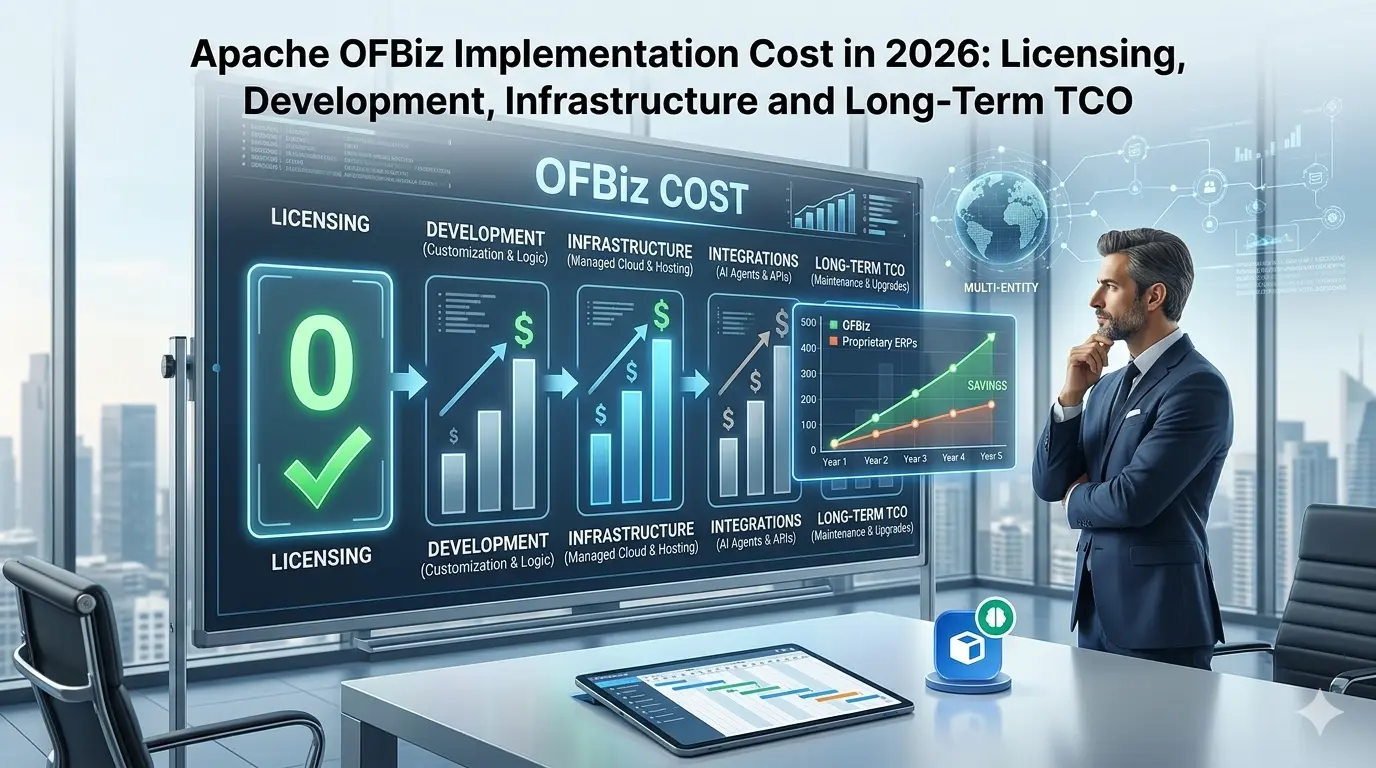
Every CFO who hears the phrase "open-source ERP" reaches the same conclusion within five seconds. If the software is free, the project must be cheap. And every implementation partner who has actually delivered an Apache OFBiz project knows that this is the most expensive assumption a business can make. Apache OFBiz carries no license fee, which is a genuine commercial advantage, but the total cost of an OFBiz implementation is shaped by development effort, infrastructure choices, integration scope, training, ongoing maintenance, and the complexity of customizations the business actually needs. The license is the smallest line item on the invoice. Everything else is where the real budget lives. This blog walks through what an Apache OFBiz implementation actually costs in 2026, where the hidden costs sit, how cloud hosting and AI customization have changed the math, and how to think about total cost of ownership over a realistic five-year horizon.
The Licensing Reality of Apache OFBiz
Apache OFBiz is released under the Apache 2.0 license. There is no per-user fee, no annual subscription, no module licensing, and no enterprise tier hiding behind a paywall. You can download the source, deploy it across as many servers as you want, customize it without restriction, and use it for commercial purposes without paying a single rupee, dollar, or euro to any software vendor. Compared to SAP, Oracle NetSuite, or Microsoft Dynamics, where licensing alone can consume hundreds of thousands of dollars annually, this is a meaningful structural saving. But the free license creates a perception problem. Because the software costs nothing, businesses often underestimate the real investment required to run OFBiz at production scale, and that mismatch between expectation and reality is the single biggest reason open-source ERP projects struggle in their first year.
The Seven Cost Components That Actually Matter
When budgeting an OFBiz implementation, there are seven cost categories that show up on every project, regardless of size or industry. Some are obvious. Most are not. The table below maps them with typical 2026 ranges based on real implementation patterns.
| Cost Category | What It Covers | Typical Range (USD) |
|---|---|---|
| Software License | Apache 2.0 license | $0 |
| Discovery and Architecture | Business process mapping, gap analysis, solution design | $10K to $50K |
| Core Implementation | Configuration, deployment, base module setup | $40K to $300K |
| Custom Development | Industry-specific modules, UI changes, business logic | $30K to $500K |
| Data Migration | Cleansing, mapping, moving data from legacy systems | $15K to $150K |
| Integrations | Connecting OFBiz with marketplaces, payment gateways, CRM, WMS | $20K to $200K |
| Training and Change Management | User training, documentation, internal champions | $5K to $40K |
| Infrastructure (annual) | Cloud hosting, databases, backups, monitoring | $6K to $80K per year |
| Ongoing Maintenance (annual) | Patches, bug fixes, minor enhancements, support | 15 to 25 percent of implementation cost |
The pattern is consistent across every OFBiz project we see. The license is zero. Everything else is real money. The businesses that succeed with OFBiz are the ones that budget for this honestly from day one.
Implementation Cost by Business Size
The honest answer to "how much does OFBiz cost to implement" is that it depends entirely on scope. A single-module deployment for a small business is a completely different project from a multi-country enterprise rollout with custom AI layers. The table below provides realistic 2026 ranges for three common scenarios.
| Business Size | Typical Scope | Implementation Cost | Realistic Timeline |
|---|---|---|---|
| Small Business | Single module (OMS or finance), one location, minimal customization | $25K to $75K | 3 to 5 months |
| Mid-Market | Multi-module ERP, 2 to 5 integrations, moderate customization | $75K to $300K | 6 to 12 months |
| Enterprise | Full ERP suite, multi-location, complex integrations, AI orchestration | $300K to $1.5M and above | 12 to 24 months |
These numbers can shift significantly based on geography, partner rates, complexity of legacy data, and whether the business is replacing an existing ERP or implementing fresh. For organizations evaluating a structured move from SAP, Oracle, or NetSuite, our ERP migration to open-source platforms service typically lands in the mid-market to enterprise band depending on data volume and integration depth.
A Realistic OFBiz Implementation Timeline
Most OFBiz implementations follow a recognizable rhythm. The chart below shows a typical mid-market timeline of around nine months across five phases.
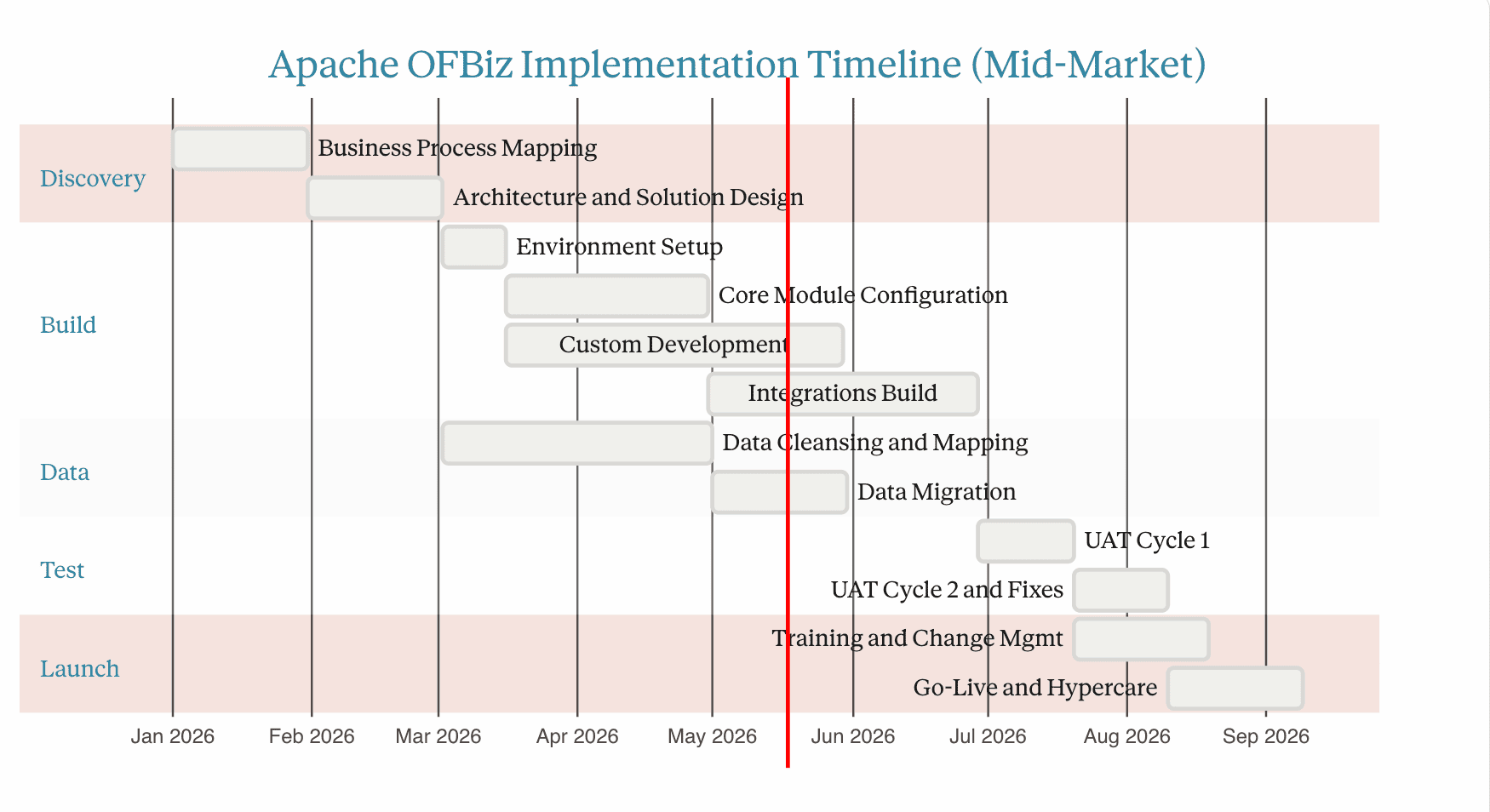
Compressing this timeline below six months is technically possible but usually expensive, because the only way to compress an OFBiz implementation is to throw more developers at it. The cost per month rises faster than the time saved. Stretching it beyond fifteen months usually signals scope creep, weak governance, or a partner who is learning OFBiz on your budget.
Infrastructure and Cloud Hosting Costs
Infrastructure is where many businesses get surprised. OFBiz can run on a single server for a small deployment, but production-grade infrastructure for a mid-market or enterprise rollout requires careful sizing across application servers, database servers, load balancers, backup systems, monitoring, and security tooling. The 2026 hosting landscape gives buyers three viable choices, each with different cost dynamics.
| Hosting Model | Monthly Cost Range | Best Fit | Trade-off |
|---|---|---|---|
| Self-Hosted On-Premise | $500 to $4,000 (amortized) | Strict data sovereignty needs | High capex, requires internal infra team |
| Public Cloud (AWS, Azure, GCP) | $800 to $6,500 | Most mid-market and enterprise deployments | Variable costs, needs cloud expertise |
| Managed Cloud by Implementation Partner | $1,500 to $8,000 | Businesses without internal devops | Premium pricing, fastest to operate |
Cloud hosting has become the default choice for most OFBiz projects in 2026 because it eliminates capex, scales elastically with business growth, and integrates naturally with modern observability tools. A common mistake is to under-size the database tier in year one and pay for it in year two when transaction volumes grow. Sizing for two-year projected growth at the start typically saves more than it costs.
The Hidden Costs Most CFOs Miss
The seven cost categories above are the visible ones. There are another four that almost never appear in vendor proposals but quietly consume budget through the project. The first is talent scarcity. OFBiz developers are not as common as Java or Python developers in general, and good OFBiz architects with five plus years of real implementation experience command premium rates. Hiring internally for OFBiz expertise is harder than it looks. The second hidden cost is integration debt. OFBiz exposes a robust service framework, but most modern SaaS tools, marketplaces, and payment gateways expect REST or GraphQL APIs with modern authentication patterns. Building and maintaining these integration layers becomes a continuous cost rather than a one-time investment. The third is performance optimization. OFBiz works well out of the box for moderate volumes, but at high transaction loads it requires careful tuning of the entity engine, caching layers, and database indexes. This work rarely shows up in initial estimates. The fourth is security hardening. Apache OFBiz is secure by design, but production deployments need additional layers including secure session management, audit logging, role-based access tuning, encryption at rest, and compliance configurations specific to industries like healthcare or financial services. A thoughtful comparison of these trade-offs against proprietary alternatives is covered in our analysis of open-source ERP migration strategy.
AI Customization Cost: The New 2026 Variable
The biggest change in OFBiz cost calculations between 2023 and 2026 is the addition of AI customization as a core line item. Businesses are no longer implementing OFBiz as a static system of record. They are layering AI agents, predictive analytics, intelligent automation, and document processing capabilities on top of it. This adds a new cost dimension that did not exist three years ago. The components of AI customization cost include agent development, integration with large language model APIs, vector database infrastructure, prompt engineering and evaluation, and ongoing inference costs that scale with usage.
| AI Customization Component | Typical Cost (USD) | Notes |
|---|---|---|
| Agent Design and Development | $15K to $120K | Per agent, depending on complexity |
| LLM API Costs (annual) | $3K to $50K | Scales with transaction volume |
| Vector Database and Embeddings | $2K to $20K per year | For semantic search and retrieval |
| Document Processing and OCR | $8K to $40K | One-time build plus per-page inference |
| Evaluation and Monitoring Setup | $5K to $25K | Required for production-grade AI |
For businesses that want a structured view of how AI agents integrate into open-source ERP architecture, our breakdown on AI-driven ERP systems maps the architectural pattern in detail.
Maintenance and Upgrade Complexity
Ongoing maintenance for OFBiz typically runs at 15 to 25 percent of the original implementation cost per year, but this number masks important nuance. Routine maintenance like patching, monitoring, and minor bug fixes sits at the lower end of the range. The expensive part is major version upgrades. OFBiz major upgrades involve significant changes to entity definitions, service signatures, and UI frameworks, and businesses with heavy customizations often find that upgrades require what is effectively a mini reimplementation of their custom code. The smart approach is to keep customizations modular and well documented from day one, which reduces upgrade pain dramatically. Businesses that try to fork OFBiz heavily and skip upgrades for three or four years usually end up with a system that costs more to upgrade than it originally cost to implement. The same architectural discipline applies to its sister framework Moqui, which is why our Moqui ERP development and consultancy practice focuses heavily on upgrade-safe customization patterns from the beginning.
Five-Year Total Cost of Ownership Comparison
License savings only matter if the total cost over the lifecycle of the system genuinely beats the alternatives. The chart below shows a realistic five-year TCO comparison for a mid-market business with around 100 users.
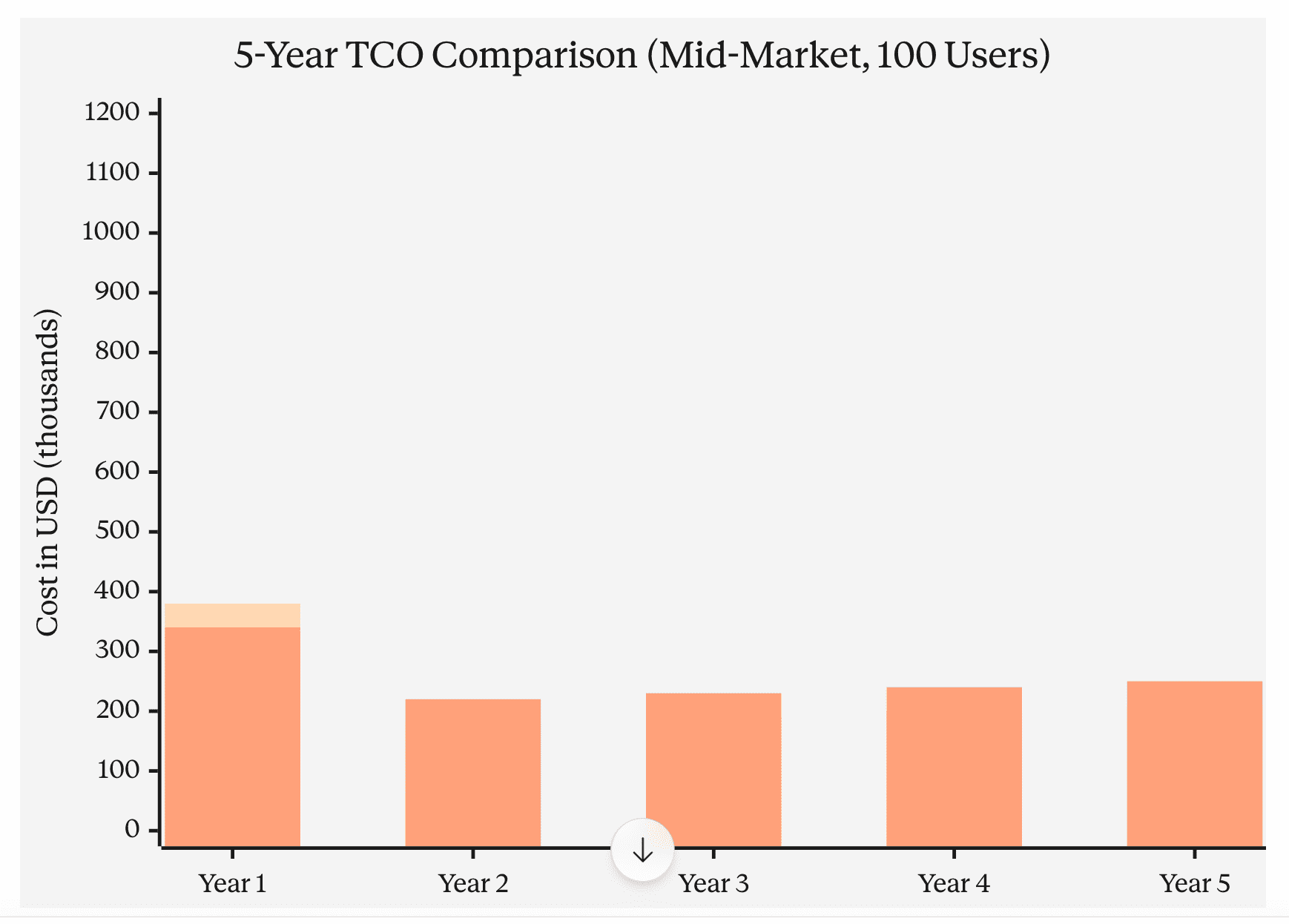
The cumulative numbers tell the real story. Over five years, an Apache OFBiz mid-market deployment typically lands between $500K and $700K total cost of ownership. The same scope on SAP Business One runs $1.1M to $1.3M, and Oracle NetSuite typically lands at $1.2M to $1.4M. The OFBiz advantage compounds in the later years because there are no annual license renewals consuming budget. The trade-off is that the upfront investment in OFBiz is heavier in implementation services, which can stretch the payback period if the business does not have the operational maturity to absorb the change.
When OFBiz Makes Financial Sense and When It Does Not
Apache OFBiz is not the right answer for every business. The decision should be based on operational fit rather than license savings alone. The table below summarizes when the math genuinely works in favor of OFBiz and when it does not.
| Scenario | OFBiz Fit |
|---|---|
| Business needs deep customization beyond what SaaS allows | Strong fit |
| Business has 50 plus users and growing | Strong fit |
| Business operates across multiple countries or entities | Strong fit |
| Business wants to avoid vendor lock-in and licensing escalations | Strong fit |
| Business is small with simple needs and limited technical capacity | Weak fit |
| Business needs to go live in under 90 days | Weak fit |
| Business has zero internal technical leadership | Weak fit |
| Business is in a highly regulated vertical needing certified ERP | Mixed fit, depends on partner |
The strongest signal for OFBiz is the combination of operational complexity, customization needs, and a multi-year horizon. If all three are present, the TCO math favors OFBiz decisively. If any of the three is missing, the business should look harder at SaaS alternatives or consider custom ERP development solutions built on a more modern open-source foundation like Moqui.
How to Reduce OFBiz Implementation Cost Without Cutting Corners
There are five practical levers that consistently reduce OFBiz implementation cost without compromising quality. The first is scope discipline. Define a clear phase one that covers only the modules and integrations that deliver immediate operational value, and defer everything else to phase two. The second is reusing community modules and plugins from the OFBiz ecosystem rather than building everything from scratch. The third is choosing a partner with genuine OFBiz depth rather than one that is learning on your project, which sounds obvious but is the single biggest cost driver in failed implementations. The fourth is investing properly in data migration upfront. Clean data shortens UAT cycles dramatically and reduces post-go-live support costs. The fifth is treating the architecture as a long-term asset rather than a one-time delivery. Customizations should be designed to survive upgrades, which keeps the maintenance cost curve flat instead of climbing. For organizations that want a deeper architectural perspective on this approach, our work on the Moqui ERP foundation describes the same principles applied to a more modern open-source framework that shares many of OFBiz's commercial advantages.
The Future Outlook for OFBiz Costs
Two trends will shape OFBiz implementation cost over the next three years. The first is the maturing AI tooling ecosystem. As LLM costs continue to fall and agent frameworks become more standardized, the cost of adding AI capabilities to OFBiz will drop significantly. What costs $80K in agent development today will likely cost $30K to $40K by 2028. The second trend is cloud-native deployment patterns. The OFBiz community is steadily improving Kubernetes-native deployment options, which will reduce infrastructure cost and complexity. Together, these trends mean that the total cost of running OFBiz at scale will continue to fall relative to proprietary alternatives, which is good news for businesses planning multi-year horizons. The bigger strategic question is no longer whether OFBiz is cheaper than SAP. The strategic question is whether your ERP can keep pace with the operational intelligence your business needs over the next decade, and on that dimension, open-source platforms are pulling ahead. To explore how this fits into a broader modernization roadmap, our overview of the Next-Gen ERP platform shows how OFBiz, Moqui, and AI orchestration come together as a unified open-source foundation, with deeper framework details available at Apache OFBiz and Moqui.org.