Introduction: From Static Workflows to Autonomous Operations
Traditional ERP workflows are predefined, rule-based, and heavily dependent on manual intervention, which makes them slow to adapt when business conditions change. As organizations scale across multiple channels, warehouses, and production units, these static workflows start creating bottlenecks instead of efficiency. This is where autonomous ERP workflows come into play, combining the flexibility of modern ERP platforms with AI agents that can make decisions, trigger actions, and continuously optimize operations without human dependency.
What Are Autonomous ERP Workflows
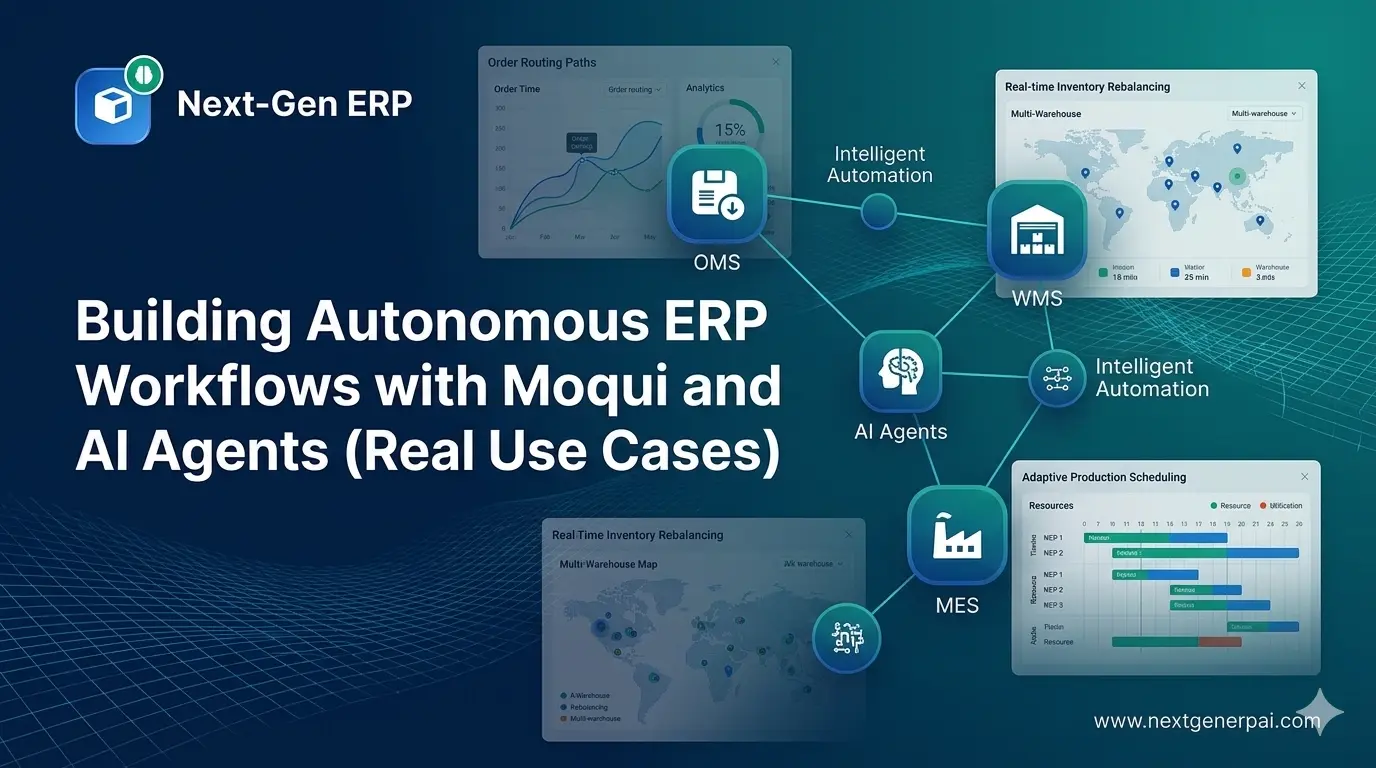
Autonomous ERP workflows are self-optimizing business processes where AI agents monitor data, make decisions, and execute actions across systems like OMS, WMS, and MES. Instead of relying on fixed logic, these workflows evolve based on real-time inputs such as demand fluctuations, inventory levels, or production delays. This aligns with the philosophy of modern ERP systems that prioritize flexibility, intelligent automation, and open architecture .
Why Moqui Is Ideal for Autonomous Execution
Moqui is not just an ERP framework, it is an execution engine designed for service-based and event-driven architectures. This makes it the perfect foundation for running AI-powered workflows in real time.
Key capabilities that enable autonomy:
- Service orchestration that allows AI agents to trigger business actions
- Event-driven architecture for real-time responsiveness
- Flexible data model for evolving workflows
- Native integration across OMS, WMS, and manufacturing systems
Businesses adopting Moqui ERP development and consultancy can move beyond static automation and build systems where AI actively drives operations instead of just supporting them.
Real Use Case 1: Order Routing Automation
In a traditional setup, order routing is handled by predefined rules such as nearest warehouse or fixed priority locations. However, this approach fails when real-world variables change rapidly.
With autonomous workflows:
- AI agents evaluate inventory availability across locations
- They consider delivery timelines, shipping costs, and warehouse workload
- Orders are dynamically routed to the most optimal fulfillment center
For example, a multi-warehouse e-commerce company using a modern order management system can automatically reroute orders during peak demand or disruptions. This creates a system of autonomous order management where decisions are continuously optimized based on real-time data instead of static rules.
To understand this transformation deeper, explore how AI agents in ERP are reshaping order workflows.
Real Use Case 2: Inventory Rebalancing Across Warehouses
Inventory imbalance is one of the biggest inefficiencies in distributed supply chains. Some warehouses face stockouts while others hold excess inventory. Manual rebalancing is slow and reactive.
Autonomous ERP workflows solve this by:
- Monitoring stock levels across all warehouses in real time
- Predicting demand shifts using historical and live data
- Automatically triggering stock transfers between locations
An organization using AI-powered warehouse management systems can ensure optimal stock distribution without manual planning. These systems evolve into autonomous warehouse management, where AI continuously balances inventory across the network.
This concept is further explored in autonomous warehouse management, where AI-driven decisions replace manual inventory planning.
Real Use Case 3: Production Scheduling in Manufacturing
Manufacturing environments are highly dynamic with constant changes in demand, machine availability, and raw material supply. Traditional scheduling systems cannot adapt fast enough.
With AI-powered ERP workflows:
- Production schedules are adjusted in real time
- AI agents detect machine downtime and reroute workloads
- Material shortages trigger alternative sourcing or schedule adjustments
A manufacturing company using custom ERP development solutions can build a system where production planning becomes adaptive rather than fixed. This leads to better resource utilization, reduced downtime, and improved delivery commitments.
These capabilities are part of a broader ERP architecture with AI agents where decision-making is distributed across intelligent agents instead of centralized logic.
How AI Agents Work Inside ERP Architecture
AI agents operate as decision-making layers on top of ERP services. Instead of replacing ERP systems, they enhance them by:
- Observing events such as new orders, stock changes, or production updates
- Analyzing patterns and predicting outcomes
- Triggering actions through ERP services
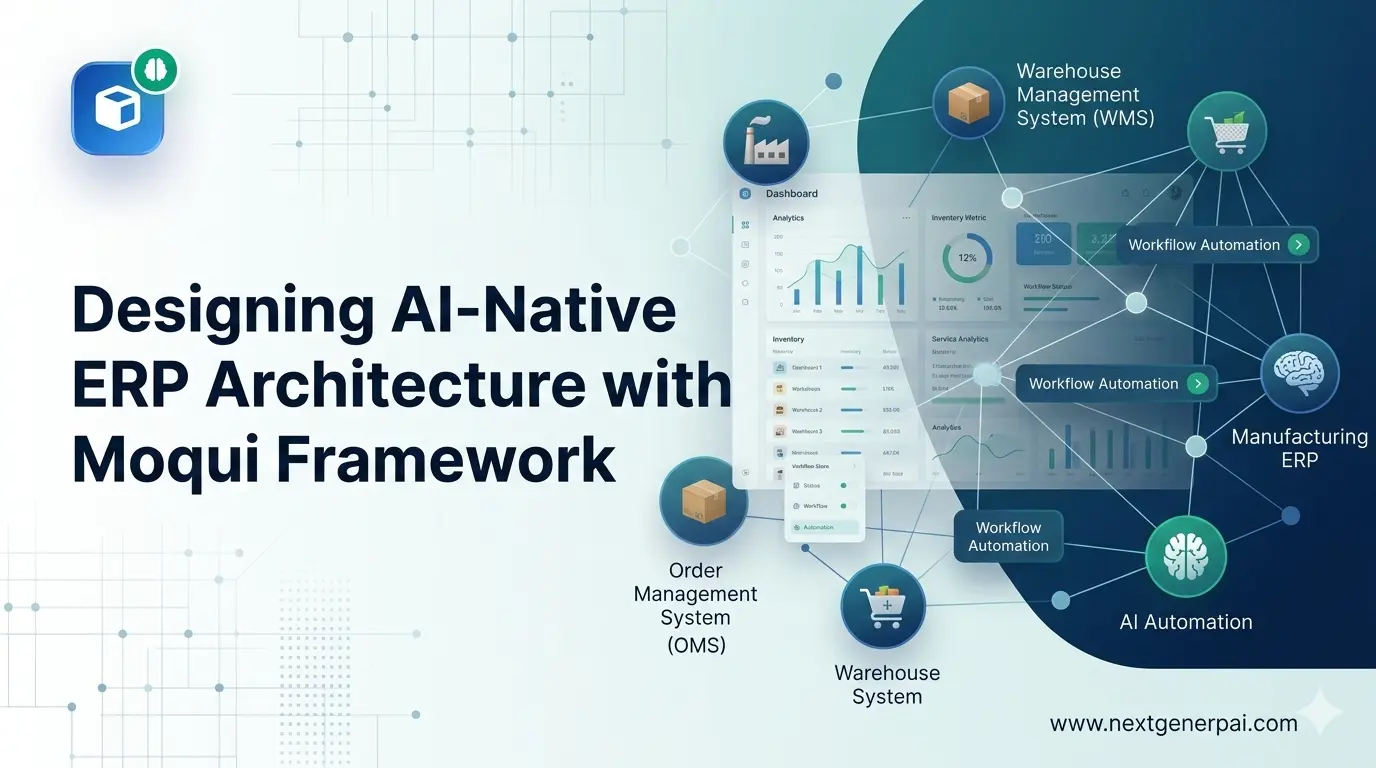
In a well-designed Next-Gen ERP architecture, AI agents interact seamlessly with OMS, WMS, and MES systems to create end-to-end autonomous workflows. This approach also supports ERP migration to open-source platforms, enabling businesses to modernize legacy systems into AI-ready environments.
Business Benefits of Autonomous ERP Workflows
Organizations implementing autonomous workflows see measurable improvements across operations:
- Faster decision-making with real-time execution
- Reduced manual intervention and operational overhead
- Improved accuracy in order fulfillment and inventory planning
- Increased scalability without increasing complexity
- Better responsiveness to market changes
These benefits align with the core idea of AI-driven ERP systems, where automation is not just about efficiency but about enabling smarter operations.
Future Outlook: ERP Systems That Run Themselves
The future of ERP is moving toward systems that are not only automated but self-optimizing. As AI agents become more sophisticated, ERP workflows will transition from reactive to predictive and eventually autonomous.
Businesses that invest early in open, flexible platforms like Moqui will be able to adopt these capabilities faster. With the right architecture, ERP systems will evolve into intelligent ecosystems where operations run continuously with minimal human intervention.
Conclusion
Autonomous ERP workflows are no longer a theoretical concept, they are already transforming how businesses operate across order management, warehousing, and manufacturing. By combining Moqui’s execution capabilities with AI agents, organizations can build systems that adapt, optimize, and act in real time. The shift is clear: ERP is no longer just a system of record, it is becoming a system of action.