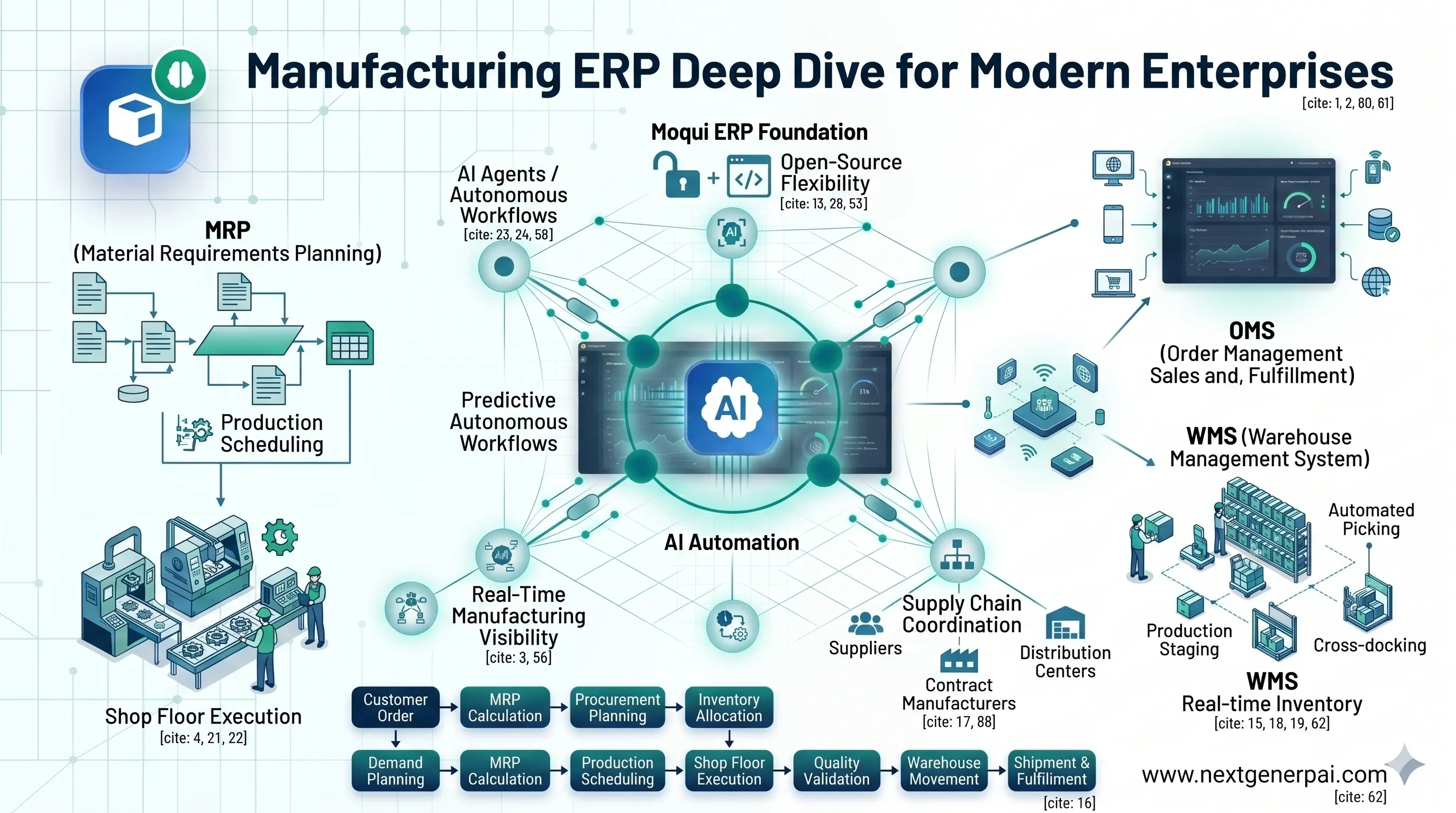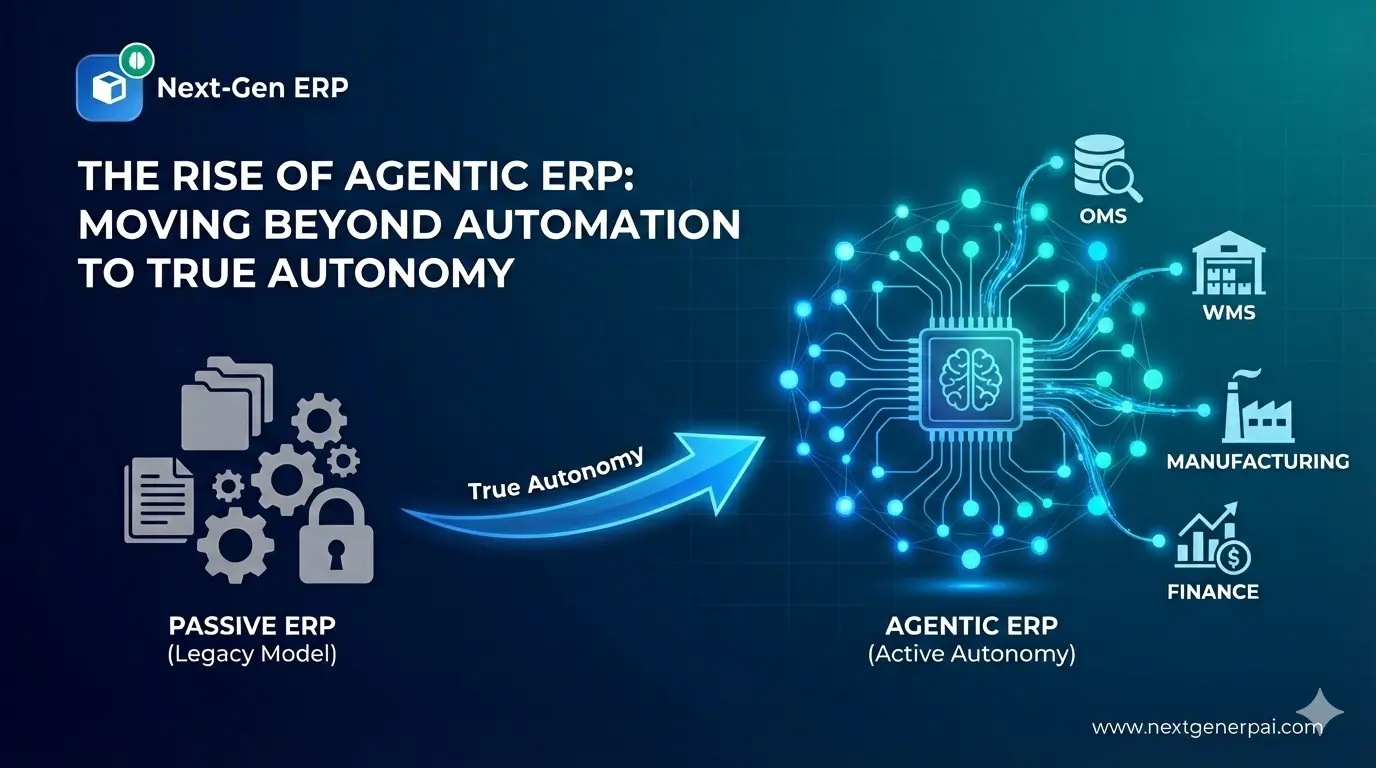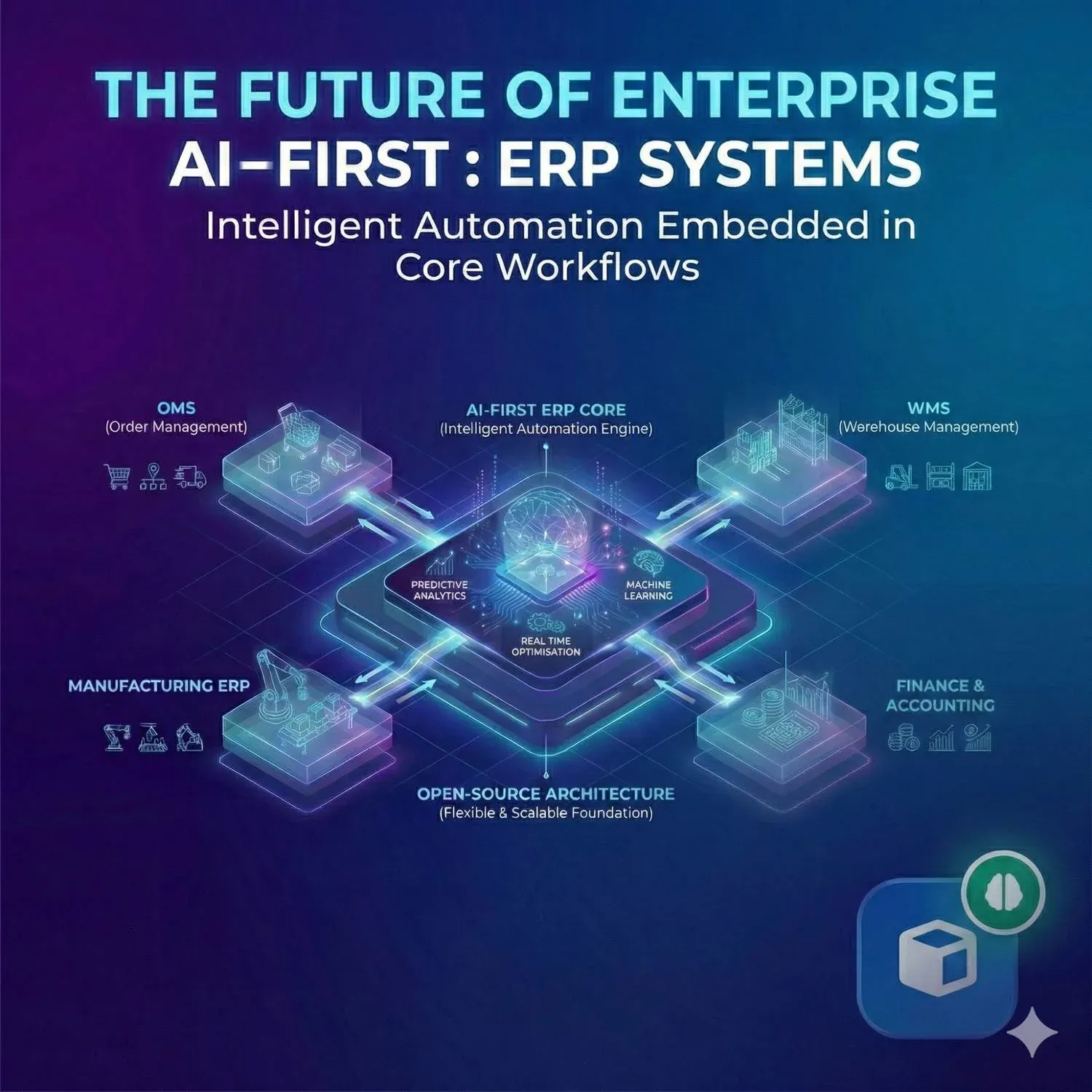
Walk into any modern factory and you will see a contradiction. The machines on the shop floor are intelligent, the sensors generate data every few seconds, the warehouse robots move on their own, and yet the ERP system sitting at the center of all this activity often behaves like it did fifteen years ago. It waits for someone to click a button. It runs MRP overnight in a batch. It expects a planner to manually approve a purchase order. It treats every event as a database update rather than an operational signal. This is the gap that AI agents are now closing inside manufacturing ERP. They are turning the ERP from a passive system of record into an active operational engine that watches, decides, and acts in real time. This blog walks through what these agents actually do on the shop floor, how they reshape production planning, inventory, procurement, and warehouse coordination, and why the architecture underneath matters more than the AI itself.
What AI Agents Actually Do Inside Manufacturing ERP
An AI agent inside ERP is not a chatbot bolted on top of the system. It is an autonomous software entity that lives inside the ERP workflow layer, has access to live operational data, understands the rules of the business, and is empowered to take action when conditions demand it. Where a traditional ERP workflow waits for a human to trigger the next step, an AI agent monitors events continuously, evaluates context across multiple data points, makes a decision based on the operational reality of that moment, and executes the workflow without waiting for instruction. The agent does not replace the human. It replaces the latency between the event and the response. In a manufacturing environment where minutes of delay translate directly into machine downtime, missed shipments, or inventory imbalances, that shift from reactive to autonomous execution is the difference between a factory that runs and a factory that constantly firefights. Our work on AI-driven ERP systems is built around exactly this principle.
Why Traditional Manufacturing Workflows Break Down
The old ERP playbook was designed for a world where production volumes were predictable, supply chains were stable, and customer demand moved in seasonal cycles rather than daily spikes. That world no longer exists. Modern manufacturing has to handle marketplace orders, B2B contracts, direct consumer demand, custom configurations, multi-location production, and supplier volatility, all at the same time. Traditional workflows simply cannot absorb that complexity. The table below shows where the cracks appear most clearly.
| Operational Dimension | Traditional ERP Workflow | AI Agent Driven Workflow |
|---|---|---|
| Decision trigger | Manual approval or scheduled batch | Live event detection |
| Planning frequency | Daily or weekly MRP runs | Continuous re-planning |
| Exception handling | Escalated to planner | Resolved autonomously where possible |
| Inventory visibility | Updated after transactions post | Real-time across all locations |
| Procurement logic | Static reorder points | Context-aware sourcing decisions |
| Shop floor response | Reactive to reported issues | Predictive based on telemetry |
| Cross-factory coordination | Manual spreadsheets and emails | Automated rebalancing across nodes |
| Quality control | Inspection after the fact | Predictive defect avoidance |
The pattern is consistent. Traditional ERP workflows are built around the assumption that humans will be in the loop for every decision. AI agent workflows assume humans should be in the loop only for decisions that genuinely require human judgment.
The Architecture Behind AI Agent Driven ERP
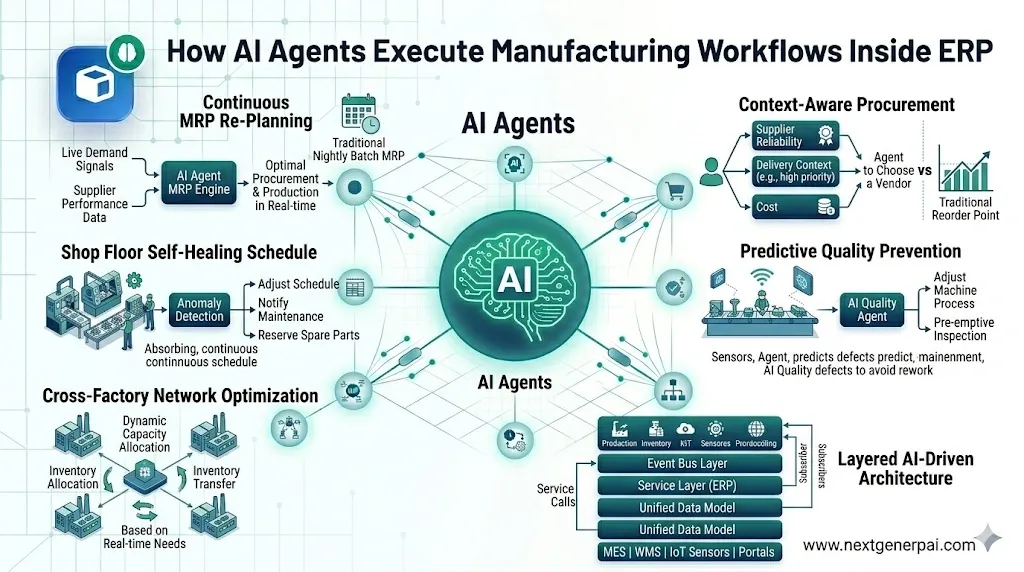
Before looking at specific workflows, it helps to understand how AI agents are wired into a modern ERP. The architecture is layered rather than monolithic, and each layer has a clear responsibility. The data layer holds the operational truth. The service layer exposes business logic as callable services. The event layer broadcasts changes the moment they happen. The agent layer subscribes to those events, applies intelligence, and triggers the right services. The integration layer connects upstream and downstream systems including MES, WMS, OMS, and supplier portals.
┌───────────────────────────┐
   │                    AI Agent Layer                                                          |
   │  Production │ Inventory │ Procurement │ Quality │ Warehouse  │
  └──────┬────────────────────┘
                           │ subscribes to events, calls services
┌──────▼─────────────────────┐
 │                    Event Bus Layer                                                           │
 │   Order Events │ Stock Events │ Machine Events │ Supplier         │
└──────┬─────────────────────┘
                           │ publishes events on every state change
┌──────▼─────────────────────┐
 │                   Service Layer (ERP)                                                     │
 │  Order │ Inventory │ Production │ Procurement │ Finance             │
└──────┬─────────────────────┘
                           │ reads and writes
┌──────▼─────────────────────┐
 │                   Unified Data Model                                                      │
 │   Single source of truth across OMS, WMS, MES, Finance        │
└────────────────────────────┘
                          ▲
                           │ integrates with
┌──────┴─────────────────────┐
 │   MES │ WMS │ IoT Sensors │ Supplier Portals │ Marketplaces      │
└────────────────────────────┘
This is the architectural pattern we use across our ERP architecture with AI agents implementations, and it is the reason agents can act in real time without breaking the financial integrity of the underlying ERP.
Production Scheduling Agents
Production scheduling is where AI agents deliver some of the most visible operational wins. A traditional ERP scheduler generates a plan based on the data available at the moment the plan is run, and then waits for someone to revise it when reality drifts. An AI scheduling agent treats the plan as a living document. It watches for changes in machine status, material arrivals, labor availability, customer priority shifts, and quality holds, and it adjusts the sequence continuously. The flow below shows what happens the moment a new sales order lands in a factory running an AI-driven schedule.
Production Scheduling Agent Workflow
- Sales order lands in the system
- Scheduling agent reads order context
- Agent evaluates three live inputs in parallel:
- Machine availability and current load
- Raw material availability
- Labor and shift plan
- Agent optimizes production sequence across work centers
- Work orders are created and raw materials reserved
- Instructions pushed to shop floor and warehouse agent notified
The result is a schedule that absorbs disruption instead of breaking under it.
Material Requirements Planning Agents
MRP is the classic ERP workflow that has remained largely unchanged for decades. The math behind it is simple. The execution has always been the problem. Net material requirement equals forecasted demand plus safety stock minus current inventory minus open purchase orders. In a traditional ERP, that calculation runs in a scheduled batch and produces a list of recommendations that a planner reviews. In an AI agent driven ERP, the same calculation runs continuously against live data, and the agent acts on shifts in any variable the moment they happen. If a supplier delays a shipment, the agent recalculates lead time risk. If demand spikes on a marketplace channel, the agent revises forecasted demand. If a quality hold reduces usable inventory, the agent triggers replenishment. The planner is no longer the engine of MRP. The planner becomes the supervisor of an engine that runs itself.
| MRP Behavior | Traditional ERP | AI Agent ERP |
|---|---|---|
| Calculation cycle | Nightly batch | Continuous, event-triggered |
| Demand input | Static forecast | Live demand signals across channels |
| Supplier lead time | Fixed value in vendor master | Dynamic value adjusted by performance |
| Action on shortage | Generates report for planner | Generates and executes purchase workflow |
| Multi-location netting | Manual aggregation | Automatic across all nodes |
| Exception flagging | End of cycle | Real time |
Inventory Optimization Agents
Inventory is where most manufacturing money quietly leaks out. Too much stock ties up working capital. Too little stock halts production. Across multiple warehouses and factories, the balance becomes nearly impossible to manage manually. Inventory optimization agents work on the principle of continuous rebalancing. They watch consumption patterns, monitor incoming receipts, track production demand, and identify imbalances across locations. When one factory is running short on a raw material and another factory has surplus, the agent does not wait for someone to notice. It initiates the transfer, updates the warehouse system, and adjusts the procurement plan accordingly. This is where the agent layer connects directly into our autonomous warehouse management capabilities and our broader AI-powered warehouse management systems.
Shop Floor Execution Agents
The shop floor is where ERP and reality have historically diverged the most. The ERP says one thing. The actual production status says another. Shop floor agents close that gap by ingesting telemetry from machines, sensors, and operator inputs in real time. They watch for downtime patterns, throughput drops, quality drift, and capacity bottlenecks, and they take action before the issue becomes a production stoppage. The diagram below shows the typical shop floor response loop.
The shop floor stops being a black box. It becomes a continuously observed and continuously corrected operational layer.
Procurement Automation Agents
Procurement workflows used to be dominated by reorder points and fixed vendor master data. AI procurement agents change the logic entirely. They evaluate supplier performance over time, factor in delivery reliability, compare cost against risk, and make sourcing decisions that account for operational context rather than just price. A cheaper supplier with a history of late deliveries is no longer automatically chosen during a high-priority production run. The agent recognizes the pattern and selects a more reliable vendor even at a slightly higher cost, because the cost of disrupting production is far greater than the price difference. Over time, these agents also feed performance data back into vendor scorecards, creating a continuous improvement loop in supplier management.
Quality Control Agents
Quality has shifted from inspection to prediction. Traditional quality workflows test the output and reject what fails. AI quality agents analyze process data, supplier material variability, machine performance trends, and historical defect patterns to predict where defects are likely to occur, and they intervene before the defective output is produced. The agent might trigger an inspection earlier in the production run, flag a raw material batch as high risk, or recommend a process adjustment to a specific machine. This shifts the cost of quality from rework and waste to prevention, which is the more efficient end of the spectrum.
Warehouse Execution Agents
The warehouse is the operational partner of the factory, and AI warehouse agents make sure the two stay synchronized. These agents coordinate material staging based on the production schedule, optimize picking routes for high-priority work orders, manage bin allocation as production consumes raw materials, and prioritize shipments based on customer commitments. When the production schedule changes, the warehouse plan changes with it, automatically. There is no morning meeting to align the two teams because the systems already agreed during the night.
Event-Driven Architecture Is the Real Enabler
None of this works without an event-driven ERP foundation. Traditional ERPs are built around scheduled jobs and request-response interactions. AI agents need events. They need to know the instant inventory drops below threshold, the moment a machine reports an anomaly, the second a high-value order is placed. The flow below shows how a single event ripples through an agent-driven ERP in real time.
One event. Multiple agents acting in parallel. A single coherent update across the entire operational picture. That is the architectural shift that makes AI in ERP genuinely useful instead of cosmetic.
Where AI Agents Sit Between ERP and MES
A common question from manufacturing leaders is how AI agents relate to the Manufacturing Execution System. The MES handles real-time shop floor execution. The ERP handles planning, finance, and enterprise-wide visibility. AI agents act as the intelligent bridge between the two, translating ERP plans into MES instructions and translating MES events back into ERP state changes. The agent layer keeps the two systems synchronized continuously, so that planning and execution never drift apart.
| Layer | Primary Role | Time Horizon | Data Type |
|---|---|---|---|
| ERP | Planning, finance, enterprise visibility | Hours to months | Structured business data |
| AI Agent Layer | Intelligent decisioning and orchestration | Seconds to minutes | Combined operational and business data |
| MES | Real-time shop floor execution | Seconds | Machine and operator data |
Multi-Factory Coordination
For manufacturers operating across multiple plants, AI agents unlock a level of coordination that was previously impractical. When one factory experiences a machine breakdown, the production agent can evaluate capacity across other facilities, identify the best alternative location, transfer the work order, coordinate the raw material movement, and update customer delivery commitments, all within the same workflow execution. The factories no longer operate as independent islands coordinated by manual escalation. They operate as a connected network with intelligence flowing across them.
Why Open Architecture Is Non-Negotiable
AI agents cannot thrive on a closed, rigid ERP platform. They need access to data, the ability to subscribe to events, freedom to extend workflows, and integration points with external systems. Proprietary ERP suites often restrict these capabilities, which is why many manufacturers move to open-source foundations as part of their modernization. This is a major driver behind ERP migration to open-source platforms, and it is why our implementation work is grounded in the Moqui ERP foundation. For those who want to dig deeper into the underlying frameworks, the official documentation at Moqui.org and Apache OFBiz provides a clear view of the architectural openness these platforms offer.
| Capability Needed for AI Agents | Closed ERP | Open-Source ERP |
|---|---|---|
| Workflow customization | Limited | Full |
| Event subscription | Often restricted | Native |
| Service extensibility | Vendor-controlled | Developer-controlled |
| Real-time integration | Limited APIs | Extensive APIs and event hooks |
| Cost of AI feature addition | High licensing fees | Low marginal cost |
| Long-term flexibility | Vendor roadmap dependent | Self-directed evolution |
Three Real Workflows in Action
The most useful way to understand what AI agents do is to see them in motion. The first is intelligent production rebalancing. A retailer pushes an urgent promotional campaign, demand for a specific SKU spikes overnight, and the production agent detects the shortage by morning. Without waiting for a planning meeting, the agent evaluates factory capacity, checks raw material availability, adjusts the production schedule across two facilities, triggers a procurement order for the long-lead component, and notifies the warehouse to prepare for the new shipment pattern. The second is predictive maintenance. A vibration sensor on a critical machine starts trending upward over twelve hours. The shop floor agent recognizes the pattern from historical failure signatures, creates a maintenance work order, reschedules production around the maintenance window, and alerts the spare parts warehouse to stage the replacement component. A failure that would have caused twelve hours of unplanned downtime becomes a forty-five minute scheduled intervention. The third is autonomous warehouse replenishment. Production consumption of a key raw material exceeds the forecast for the day. The warehouse agent identifies the nearest source of inventory, creates the transfer order, optimizes the picking route, updates the production schedule to reflect the new material arrival time, and adjusts the customer delivery promise where necessary. None of this requires a human decision unless the agent encounters an exception that genuinely needs judgment.
The Future of AI Agents Inside ERP
The trajectory is clear. AI agents inside ERP will continue to take on more operational responsibility over the next several years. Production workflows will become self-healing, recovering from disruptions without manual intervention. Supply chains will become genuinely adaptive, with agents negotiating with supplier systems in real time. Digital twins of factories will allow agents to simulate decisions before executing them. Quality control will become predictive across entire product lines. Warehouse operations will self-optimize based on rolling demand patterns. The role of the planner, the buyer, and the operations manager will shift from executing workflows to designing the policies that agents follow. The ERP will stop being a system that records what happened and start being a system that shapes what happens next.
What This Means for Manufacturing Leaders
Manufacturing complexity is not going to slow down. Supply chains will remain volatile, customer expectations will continue to rise, and labor availability will remain constrained. The manufacturers who win the next decade will not be the ones with the largest ERP implementations. They will be the ones whose ERP systems can think, decide, and act at the speed of the operations they support. That requires three things working together: an open architecture that allows intelligence to be embedded anywhere, an event-driven foundation that lets agents respond in real time, and a clear operational strategy that defines what the agents should optimize for. This is the foundation we help clients build through custom ERP development solutions and the unified Next-Gen ERP that brings AI agents, OMS, WMS, and MES into a single coherent operational platform.