Introduction
Most ERP discussions stop at automation, integrations, and dashboards, but the real shift is happening deeper in the stack. Businesses today do not just need systems that track operations, they need systems that execute decisions in real time. This is where Moqui ERP evolves from being a backend framework into an AI execution engine. Instead of simply orchestrating workflows, it becomes the layer where intelligence actively runs business operations. As explained in the foundation of Next-Gen ERP, modern systems are built around automation, flexibility, and real-time intelligence, and Moqui sits exactly at that execution core.
What It Means to Be an AI Execution Engine
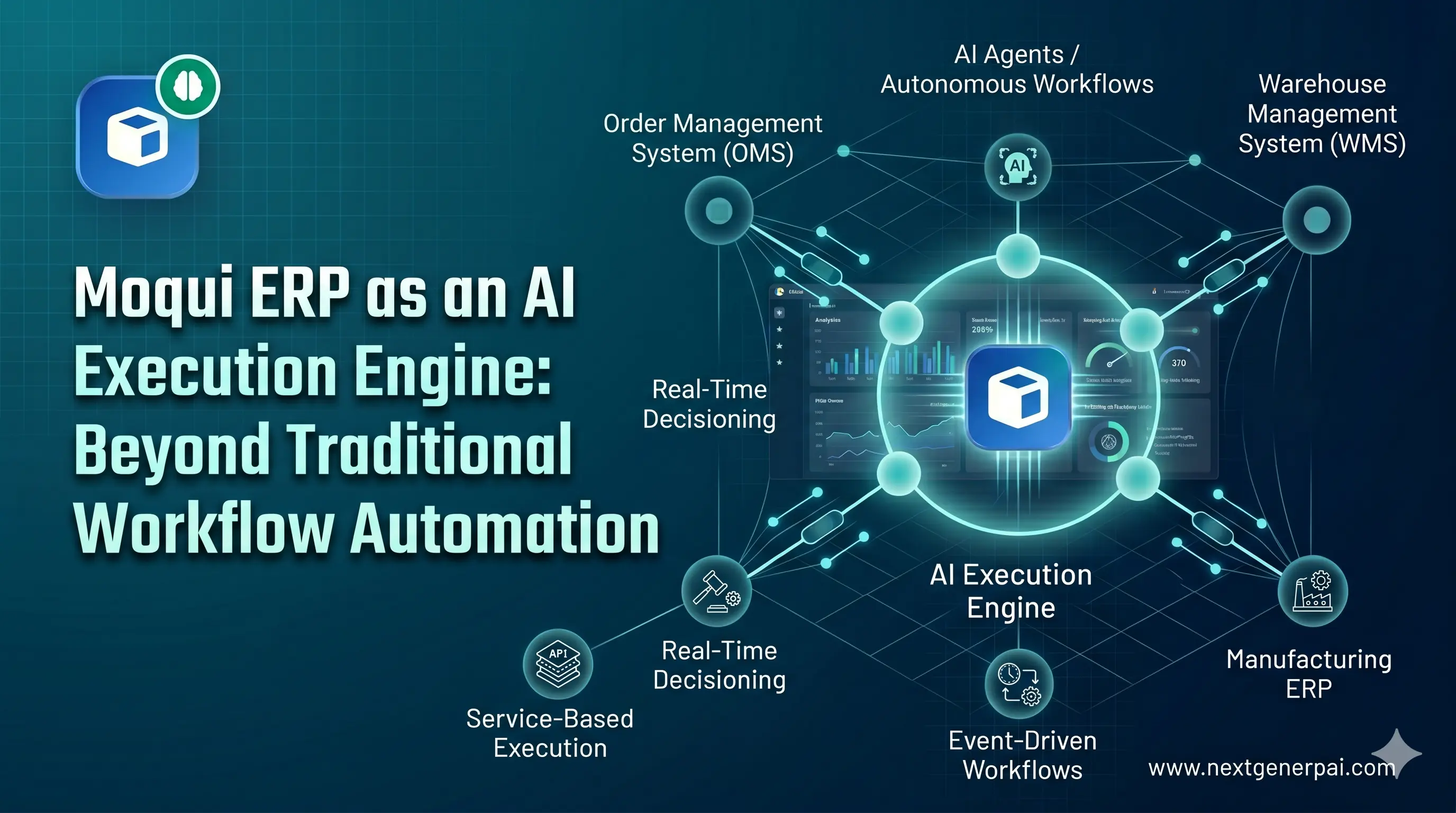
An AI execution engine is not just a system that connects AI models to ERP data. It is a runtime environment where decisions, actions, and workflows are continuously executed based on real-time signals. In this model, ERP is no longer passive infrastructure, it becomes an active participant in operations.
With a strong Next-Gen ERP architecture, Moqui enables:
- Real-time decision execution instead of batch processing
- Continuous workflow adaptation based on data signals
- Direct integration of AI agents into business processes
This shifts ERP from “system of record” to “system of action.”
Service-Based Execution in Moqui
At the heart of Moqui ERP is its service-oriented architecture. Every business function, whether it is order validation, inventory allocation, or payment processing, is exposed as a service. This design is critical for AI-driven execution.
Why Service-Based Architecture Matters
- Each service is independently callable by AI agents
- Business logic is modular and reusable
- Execution can be triggered dynamically without UI interaction
For example, in a modern order management system, an AI agent can:
- Trigger order risk validation service
- Call pricing optimization service
- Execute fulfillment routing service
All of this happens in real time without manual intervention.
This is where Moqui ERP development and consultancy becomes essential, because designing services correctly determines how effectively AI can execute operations.
Event-Driven Workflows: Moving Beyond Static Processes
Traditional ERP workflows are linear and predefined. Moqui introduces an event-driven model where workflows react to real-time triggers.
How Event-Driven Execution Works
- Events such as order creation, inventory changes, or shipment delays trigger workflows
- AI agents subscribe to these events and take actions
- Workflows are dynamically adjusted based on context
For example:
- A delayed shipment triggers an AI agent
- The agent evaluates alternative warehouses
- A new fulfillment plan is executed instantly
This aligns with the concept of AI agents in ERP, where agents are not just advisory but operational.
Real-Time Decisioning Inside ERP
The biggest limitation of traditional ERP is delayed decision-making. Reports are generated after the fact, and actions are taken manually. Moqui changes this by embedding decision logic directly into execution flows.
Key Capabilities
- Real-time data processing across OMS, WMS, and MES
- Immediate execution of decisions without human bottlenecks
- Continuous optimization based on live inputs
In an AI-powered warehouse management system, this enables:
- Dynamic inventory reallocation
- Automated replenishment triggers
- Real-time picking route optimization
This approach also connects deeply with autonomous warehouse management, where decisions are executed instantly at the operational level.
Moqui as the Execution Layer in AI-Driven ERP Architecture
In modern ERP architecture, different layers play different roles:
- Data layer stores transactional and historical data
- Intelligence layer (AI models) generates predictions
- Execution layer applies those decisions in real time
Moqui operates as the execution layer where:
- AI outputs are converted into actions
- Services are triggered dynamically
- Workflows are orchestrated based on events
This is why it is often considered the backbone of ERP architecture with AI agents.
For businesses planning an ERP migration to open-source platforms, this shift is critical because legacy systems cannot support this level of real-time execution.
Real-World Use Cases
Intelligent Order Fulfillment
An e-commerce company uses AI to predict delivery delays. Moqui executes:
- Warehouse reassignment
- Shipment rerouting
- Customer notification workflows
All in real time without manual intervention.
Autonomous Inventory Optimization
A manufacturing business integrates demand forecasting models. Moqui executes:
- Automatic purchase order generation
- Supplier selection
- Production schedule adjustments
Financial Decision Automation
AI detects anomalies in transactions. Moqui executes:
- Fraud checks
- Payment holds
- Escalation workflows
These use cases show how ERP evolves from tracking operations to running them.
Business Benefits
Faster Operational Execution
Decisions are executed instantly, reducing delays across order processing, inventory, and production.
Reduced Manual Dependency
AI agents handle repetitive and decision-heavy tasks, freeing teams for strategic work.
Scalable Architecture
With custom ERP development solutions, businesses can extend execution capabilities as they grow.
Lower Total Cost of Ownership
Open-source foundations like Moqui and Apache OFBiz reduce licensing costs while increasing flexibility.
The Future: ERP as a Continuous Execution System
The future of ERP is not about better dashboards or faster reports. It is about continuous execution. Systems will not wait for user input, they will act autonomously based on real-time data and AI insights.
Moqui ERP is already aligned with this direction. It is not just AI-ready, it is AI-operational. It provides the environment where intelligence is not just generated but executed at scale.
As businesses move toward fully autonomous operations, ERP systems that cannot execute decisions will become obsolete. The focus will shift to platforms that can run business logic dynamically, and Moqui stands at the center of that transformation.