Choosing the right ERP system is one of the most important technology decisions for any growing business. The ERP you choose will manage finance, inventory, order processing, manufacturing operations, and business workflows for years.
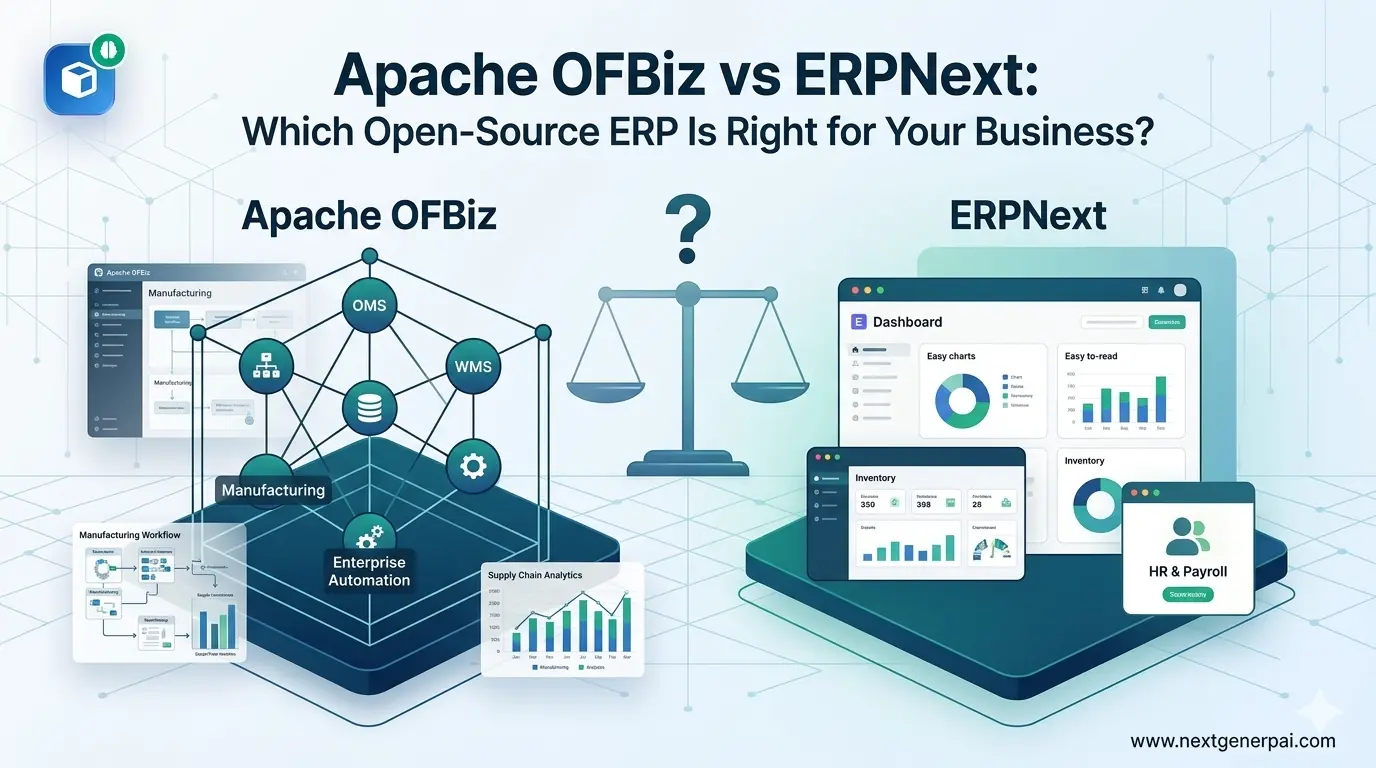
For companies exploring open-source ERP platforms, two names frequently appear in discussions: Apache OFBiz and ERPNext.
Both are powerful open-source ERP systems, but they are designed for different levels of customization, scalability, and enterprise needs.
This guide compares Apache OFBiz vs ERPNext to help business leaders, IT teams, and ERP consultants decide which platform fits their organization best.
If your company is planning to implement or modernize ERP, working with an experienced partner such as Next-Gen ERP can help ensure your system is built with scalability, automation, and future-ready architecture.
What Is Apache OFBiz?
Apache OFBiz is an open-source enterprise automation platform developed by the Apache Software Foundation. It provides a comprehensive set of ERP and business management tools along with a powerful development framework.
The system includes modules for:
- Accounting and financial management
- Order management
- Manufacturing management
- Inventory management
- Supply chain operations
- Customer relationship management (CRM)
What makes OFBiz unique is that it is not just an ERP application, but also a full enterprise application framework used to build custom business systems.
Organizations often use OFBiz as a foundation for building highly customized ERP solutions.
Companies that require advanced customization typically work with specialists offering Apache OFBiz development and consultancy.
You can explore the official platform here:
https://ofbiz.apache.org
What Is ERPNext?
ERPNext is a modern open-source ERP platform designed primarily for small and mid-sized businesses (SMEs).
It offers a wide range of built-in modules including:
- Accounting
- CRM
- Sales and purchasing
- Inventory management
- Manufacturing
- HR and payroll
- Project management
ERPNext is known for its user-friendly interface and fast implementation, making it attractive for businesses that want a working ERP quickly without heavy development.
Unlike OFBiz, ERPNext focuses more on out-of-the-box ERP functionality rather than serving as a development framework.
You can explore the official platform here: https://frappe.io/erpnext
Apache OFBiz vs ERPNext: Core Architecture
Understanding the architecture of these platforms helps explain their differences.
Apache OFBiz Architecture
Apache OFBiz uses a component-based architecture designed for large enterprise systems.
Key characteristics include:
- Service-oriented architecture
- Entity engine for database abstraction
- XML-based configuration
- Built-in workflow and service engine
- Highly extensible development framework
Because of this design, OFBiz is commonly used to build custom ERP solutions, OMS platforms, and supply chain systems.
Organizations implementing complex commerce or supply chain operations often integrate OFBiz with modern order management systems like those offered through Order Management System solutions.
ERPNext Architecture
ERPNext is built on the Frappe Framework, which uses Python and MariaDB.
Key architectural features include:
- Web-based application framework
- Python-based backend
- Simple module configuration
- Rapid deployment capabilities
- Built-in UI and workflow tools
ERPNext prioritizes ease of use and speed of deployment, which is why many SMEs adopt it quickly.
However, large enterprises sometimes find ERPNext less flexible when deep customization is required.
Customization and Flexibility
Customization is one of the biggest differences between these two ERP platforms.
Apache OFBiz Customization
OFBiz is designed for deep customization and enterprise-scale systems.
Capabilities include:
- Custom business workflows
- Complex integration architectures
- Custom modules and services
- Large-scale transaction processing
- Advanced commerce and supply chain systems
Companies with complex operational needs often build tailored systems using custom ERP development solutions on top of OFBiz.
OFBiz is especially powerful for:
- Manufacturing companies
- Large distribution networks
- Enterprise e-commerce platforms
- Multi-country operations
ERPNext Customization
ERPNext also supports customization but at a different scale.
Typical customization options include:
- Custom fields and forms
- Business workflows
- App-based extensions
- Scripting and automation
While ERPNext is flexible, large-scale enterprise customization often requires significant modification of the framework.
For smaller companies, however, this simplicity can be an advantage.
Implementation Complexity
ERP implementation time varies greatly between OFBiz and ERPNext.
Apache OFBiz Implementation
Because OFBiz is a development platform, implementations usually involve:
- Architecture design
- Custom module development
- Workflow configuration
- System integration
As a result, implementation may take longer but produces a highly tailored ERP environment.
Companies modernizing legacy systems frequently choose ERP migration to open-source platforms using OFBiz or Moqui frameworks.
ERPNext Implementation
ERPNext implementations are typically faster.
Many companies can deploy ERPNext within weeks because:
- Most modules are pre-built
- The system includes standard workflows
- Minimal development is required
This makes ERPNext appealing for companies that need a quick ERP rollout.
Manufacturing and Supply Chain Capabilities
Both platforms support manufacturing and supply chain management.
Apache OFBiz Manufacturing Features
OFBiz offers advanced manufacturing functionality including:
- Bill of Materials (BOM) management
- Production planning
- Work order management
- Inventory tracking
- Supply chain coordination
When combined with AI-powered warehouse management systems, companies can achieve real-time inventory visibility using solutions like Warehouse Management System platforms.
ERPNext Manufacturing Features
ERPNext provides manufacturing tools suitable for small and mid-sized manufacturers:
- Production planning
- Work orders
- Material requirements planning (MRP)
- Quality inspection
- Inventory tracking
These features work well for simpler manufacturing environments but may require customization for complex factories.
Scalability and Enterprise Readiness
Scalability is another important factor when comparing Apache OFBiz vs ERPNext.
Apache OFBiz Scalability
OFBiz is designed for large enterprise systems and high transaction volumes.
Its architecture supports:
- Distributed systems
- Complex integrations
- High transaction throughput
- Multi-organization deployments
This is why many large commerce and logistics platforms use OFBiz as their core system.
ERPNext Scalability
ERPNext works well for small and mid-sized companies, but scaling beyond certain levels can require architectural changes.
Large enterprises sometimes migrate from ERPNext to more customizable frameworks when their operations become more complex.
User Experience and Interface
User experience plays a major role in ERP adoption.
ERPNext User Interface
ERPNext is widely recognized for its clean and modern interface.
Advantages include:
- Simple navigation
- Easy dashboard creation
- Minimal training requirements
- Mobile-friendly UI
This makes ERPNext attractive for non-technical business users.
Apache OFBiz User Interface
OFBiz prioritizes functionality and flexibility over UI simplicity.
Many companies implementing OFBiz customize the user interface as part of their ERP development project.
This is common when building Next-Gen ERP architectures that integrate OMS, WMS, and AI automation into a single platform.
When to Choose Apache OFBiz
Apache OFBiz is often the better choice if your business requires:
- Deep ERP customization
- Enterprise-scale systems
- Complex manufacturing workflows
- Advanced supply chain operations
- Integration with multiple platforms
Companies building future-ready ERP platforms frequently combine OFBiz with modern frameworks like Moqui ERP development and consultancy services.
When to Choose ERPNext
ERPNext is ideal for organizations that want:
- Fast ERP deployment
- Lower initial implementation costs
- Simple business workflows
- Minimal technical complexity
- A ready-to-use ERP platform
It is particularly well-suited for small and mid-sized companies that want ERP functionality without a large development project.
Real-World ERP Strategy
Many companies today are moving toward open, modular ERP architectures that combine:
- ERP systems
- order management
- warehouse management
- manufacturing systems
- AI automation
This approach aligns with the philosophy of modern ERP platforms where businesses implement flexible solutions rather than rigid monolithic systems.
According to the Next-Gen ERP approach, modern ERP platforms combine automation, open architecture, and scalable integrations to help companies operate faster and more efficiently. :contentReference[oaicite:0]{index=0}
Organizations adopting this model can integrate ERP with intelligent automation, analytics, and advanced supply chain tools.
Final Verdict: Apache OFBiz vs ERPNext
Both ERP systems are powerful open-source solutions, but they serve different business needs.
Choose Apache OFBiz if you need:
- enterprise-grade customization
- scalable ERP architecture
- complex business workflows
- deep system integration
Choose ERPNext if you need:
- quick deployment
- simple ERP workflows
- user-friendly interface
- cost-effective ERP for SMEs
For many growing companies, the decision depends on how complex their operations will become in the future.
Working with an experienced ERP consulting partner such as Next-Gen ERP helps ensure the chosen platform is designed for long-term scalability and intelligent automation.
The Future of Open-Source ERP
Open-source ERP systems are rapidly evolving.
The next generation of ERP platforms will combine:
- AI-driven automation
- real-time analytics
- autonomous workflows
- integrated supply chain systems
Frameworks like Moqui and Apache OFBiz are increasingly used to build Next-Gen ERP architectures that support intelligent automation and modern enterprise operations.
Businesses that adopt flexible ERP systems today will be better positioned to scale, innovate, and compete in the future.