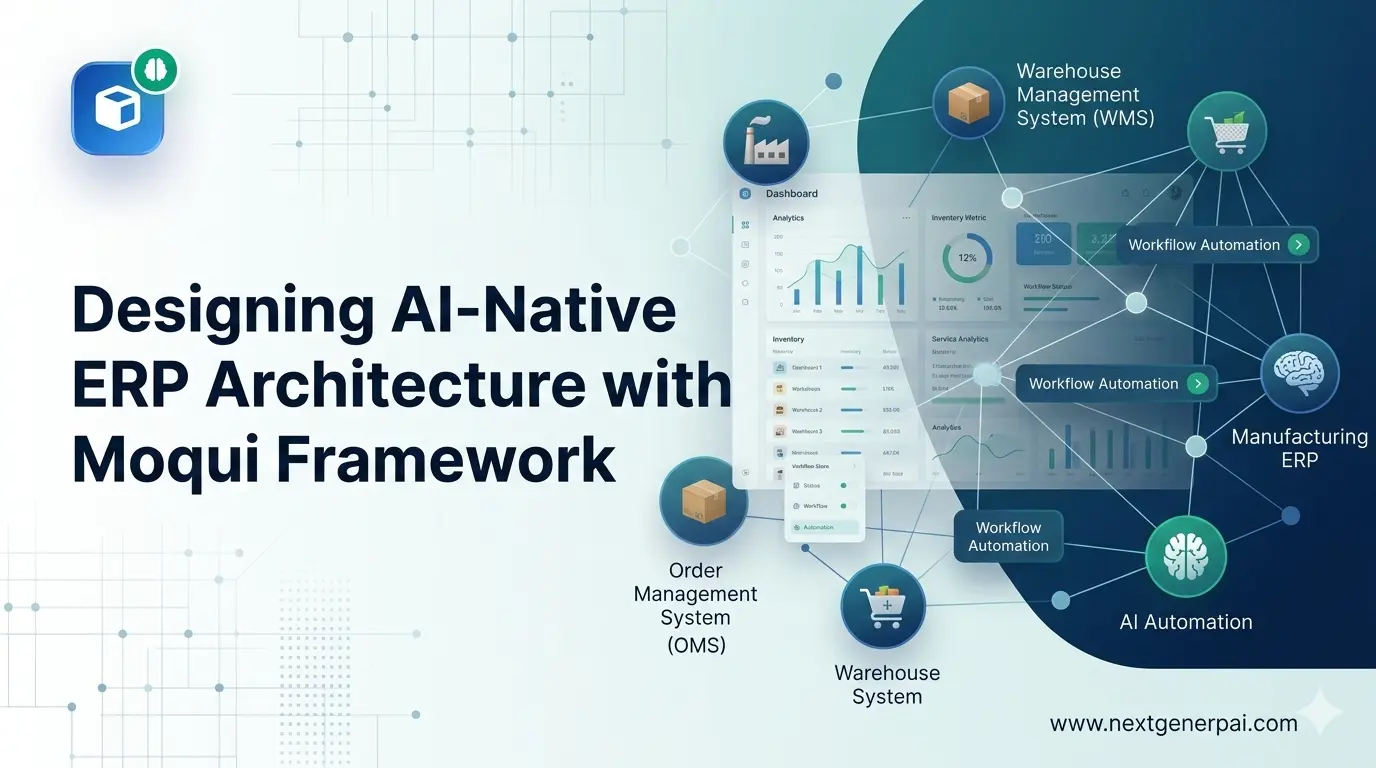
AI-Native ERP Architecture is not about adding a chatbot on top of an old system. It means designing ERP from the ground up so intelligence, automation, and adaptability are part of the core structure. When built correctly, AI does not sit outside the ERP. It operates inside workflows, services, and data models. This is where the Moqui Framework becomes a powerful foundation for building a true AI-Native ERP.
At its core, Next-Gen ERP is a modern, intelligent, and flexible enterprise approach designed for scalability, automation, and real-time decision-making . Designing an AI-native architecture on Moqui aligns perfectly with this philosophy because Moqui itself is service-driven, modular, and open-source.
What Is AI-Native ERP Architecture?
AI-Native ERP Architecture is a system design where artificial intelligence is embedded directly into core ERP layers such as services, workflows, data processing, and decision engines. Instead of running reports after transactions happen, the system analyzes, predicts, and acts during transactions.
In practical terms, this means: • Orders are validated and prioritized intelligently. • Inventory is auto-rebalanced based on predictive demand. • Production schedules adjust dynamically. • Financial risks are flagged before approvals.
The ERP does not just record operations. It continuously optimizes them.
Why Moqui Framework Is Ideal for AI-Native ERP
Moqui Framework provides a clean architectural base for building intelligent ERP systems because of four core strengths.
1. Service-Oriented Architecture
Moqui is built around services. Every business action such as creating an order, approving a shipment, generating an invoice, or updating inventory runs through structured services.
This service layer is the perfect insertion point for AI models. Instead of rewriting the system, AI logic can be injected into: • Pre-service validations • Decision branches • Post-service automation triggers • Asynchronous background processes
For example, in an Order Management System, AI can evaluate risk score before confirming the order. In a Warehouse Management System, AI can determine optimal picking routes. The architecture supports this natively.
2. Strong Entity and Data Model Design
AI is only as powerful as the data structure behind it. Moqui uses a well-defined entity engine with relational consistency and extensibility.
An AI-Native ERP requires: • Clean master data • Event tracking • Historical records • Transaction visibility
Moqui’s entity model allows businesses to extend schemas without breaking the system. This flexibility is critical when integrating predictive analytics or machine learning outputs into ERP workflows.
3. Built-In Workflow and Automation Engine
Moqui includes workflow capabilities that allow complex business processes to be modeled declaratively.
In traditional ERP, workflows are rigid. In AI-Native ERP, workflows become adaptive. AI can: • Reroute approvals • Adjust thresholds • Trigger preventive maintenance • Optimize production plans
Because workflows in Moqui are configurable and data-driven, they can respond dynamically to AI-driven insights.
4. Open-Source Flexibility
AI-Native ERP Architecture requires freedom. Proprietary ERP systems limit customization and often restrict deep integration.
Moqui, as an open-source ERP foundation, allows: • Integration with AI engines • Custom model deployment • Real-time event streaming • API-first connectivity
This avoids vendor lock-in and ensures long-term scalability.
Core Layers of AI-Native ERP Architecture in Moqui
Designing AI-Native ERP on Moqui involves structuring the system into intelligent layers.
1. Data Layer
This includes entities, audit trails, operational logs, and transactional history. For industries like manufacturing or retail, this means capturing: • Production cycle time • Inventory movement velocity • Order fulfillment performance • Supplier lead time accuracy
Without structured data, AI cannot deliver value.
2. Service Layer
This is the heart of Moqui. Every ERP function runs through services. AI models can be integrated as: • Decision services • Scoring services • Prediction services • Recommendation engines
For example, a Manufacturing ERP module can call a predictive service before generating work orders to optimize batch sizes.
3. Automation Layer
This layer orchestrates triggers and intelligent workflows. AI outputs can automatically: • Adjust reorder points • Reschedule delayed shipments • Allocate warehouse space dynamically • Flag financial anomalies
This is where ERP automation becomes proactive rather than reactive.
4. Interface and Experience Layer
AI-Native ERP should simplify user experience, not complicate it.
Dashboards in Moqui can surface: • Predictive KPIs • Intelligent alerts • Suggested next actions • Real-time operational health indicators
Instead of managers searching for problems, the system highlights them instantly.
Industry Use Cases of AI-Native ERP with Moqui
Manufacturing
AI can analyze machine data, historical production delays, and order demand to optimize shop floor planning. Work orders adjust automatically based on priority and capacity.
Retail and E-commerce
Order Management Systems powered by AI can detect fraud patterns, optimize last-mile shipping decisions, and balance inventory across warehouses.
Healthcare
AI-driven ERP can monitor inventory of critical supplies, predict shortages, and maintain compliance documentation automatically.
Financial Services
Intelligent ERP can flag unusual financial entries, assess credit exposure, and automate reconciliation with predictive validation.
Each industry benefits differently, but the architectural principle remains the same. Intelligence must be embedded into the operational core.
Designing for Scalability and Future Growth
An AI-Native ERP Architecture must scale in three dimensions:
- Transaction scale
- Data volume
- Intelligence complexity
Moqui supports horizontal scaling and modular deployment. AI services can be containerized and scaled independently. This allows businesses to expand operations without redesigning the system.
Future-ready architecture also means preparing for: • Agent-based automation • Real-time analytics • Event-driven microservices • Continuous model retraining
Because Moqui is modular and extensible, these capabilities can evolve alongside the business.
Moving from Traditional ERP to AI-Native ERP
Many businesses operate legacy ERP systems that are rigid and difficult to extend. Transitioning to an AI-Native ERP Architecture requires: • Migrating clean master data • Redesigning workflows • Modularizing services • Integrating automation layers
This is where open-source ERP migration strategies become critical. A structured migration approach ensures minimal disruption while unlocking long-term flexibility.
Why AI-Native ERP Is the Future
Traditional ERP systems record history. AI-Native ERP systems shape outcomes.
Instead of asking what happened last quarter, leaders can ask: • What will happen next month? • Where is operational risk building? • How can we improve margins automatically?
An AI-Native ERP built on Moqui transforms ERP from a reporting tool into an operational intelligence platform.
For organizations in manufacturing, retail, healthcare, or e-commerce, this shift is not optional. It defines competitive advantage.
Designing AI-Native ERP Architecture with Moqui Framework is not about adding AI features. It is about building intelligence into the DNA of enterprise operations. With open-source flexibility, service-driven design, and scalable architecture, businesses gain a foundation that adapts, learns, and improves continuously.
This is the direction modern ERP must take to remain relevant in an increasingly intelligent business environment.