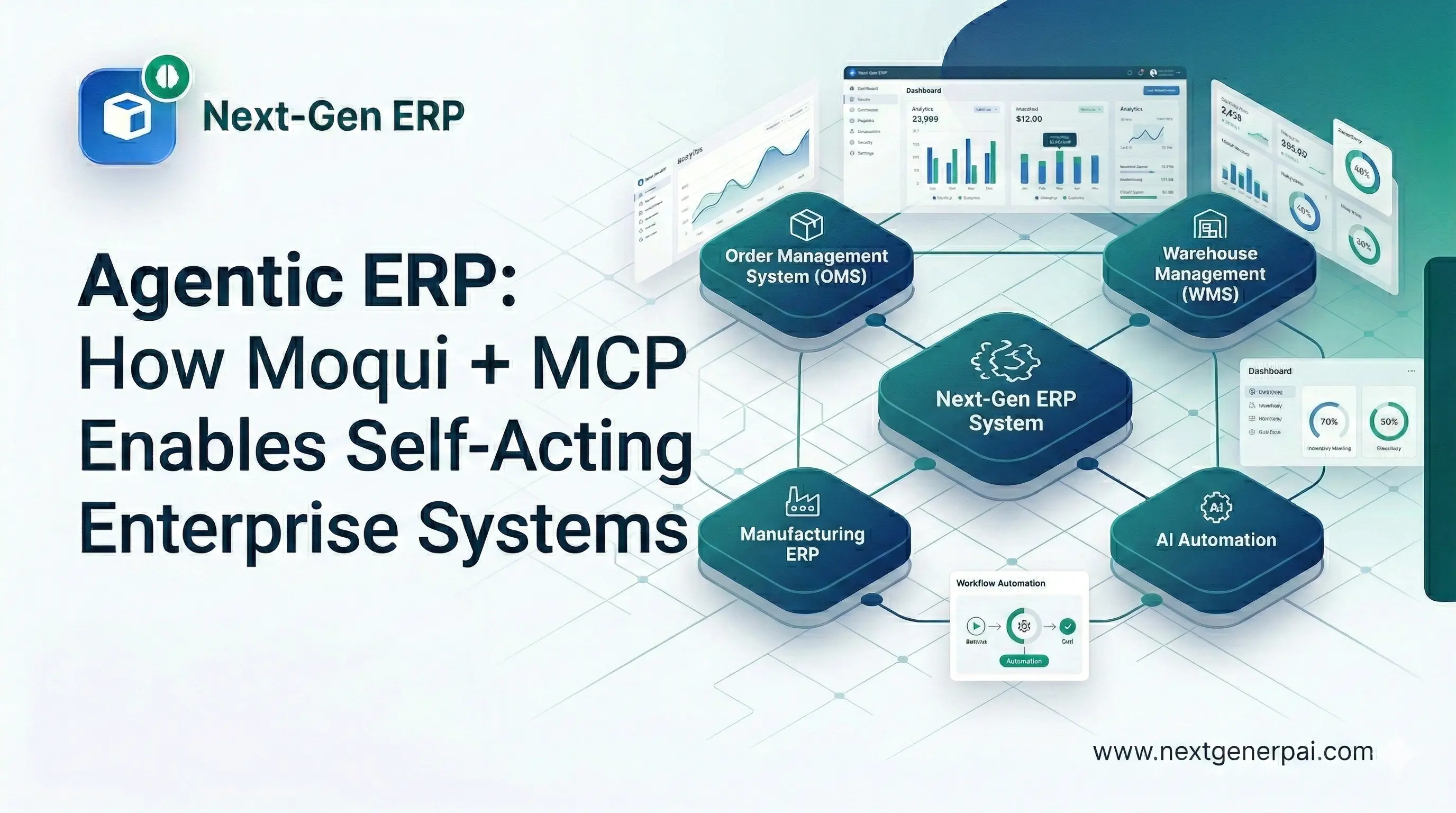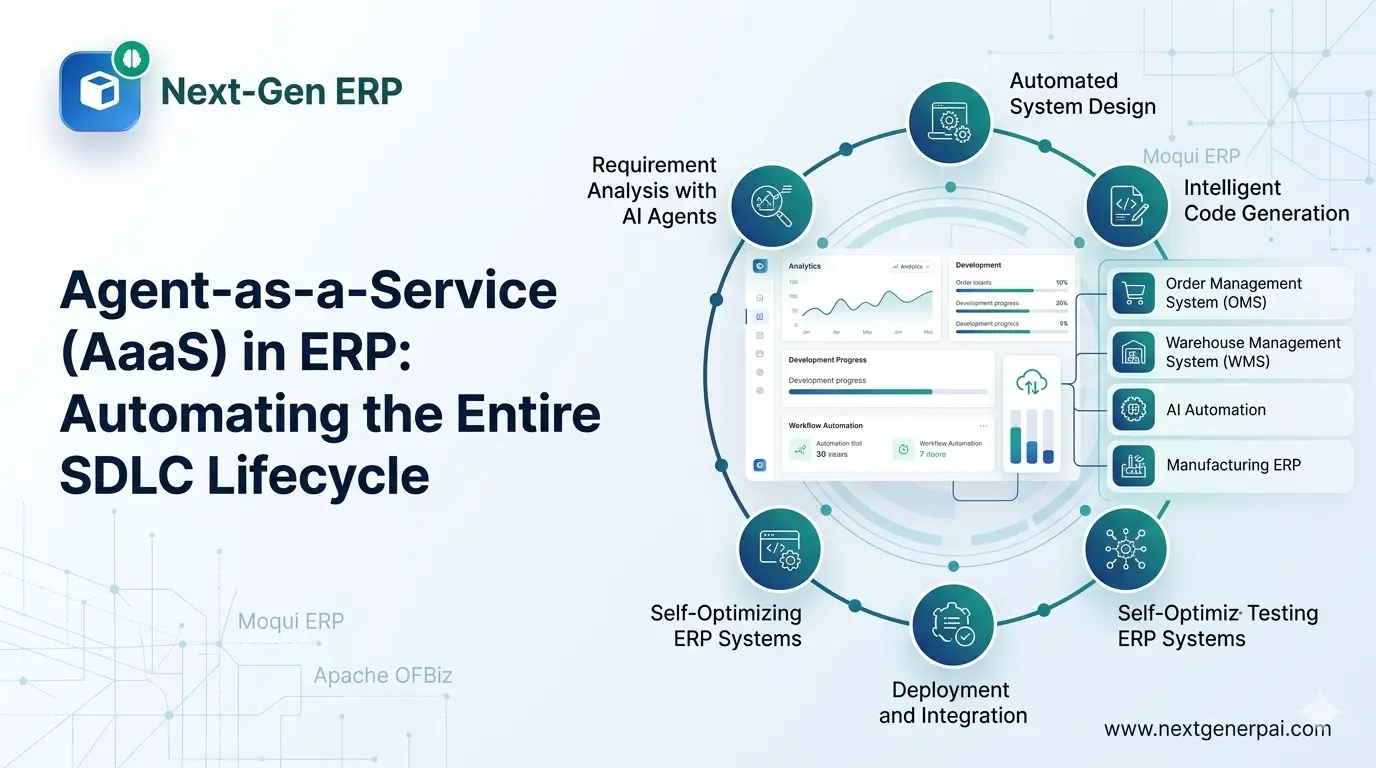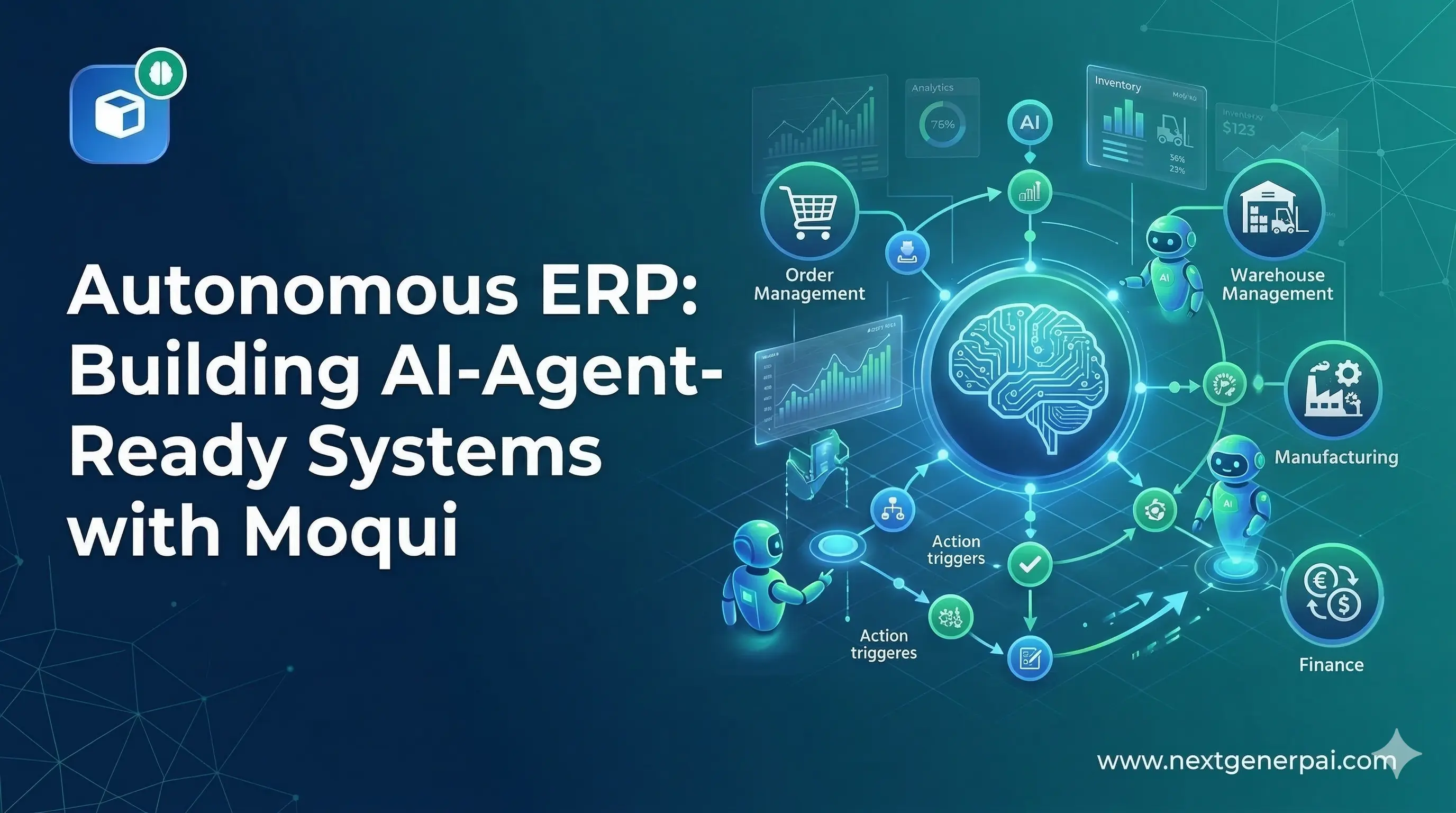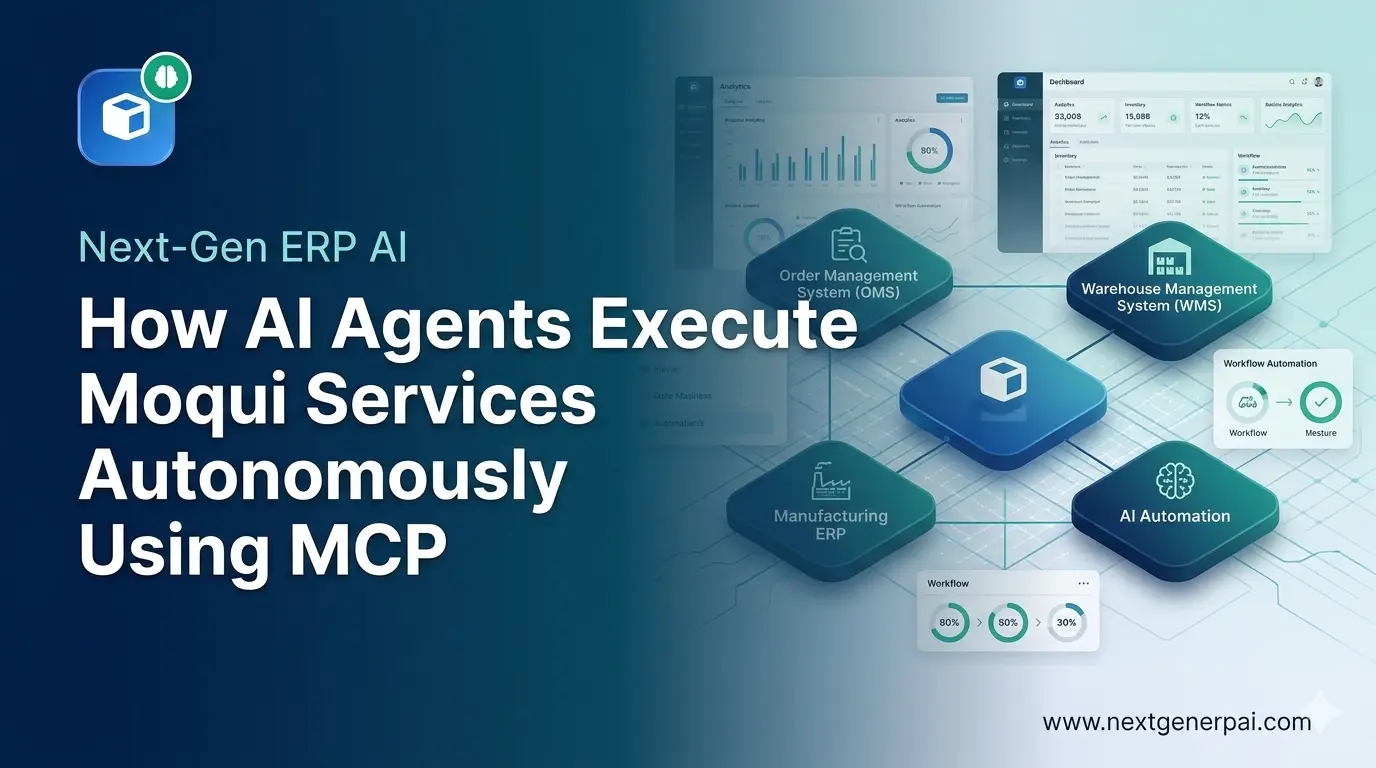
Artificial Intelligence is moving from dashboards and reports to direct system execution. The real shift is not in generating insights, but in taking action. This is where AI agents and the Model Context Protocol, combined with Moqui services, create a powerful foundation for autonomous enterprise execution. In a modern Next-Gen ERP environment, AI agents do not just recommend what to do. They execute workflows, trigger services, validate business rules, and complete transactions with full system awareness.
This article explains how AI agents execute Moqui services autonomously using MCP, how it works technically, and why it matters for businesses running intelligent ERP systems.
What Does It Mean for AI Agents to Execute Moqui Services Autonomously
When we say AI agents execute Moqui services autonomously, we mean that an AI system can:
- Understand business intent
- Identify the correct Moqui service
- Prepare validated input parameters
- Execute the service securely
- Interpret the result and trigger follow-up actions
Instead of a user manually clicking through screens to create orders, allocate inventory, release work orders, or generate invoices, an AI agent performs those actions by directly invoking Moqui services.
In a Next-Gen ERP architecture, services are the core execution layer. Every transaction, validation, and workflow runs through well-defined service definitions. That makes Moqui an ideal foundation for Agentic ERP.
Why Moqui Services Are Perfect for AI-Driven Execution
Moqui is designed around service-oriented architecture. Business logic is encapsulated inside services with:
- Strong parameter validation
- Defined input and output structures
- Transaction control
- Security permissions
- Entity integration
Because of this structure, AI agents do not need to manipulate UI screens. They interact with clean, well-defined service contracts.
This aligns perfectly with the philosophy of Next-Gen ERP, which focuses on flexibility, intelligent automation, and open architecture . When ERP is modular and service-driven, it becomes executable by both humans and AI agents.
In practical terms, Moqui services act like trusted tools. MCP exposes those tools in a controlled way to AI agents.
What Is MCP and Why It Matters
Model Context Protocol, or MCP, is a structured way for AI agents to interact with enterprise systems. Instead of giving the AI unrestricted access, MCP provides:
- Tool definitions
- Input schemas
- Permission boundaries
- Context awareness
- Response formatting
Think of MCP as a controlled bridge between the AI model and Moqui services.
Without MCP, an AI agent would need brittle integrations or unsafe direct database access. With MCP, the AI agent only sees approved tools, each mapped to specific Moqui services.
This makes autonomous ERP workflows safe, auditable, and scalable.
Architecture: How AI Agents Execute Moqui Services Using MCP
Let us break this into a clear flow.
Step 1: Intent Understanding
A business user might say: Release all confirmed sales orders for dispatch where inventory is available.
The AI agent parses the intent and translates it into structured tasks.
Step 2: Tool Discovery Through Moqui MCP
Through Moqui MCP, the agent sees available tools such as:
- createSalesOrder
- reserveInventory
- releaseOrder
- generateShipment
Each tool is mapped to a Moqui service definition.
The tool includes metadata such as:
- Required parameters
- Data types
- Permission requirements
- Validation rules
Step 3: Context Enrichment
The agent queries contextual data through approved read services. For example:
- Find confirmed orders
- Check real-time inventory levels
- Validate customer credit status
Moqui’s entity and service layer provide clean access to structured data.
Step 4: Service Execution
The AI agent calls the appropriate Moqui service through MCP. For example:
- reserveInventory service
- releaseOrder service
Each service executes inside Moqui’s transactional framework. If validation fails, the service returns structured errors.
Step 5: Result Interpretation and Next Action
The agent evaluates the response. If inventory allocation succeeds, it proceeds to shipment generation. If not, it may trigger a notification or exception workflow.
This is not scripted automation. This is dynamic decision-making within defined business rules.
Real Example: Autonomous Manufacturing Execution
Consider a manufacturing company running Moqui-based Manufacturing ERP.
A production planner says: Schedule urgent work orders for all pending high-priority sales orders.
The AI agent performs:
- Query sales orders with priority flag
- Check Bill of Materials
- Validate raw material availability
- Trigger work order creation service
- Allocate machine capacity
- Notify production supervisors
Each step is executed via Moqui services exposed through MCP.
This aligns directly with the Next-Gen ERP principle of automation with intelligence. Instead of static workflows, the system adapts dynamically to current data.
Security and Governance in Autonomous ERP Workflows
Autonomous execution does not mean uncontrolled execution.
Moqui already provides:
- Role-based permissions
- Service-level authorization
- Transaction control
- Audit logging
MCP adds another layer by restricting which services are visible to AI agents.
For example:
- AI agent for warehouse automation can access WMS-related services
- AI agent for finance cannot trigger payment disbursement without approval logic
Every service call is logged. Every parameter is validated.
This ensures AI-driven ERP automation remains compliant, secure, and auditable.
How This Powers Agentic ERP
Traditional ERP systems are passive. They store data and wait for human action.
Agentic ERP changes that model.
With AI agents executing Moqui services:
- Inventory replenishment can trigger automatically based on predictive demand
- Credit limit violations can pause order processing without manual review
- Production schedules can self-adjust based on real-time shop floor feedback
- Warehouse allocation can optimize picking routes dynamically
The ERP system becomes an active participant in operations.
This reflects the broader vision of Next-Gen ERP, which is built to be intelligent, flexible, and future-ready.
Industry Use Cases
Manufacturing
Autonomous work order creation, machine load balancing, and predictive maintenance scheduling through MES and service-driven workflows.
Retail and E-commerce
AI agents monitor order spikes, allocate warehouse inventory, adjust replenishment, and trigger supplier orders using OMS and WMS services.
Healthcare
Automated procurement workflows based on consumption patterns while maintaining compliance and audit traceability.
Financial Services
AI-driven validation workflows for invoices, expense approvals, and anomaly detection using structured service calls.
In every case, the foundation is the same: well-defined Moqui services executed through MCP.
Technical Depth: Why Open-Source ERP Makes This Possible
Closed ERP platforms often hide business logic behind UI layers. That makes AI integration complex and fragile.
Moqui, as an open-source framework, provides:
- Transparent service definitions
- XML and Groovy-based service logic
- Entity-driven data models
- Extensible architecture
- Clean separation of business logic
This openness is central to building scalable AI ERP automation. It also reflects the open and future-proof architecture principle described in Next-Gen ERP .
Because the system is modular, AI agents can evolve without rewriting the ERP core.
From Automation to Autonomy
Basic automation follows fixed rules.
Autonomous ERP workflows adapt. They:
- Evaluate conditions
- Choose services dynamically
- Handle exceptions
- Escalate intelligently
- Learn from outcomes
When AI agents execute Moqui services using MCP, the ERP system becomes capable of controlled autonomy.
This is not about replacing humans. It is about reducing operational friction so teams focus on strategic decisions rather than repetitive execution.
The Business Impact
For CTOs and operations leaders, the benefits are measurable:
- Faster order processing cycles
- Reduced manual workload
- Improved inventory accuracy
- Real-time decision execution
- Lower operational cost
- Scalable automation without vendor lock-in
In a competitive environment, the difference between insight and action defines performance. AI agents that execute services directly close that gap.
The Future of Autonomous ERP Execution
The next stage of enterprise systems is not better reporting. It is intelligent execution.
By combining Moqui ERP automation, Model Context Protocol, and AI agents, businesses can build systems that act within defined governance frameworks.
This is how modern enterprises move from reactive ERP to proactive, self-acting systems. It is a natural evolution of the Next-Gen ERP approach, where flexibility, AI-driven automation, and open architecture work together to create truly future-ready enterprise platforms.
Organizations that adopt this model early will not just automate processes. They will redefine how work gets done inside ERP systems.