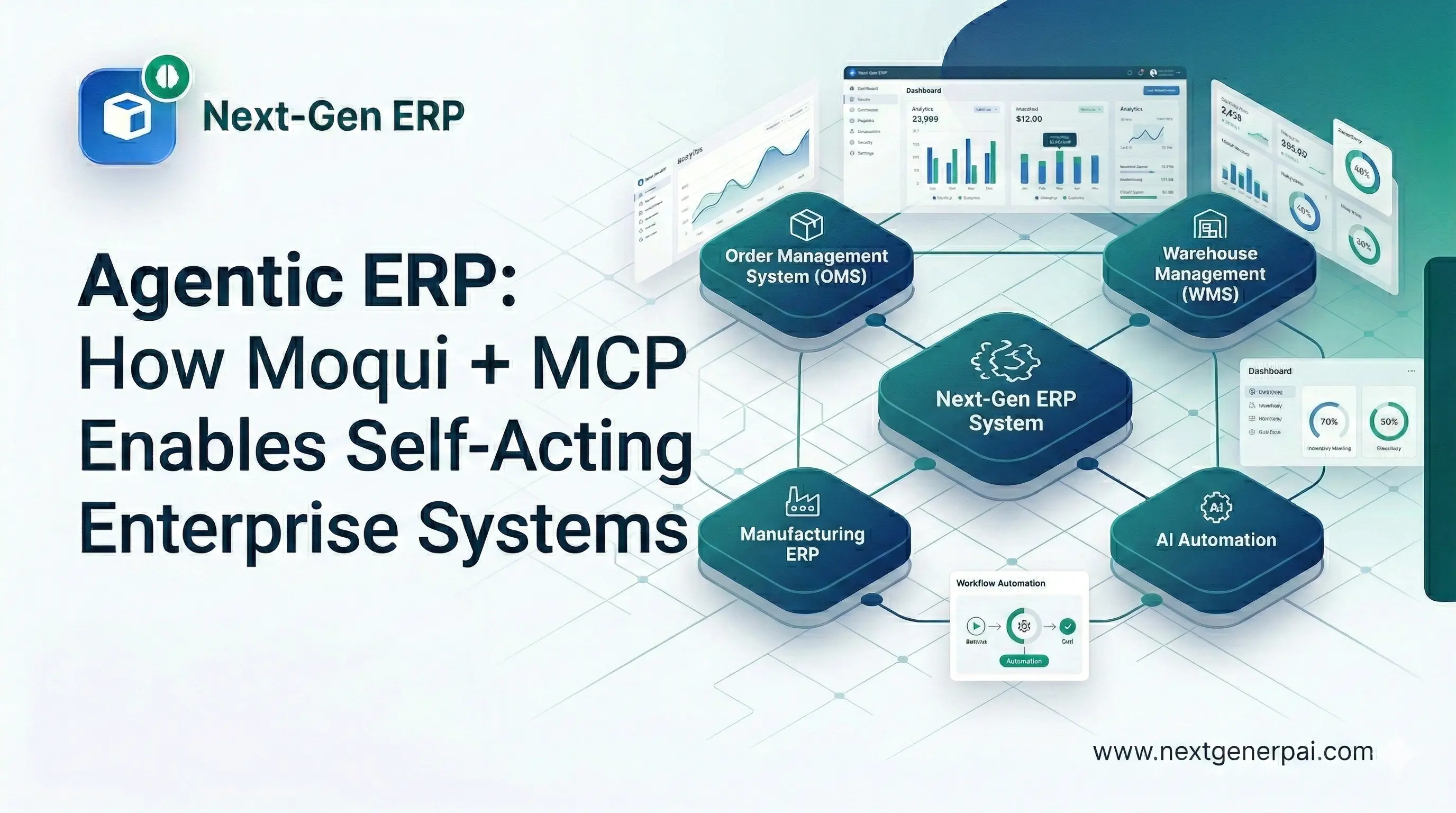
Enterprise software is entering a new phase. Automation is no longer enough. Businesses now expect their ERP systems to not only record transactions and generate reports, but to act intelligently on real-time data. This is where Agentic ERP comes into play.
Agentic ERP represents a shift from passive enterprise systems to self-acting enterprise systems that can analyze context, make decisions within defined rules, and execute business actions automatically. When built on Moqui ERP and enhanced with Model Context Protocol (MCP), this concept becomes practical, scalable, and production-ready.
At Next-Gen ERP, this evolution is not theoretical. It is grounded in the core philosophy of building intelligent, flexible, and future-ready ERP systems.
What Is Agentic ERP?
Agentic ERP is an enterprise system that does more than automate predefined workflows. It continuously evaluates business context and performs actions autonomously within governance boundaries.
Traditional ERP systems are reactive. They wait for user input. They process transactions. They generate static reports. Even modern automated ERP systems rely heavily on fixed rule engines.
Agentic ERP, by contrast, combines:
- Real-time business data
- AI-driven reasoning
- Context-aware decision models
- Service-level execution capabilities
The result is an ERP platform that can:
- Restock inventory when demand patterns shift
- Trigger production adjustments based on supply constraints
- Reroute orders dynamically when warehouse capacity changes
- Escalate compliance risks automatically
This is not about replacing human decision-making. It is about augmenting it with intelligent, self-acting systems that operate at machine speed.
Why Moqui Is the Ideal Foundation for Agentic ERP
To build Agentic ERP, you need an architecture that is flexible, service-driven, and open. Moqui ERP provides exactly that.
Moqui is not a rigid, monolithic ERP. It is a highly modular, service-oriented enterprise framework that supports:
- Strong entity modeling
- Robust service layers
- Workflow orchestration
- Event-driven logic
- Open-source extensibility
The philosophy behind modern ERP is built on flexibility, automation, and open architecture. Moqui aligns perfectly with this foundation.
In practical terms, Moqui enables:
-
Services as Action Units Every meaningful business operation in Moqui is exposed as a service. Create order, allocate inventory, generate shipment, update BOM, post invoice. These services become executable building blocks for AI agents.
-
Entities as Structured Knowledge Moqui’s entity engine provides structured, relational business data. AI agents need consistent context. Entities provide that context in a clean, queryable format.
-
Workflows as Governed Boundaries Moqui workflows define what is allowed, when, and under which conditions. This ensures Agentic ERP remains compliant and controlled.
What Is MCP and Why It Matters
Model Context Protocol, or MCP, enables AI systems to interact with structured enterprise tools safely and systematically. Instead of treating ERP as an external black box, MCP allows AI models to:
- Discover available services
- Understand input and output structures
- Execute actions within defined parameters
- Access relevant documentation and context
In a Moqui-based system, MCP can expose:
- Services as tools
- Entities as data resources
- Documentation as knowledge context
This transforms Moqui ERP into an AI-agent-ready platform.
Without MCP, AI integration often becomes fragile and custom-coded. With MCP, ERP services become discoverable and standardized for intelligent execution.
From Automation to Agency
Most ERP automation today is rule-based. For example:
If inventory drops below 100 units, trigger reorder.
This works, but it lacks intelligence. Agentic ERP adds context and reasoning:
- Is demand rising or falling?
- Are supplier lead times stable?
- Is there a production backlog?
- Are there seasonal variations?
Instead of a static rule, the system evaluates multiple signals before executing a service like createPurchaseOrder.
This shift is critical for industries such as manufacturing, retail, and e-commerce where operational volatility is high.
Real-World Use Cases of Agentic ERP
1. Intelligent Order Management
In a multi-warehouse retail environment, an Agentic ERP system can:
- Analyze order priority
- Check warehouse capacity
- Evaluate shipping cost and SLA
- Automatically allocate fulfillment location
The OMS does not just record the order. It actively optimizes fulfillment.
2. Autonomous Production Adjustments
In manufacturing, Agentic ERP connected to MES can:
- Detect raw material shortages
- Reschedule work orders
- Notify procurement
- Adjust production plans
All while maintaining audit logs and governance.
3. Predictive Inventory Optimization
For e-commerce businesses, AI-driven ERP automation can:
- Forecast demand trends
- Adjust reorder quantities
- Balance stock across locations
- Reduce dead inventory
The ERP becomes proactive rather than reactive.
Governance and Control in Self-Acting Systems
A key concern with self-acting enterprise systems is control. Agentic ERP must operate within defined governance layers.
Moqui enables:
- Role-based permissions
- Service-level authorization
- Transaction management
- Full audit trails
MCP ensures that AI agents only access approved services.
This architecture prevents uncontrolled system behavior while still enabling intelligent autonomy.
Why Open-Source ERP Is Critical for Agentic Systems
Closed, proprietary ERP platforms often restrict deep service access. Agentic ERP requires transparent service layers and extensibility.
An open-source ERP platform like Moqui provides:
- Full control over business logic
- Customizable service definitions
- Extensible data models
- Integration flexibility
At Next-Gen ERP, we build Agentic ERP systems that combine Moqui’s open architecture with AI-driven execution models. This aligns with the broader vision of intelligent, scalable, and future-ready enterprise systems .
Architecture Overview: Moqui + MCP + AI Layer
A simplified Agentic ERP architecture looks like this:
-
Moqui Core Layer Entities, services, workflows, security, transactions
-
MCP Interface Layer Structured exposure of services and context to AI agents
-
AI Reasoning Layer Context analysis, decision modeling, multi-step orchestration
-
Execution Feedback Loop Service execution results fed back into the AI for continuous optimization
This layered approach ensures modularity, security, and scalability.
Industry Impact
Manufacturing
Reduced downtime, adaptive production scheduling, better demand alignment
Retail
Dynamic fulfillment optimization, reduced stockouts, improved margin control
Healthcare
Automated compliance monitoring, intelligent procurement, demand-sensitive resource allocation
Financial Services
Risk-triggered workflow automation, real-time exception handling
Agentic ERP is especially valuable in industries where operational complexity and data volume are high.
The Business Value of Agentic ERP
The measurable outcomes include:
- Faster decision cycles
- Reduced operational overhead
- Lower human error
- Improved responsiveness to market shifts
- Higher system utilization
Most importantly, it turns ERP into an active operational partner rather than a passive database.
The Future: ERP That Acts, Not Just Records
The evolution from traditional ERP to AI-powered ERP automation and now to Agentic ERP is natural. Businesses want systems that understand context and act intelligently.
Moqui, enhanced with MCP, provides the structural foundation required for this transformation.
At Next-Gen ERP, we see Agentic ERP not as a trend, but as the next logical stage in enterprise system maturity. By combining open-source ERP flexibility, service-driven architecture, and AI-powered autonomy, organizations can build truly self-acting enterprise systems that are secure, scalable, and future-ready.
The question is no longer whether ERP should automate tasks. The real question is whether your ERP is ready to think and act.