Introduction: Why ERP Needs Autonomous Intelligence
Agent-as-a-Service (AaaS) in ERP is emerging as a transformative approach for organizations looking to automate the entire Software Development Lifecycle (SDLC) within enterprise systems. Traditional ERP implementations often struggle with slow development cycles, manual configurations, and heavy dependency on engineering teams. Businesses today require faster iteration, continuous delivery, and intelligent automation that adapts in real time.
This is where AaaS changes the paradigm. By embedding autonomous agents into ERP architecture, companies can automate design, development, testing, deployment, and optimization processes. When combined with modern ERP platforms like Next-Gen ERP architecture, AaaS enables organizations to build self-evolving systems that reduce manual effort and accelerate innovation.
What is Agent-as-a-Service (AaaS) in ERP?
Agent-as-a-Service (AaaS) in ERP refers to a model where intelligent software agents are deployed as modular services within the ERP ecosystem to automate specific tasks across the SDLC lifecycle. These agents operate independently, communicate with each other, and continuously learn from data to improve outcomes.
In the context of ERP, AaaS integrates deeply with core systems such as Order Management, Warehouse Management, Manufacturing, and Finance to automate workflows, decisions, and system evolution.
As defined in modern ERP thinking, systems are no longer static but adaptive platforms built on automation, flexibility, and intelligence .
Key Characteristics of AaaS in ERP
- Autonomous decision-making agents
- Continuous learning from operational data
- Modular and service-based architecture
- Real-time orchestration across ERP modules
- Integration with AI-driven workflows
Understanding the SDLC Lifecycle in ERP
Before exploring automation, it is important to understand how SDLC applies to ERP systems. Unlike traditional applications, ERP SDLC involves complex workflows across multiple business domains.
Typical ERP SDLC Phases
- Requirement gathering and business process mapping
- System design and architecture planning
- Development and customization
- Testing and validation
- Deployment and integration
- Continuous monitoring and optimization
In legacy ERP systems, each phase requires manual intervention, making the process slow and error-prone. AaaS introduces intelligent agents that automate each of these stages.
How AaaS Automates the Entire SDLC Lifecycle
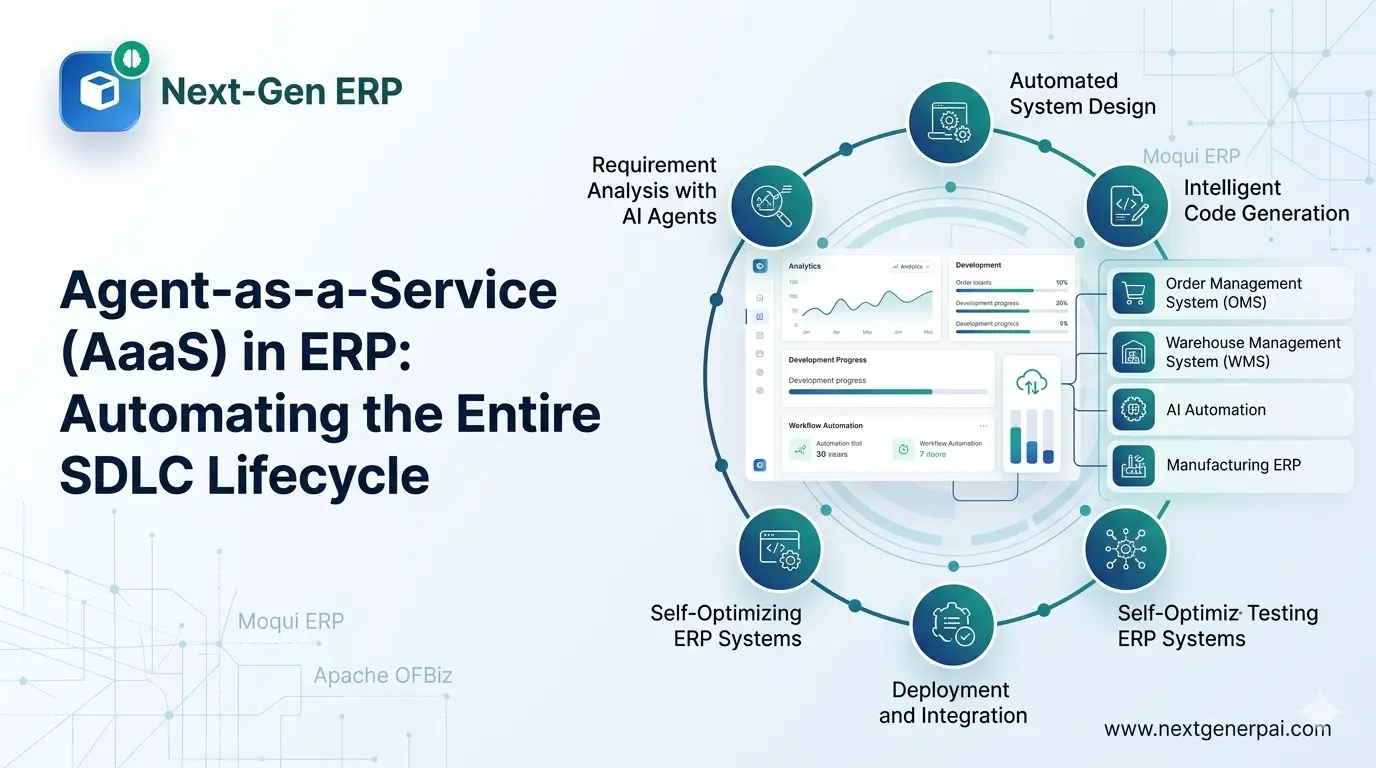
1. Requirement Analysis with AI Agents
AaaS begins with intelligent agents that analyze business workflows, historical data, and user behavior to automatically generate system requirements.
For example:
- An agent analyzes order patterns in a modern order management systems and suggests optimization rules
- Another agent identifies warehouse bottlenecks using data from AI-powered warehouse management systems
This reduces dependency on manual documentation and improves accuracy.
2. Automated System Design
Design agents convert business requirements into system architecture by:
- Mapping workflows to ERP modules
- Defining data models
- Suggesting integration points
Platforms built using Moqui ERP development and consultancy are particularly suited for this due to their flexible and component-based architecture.
3. Intelligent Code Generation
Development agents generate code for ERP modules using predefined templates and business rules. These agents:
- Create workflows for OMS, WMS, and MES
- Configure APIs and integrations
- Automate repetitive coding tasks
This significantly accelerates development while maintaining consistency.
4. Autonomous Testing and Validation
Testing agents simulate real-world scenarios using live data and continuously validate system behavior.
They perform:
- Functional testing across ERP modules
- Performance testing under load conditions
- Data integrity checks across workflows
This ensures that ERP systems are production-ready with minimal human intervention.
5. Continuous Deployment and Integration
Deployment agents manage:
- Automated releases
- Environment configuration
- Integration with external systems
Organizations leveraging ERP migration to open-source platforms benefit from seamless transitions and reduced downtime during deployment.
6. Self-Optimizing ERP Systems
Once deployed, optimization agents continuously monitor system performance and recommend improvements.
Examples include:
- Adjusting inventory rules in WMS
- Optimizing production schedules in MES
- Improving order routing in OMS
This creates a self-healing ERP ecosystem that evolves with business needs.
Architecture of AaaS in Next-Gen ERP
AaaS works best within a modern, open architecture ERP environment. Next-Gen ERP systems are designed with flexibility and modularity, making them ideal for agent-based automation.
Core Components
1. Agent Layer
This layer consists of specialized agents such as:
- Requirement agents
- Design agents
- Development agents
- Testing agents
- Optimization agents
Each agent operates independently but collaborates with others.
2. ERP Core Modules
- Order Management System
- Warehouse Management System
- Manufacturing Execution System
- Financial systems
These modules act as the operational backbone.
3. Integration Layer
Handles communication between agents and ERP modules through APIs and event-driven architecture.
4. Data Intelligence Layer
Processes data for:
- Predictive analytics
- Decision-making
- Continuous learning
Frameworks like Moqui and Apache OFBiz provide strong foundations for building such architectures.
Real-World Use Cases of AaaS in ERP
Manufacturing Industry
In manufacturing ERP systems, AaaS enables:
- Automated production planning
- Real-time shop floor optimization
- Predictive maintenance scheduling
Agents continuously adjust production workflows based on demand and resource availability.
E-commerce and Retail
For e-commerce businesses:
- Order processing is fully automated
- Inventory is dynamically optimized
- Fulfillment decisions are AI-driven
This results in faster delivery and reduced operational costs.
Logistics and Warehousing
In warehouse operations:
- Picking and packing workflows are optimized
- Inventory levels are auto-adjusted
- Shipping routes are dynamically planned
AaaS transforms warehouses into intelligent, autonomous systems.
Financial Services
ERP agents automate:
- Financial reconciliation
- Risk analysis
- Compliance monitoring
This reduces errors and improves regulatory compliance.
Business Benefits of AaaS in ERP
1. Faster Time-to-Market
Automation reduces development cycles from months to weeks or even days.
2. Reduced Operational Costs
By minimizing manual intervention, organizations significantly lower operational expenses.
3. Increased Accuracy and Efficiency
Agents eliminate human errors and ensure consistent execution of workflows.
4. Scalability
AaaS allows businesses to scale ERP systems without re-engineering core processes.
5. Continuous Innovation
With self-learning capabilities, ERP systems continuously evolve and improve.
6. Vendor Independence
Using custom ERP development solutions and open-source platforms ensures long-term flexibility and cost control.
Relationship Between AaaS, OMS, WMS, and MES
AaaS acts as the intelligence layer that connects and optimizes core ERP modules.
- In OMS, agents optimize order routing and fulfillment
- In WMS, agents manage inventory and warehouse operations
- In MES, agents control production and quality processes
This unified intelligence creates a seamless flow of information across the enterprise.
Future of AaaS in ERP
The future of ERP lies in fully autonomous systems where:
- ERP systems build themselves
- Workflows adapt in real time
- Decisions are made without human intervention
AaaS will evolve into a standard capability within ERP platforms, enabling businesses to operate with minimal manual effort.
Organizations adopting AaaS today are positioning themselves for:
- Hyperautomation
- Real-time enterprise intelligence
- Fully digital operations
Conclusion
Agent-as-a-Service (AaaS) in ERP is redefining how enterprise systems are built, deployed, and managed. By automating the entire SDLC lifecycle, AaaS eliminates traditional bottlenecks and enables organizations to operate with unprecedented speed and efficiency.
When combined with modern platforms like Next-Gen ERP architecture, AaaS transforms ERP from a static system into a dynamic, self-evolving ecosystem. Businesses that embrace this model will gain a significant competitive advantage in the era of intelligent automation.